
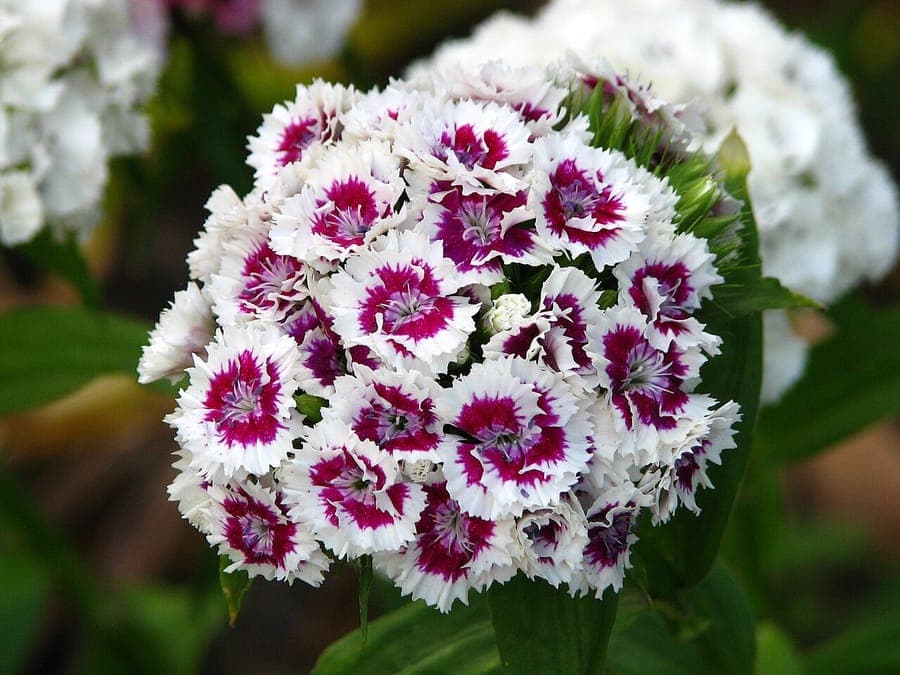
Kor!An (Андрей Корзун) / CC BY-SA 3.0, via Wikimedia Commons
Sweet-william: complete guide
Dianthus barbatus
Want to see Sweet-william: complete guide in your garden?
1 minute, no credit card
Overview
Sweet-william (Dianthus barbatus) is a striking herbaceous forb that typically grows as a biennial, though it can behave as a short-lived perennial in milder climates. Native to mountainous regions of central and southern Europe, it's been a staple in cottage gardens for generations. In the UK and US, it's usually treated as a biennial: vegetative growth in year one, flowering in year two. Plants reach 30 to 60 cm in height, making them ideal for mid-border placement. On gardenworld.app, you can design a seasonal planting scheme that highlights Sweet-william's bold summer display.
Appearance & bloom cycle
Sweet-william forms a low rosette of broad, lance-shaped green leaves in its first season. In the second year, upright, sturdy stems rise with dense, rounded clusters of small, five-petaled flowers. The bloom color is most commonly deep purple, though cultivars offer pink, red, white, and bicolor options. Flowering runs from July to August - a solid six to eight weeks of color. The flowers have a light, clove-like fragrance that draws bees, butterflies, and hoverflies. They also make excellent cut flowers, lasting up to ten days in a vase. When planted in groups, Sweet-william creates a rich tapestry of texture and hue.
Ideal location
Choose a full sun to light shade spot. Sweet-william thrives at light level 8, meaning it needs at least 6 hours of direct sunlight daily. In heavy shade, stems stretch and flop, and flower production drops. An ideal site is against a south-facing wall or fence where plants receive warmth and shelter from strong winds. Good air circulation is essential to prevent fungal diseases like powdery mildew. It works beautifully in cottage borders, herb gardens, or mixed perennial beds.
Soil requirements
Soil should be well-drained with a pH between 4.5 and 5.0 - slightly acidic to neutral. Avoid heavy clay; amend it with sharp sand and compost to improve drainage. Sweet-william dislikes waterlogged roots. A mix of garden loam, leaf mold, and grit works well. Do not plant in chalky or highly alkaline soils, which can cause iron deficiency and yellowing leaves. Avoid high-nitrogen fertilizers - they encourage leafy growth at the expense of blooms.
Watering
Water regularly during dry spells, especially in spring and early summer when plants are establishing. Roots are shallow, so they dry out fast. Use rainwater when possible, as tap water can raise soil pH over time. Water at the base to keep foliage dry and reduce disease risk. No supplemental watering is needed in wet seasons. A light mulch of pine needles helps retain moisture and suppress weeds.
Free design
Want to see Sweet-william: complete guide in your garden? Make a free design now.
Pruning
Deadhead spent flower heads to encourage self-seeding or a secondary flush of blooms. Cut stems back to a leaf node after flowering. If you want naturalized drifts, leave a few stems to set seed - they'll drop freely and germinate the next spring. Remove any diseased or damaged foliage during summer to maintain plant health. Avoid heavy pruning in autumn; let the base foliage protect the crown over winter.
Maintenance calendar
- Jan: Check for overwintering seedlings under old foliage
- Feb: No action needed
- Mar: Loosen soil around emerging seedlings
- Apr: Water during dry periods; watch for aphids
- May: Weed gently; apply thin compost layer
- Jun: Stake taller plants if needed; prepare for bloom
- Jul: Peak bloom; water if dry
- Aug: Continue deadheading; cut back after flowering
- Sep: Allow some seed heads to mature; remove dead material
- Oct: Apply pine needle mulch
- Nov: Clear dead leaves; check for new rosettes
- Dec: Monitor overwintering plants
On gardenworld.app, you can set up a seasonal care calendar with reminders for deadheading and sowing Sweet-william.
Winter hardiness
Sweet-william is hardy in USDA zones 6 to 8. As a biennial, it typically dies after flowering in year two. However, self-sown seedlings often appear the following spring, creating a natural succession. In milder areas, young rosettes survive winter under a protective mulch. Avoid plastic covers - they trap moisture. South-facing slopes and urban gardens offer better microclimates for overwintering.
Companion plants
Pair Sweet-william with yarrow, catmint, or lavender for a pollinator-rich border. These companions share similar sun and soil needs. Avoid invasive groundcovers like ivy that compete for light. It combines well with herbs like thyme and oregano in a kitchen garden. In mixed borders, it contrasts beautifully with silver-leaved plants like artemisia or stachys.
Closing
Sweet-william isn't fussy, but it rewards attention to detail: well-drained acidic soil, full sun, and timely deadheading. Its nostalgic charm and wildlife appeal make it a must-have for traditional and modern gardens alike. Purchase seeds or young plants from garden centres, or start from seed in early summer. With a little care, Sweet-william returns year after year - sometimes where you least expect it, always a delight.
Want to see Sweet-william: complete guide in your garden? Make a free design now.
Upload a photo, pick a style, and get a photorealistic design with plant list in under a minute.
10,000+ gardens designed already
No credit card required


Similar plants
Dianthus karami: complete guide
Dianthus karami
Dianthus karami is a rare Lebanese mountain pink with fringed pink blooms on limestone cliffs, ideal for rock gardens and troughs.
Sicilian pink: complete guide
Dianthus siculus
Discover Dianthus siculus, an elegant purple bloomer from Sicily. Cultivation, June-September flowering and garden combinations.
Alpine mouse-ear chickweed: complete guide
Cerastium pedunculatum
Full growing guide for Cerastium pedunculatum: ideal location, soil, watering, winter hardiness, and companion plants for rock gardens.