
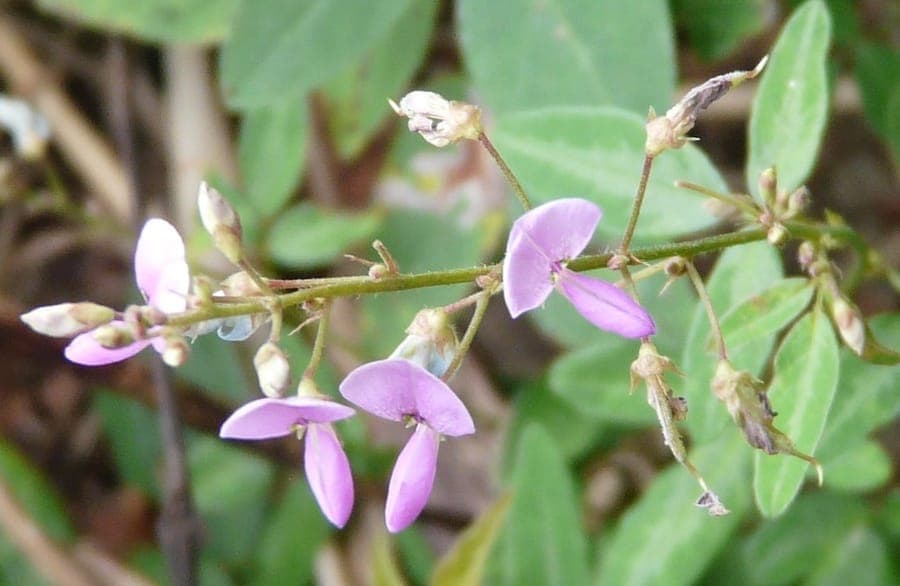
kent_ozment / CC0, via Wikimedia Commons
Panicled tick-clover: complete guide
Desmodium paniculatum
Want to see Panicled tick-clover: complete guide in your garden?
1 minute, no credit card
Overview
Panicled tick-clover (Desmodium paniculatum) is a native North American perennial herb in the family Fabaceae, found naturally across the central and eastern United States from Minnesota and Maine south to Texas and Florida. Its natural habitat is the edges of deciduous woodlands, open sunny grasslands, roadsides, and lightly shaded forest clearings - the classic 'edge' zones where full sun and partial shade alternate throughout the day.
The plant is also known as narrow-leaf tick-trefoil, panicled ticktrefoil, and panicledleaf ticktrefoil - names that capture its two most distinctive features: the unusually narrow, linear leaflets that distinguish it from related species, and the open, branching panicle of flowers that it produces in late summer. Like all Desmodium species, it produces the characteristic jointed seed pods (loments) with hooked segments that cling to clothing and animal fur, earning the genus the colloquial name 'tick-clovers' or 'beggar's-lice' across eastern North America.
In ecological terms, panicled tick-clover is exceptionally valuable. It is a confirmed host plant for the larvae of several specialist bee species, particularly long-tongued bees in the genus Melissodes that collect pollen exclusively from Desmodium flowers. The plant also fixes atmospheric nitrogen through root nodule bacteria, improving soil fertility for neighbouring plants. Gardeners wishing to design a wildlife-friendly, naturalistic border around native North American species can find planting guidance at gardenworld.app.
Appearance & bloom cycle
Desmodium paniculatum is an erect, single-crowned perennial, growing 40 to 90 cm tall in typical garden conditions - occasionally reaching 120 cm in moist, fertile soils. The stems are slender, light green to yellow-green, lightly hairy, and branch above mid-height to form the characteristic open, paniculate inflorescence. Unlike the stoloniferous Desmodium incanum, this species does not send out creeping runners; it grows as a compact, clumping individual that stays contained in a fixed position year after year.
The leaves are the species' most distinctive feature. They are trifoliate - three leaflets per leaf, like clover - but the leaflets are unusually narrow and elongated: 4 to 9 cm long and only 0.5 to 2.5 cm wide. This gives the foliage a linear, almost grass-like quality that is immediately recognisable. The upper surface is dark green and slightly lustrous; the underside is paler and softly hairy.
Flowering begins in July and continues through August and into early September. The flowers are borne in open, branched panicles at the tips of the stems and upper side branches. Individual flowers are 6 to 9 mm across, pink to pale lilac, with the standard structure of a legume blossom: a broad standard, two wing petals, and a keel. They are visited freely by native bees, bumble-bees, and hover-flies. The specialist Melissodes bees are particularly faithful pollinators, relying on Desmodium pollen as a primary larval food source.
After pollination, jointed seed pods develop in August and September. Each pod consists of 2 to 4 one-seeded segments densely covered in hooked hairs. These hooks cling to passing animals, birds, and humans, dispersing the seeds across considerable distances. The pods are conspicuous on the plant in late summer and autumn, adding textural interest long after the flowers have faded.
Ideal location
Panicled tick-clover performs best in full sun to light partial shade. In its native woodland-edge habitat it typically receives five to seven hours of direct sunlight each day, with dappled afternoon shade providing some relief during the hottest weeks of summer. In European gardens a similar balance is ideal: a south- or west-facing position that gets full sun in the morning and light shade from nearby shrubs or a fence in the afternoon.
The species is genuinely winter-hardy in most of northern Europe. Rated USDA zones 4 to 8, it comfortably tolerates the winters of the Netherlands, Belgium, the United Kingdom, Germany, and most of France without any protection. In continental areas with colder winters - central Germany, Austria - a modest mulch over the crown in late autumn provides worthwhile insurance.
As a woodland-edge plant, panicled tick-clover adapts well to positions near shrub borders or the north side of a taller planting. Avoid deep shade, where flowering is poor, and avoid waterlogged low spots in the garden. A slightly raised position or a gentle slope improves drainage around the crown and is especially important in areas with wet winters.
Soil requirements
Desmodium paniculatum succeeds on a wide range of soils as long as they are reasonably well-drained and not waterlogged. The optimal pH is 6.0 to 7.0 - neutral to slightly acidic. Like all legumes, it fixes atmospheric nitrogen via symbiotic Rhizobium bacteria in root nodules, which means it grows well on low-fertility soils where other perennials might struggle. Excessively rich, nitrogen-heavy soils produce lush foliage at the expense of flowers; lean to moderately fertile soils give the best flowering results.
The plant is well adapted to sandy loam, loam, and even clay loam soils - the range of soil types typical of the eastern US where it is native. On heavy clay, improving drainage by incorporating sharp grit and compost into the top 30 cm before planting is worthwhile. On very sandy soils, a modest addition of compost helps retain sufficient moisture during dry spells in the growing season.
At planting, incorporate a small amount of well-rotted compost - no more than one to two litres per planting hole - to give the plant a good start. Annual top-dressing with compost each spring is sufficient maintenance. Avoid high-nitrogen fertilisers; the plant's root bacteria supply most of its nitrogen needs, and excess fertiliser tips the balance towards vegetative growth at the expense of flowers.
Watering
Panicled tick-clover is a drought-tolerant species once established. In its native habitat along woodland edges and open grasslands, it routinely endures periods of several weeks without significant rainfall, especially in the hot, dry summers of the southern and central United States. In European gardens, established plants in the open ground rarely need supplemental watering except during the most severe drought conditions - extended periods of several weeks without rain combined with temperatures above 30 degrees C.
For the first growing season after planting, however, regular watering is essential. Newly planted specimens need water once or twice a week for the first four to six weeks to establish a good root system before they can draw on deeper moisture reserves. Once the plant is through its first summer, it can be considered self-sufficient in normal rainfall years.
In containers and raised beds, where soil dries out more quickly than in open ground, watering two to three times per week during the growing season (May to September) is appropriate. Check the top 5 cm of compost and water when it feels dry. In autumn and winter, reduce watering sharply; the plant is dormant and requires no supplemental irrigation unless the container is in a completely rainless position.
Mulching with 5 to 7 cm of bark chippings or shredded leaves helps retain moisture in the root zone during dry summers and protects the crown in winter.
Free design
Want to see Panicled tick-clover: complete guide in your garden? Make a free design now.
Pruning
Desmodium paniculatum requires minimal pruning. The main operation is the annual autumn cutback: once the stems have been blackened by the first hard frost - typically in October or November - cut all growth down to 5 to 10 cm above the ground. Remove the cut material promptly to prevent it harbouring fungal disease or overwintering pests at the crown level.
In spring, wait until the new shoots are clearly visible before removing any remaining stem stubs from the previous year. The emerging shoots are soft and easily damaged, so avoid disturbing the crown until they are 5 to 10 cm tall.
A light trim of individual stems that become straggly during the flowering period in July and August can improve the plant's appearance and encourage some fresh lateral growth, but this is not strictly necessary. Well-sited plants in appropriate soil look after themselves very effectively without intervention during the growing season.
Remove seed pods in August and September if you wish to limit self-seeding or prevent the spread of sticky pods into paths and lawn areas. If you are growing the plant specifically for wildlife benefit, leaving the seed pods in place through winter provides food for birds and small mammals foraging in the garden through the colder months.
Maintenance calendar
March – April: Remove any remaining dead stems once the new shoots are visible; apply a thin top-dressing of compost if desired; check soil pH and add ground limestone if below 6.0.
May: Plant out new specimens after the last frost risk; water new plants twice weekly for the first four to six weeks; no fertilising needed for established plants.
June – July: Established plants need water only during prolonged dry spells; provide support stakes if stems are flopping on exposed or windy sites.
July – August: Main flowering period; monitor for aphid colonies; enjoy the blooms and the associated bee activity; remove pods if spread is unwanted.
September: Allow seed pods to ripen for wildlife benefit or harvest for propagation; begin reducing watering in containers.
October – November: Cut back all stems to 5 to 10 cm after the first hard frost; apply a mulch of 5 cm bark chippings over the crown.
December – February: No care required; check that mulch has not washed away during winter storms.
Winter hardiness
Panicled tick-clover is a genuinely winter-hardy perennial, rated USDA zones 4 to 8. Zone 4 covers minimum winter temperatures of approximately -34 to -29 degrees C - the cold continental climates of northern Minnesota, Wisconsin, and southern Canada. The fact that this species thrives in zone 4 means it has no difficulty surviving the winters of the Netherlands (zone 8), Belgium (zone 8), Germany (zone 7-8), or the United Kingdom (zone 8-9).
In the open ground with freely draining soil, the fleshy crown survives cold winters reliably without any special protection. The greatest risk to the crown is waterlogged soil in combination with repeated freeze-thaw cycles in winter, which can rupture root tissue. Good drainage and a protective mulch of dry bark or leaves applied in late autumn provide the most effective insurance against this risk.
In container cultivation in exposed northern positions - rooftop gardens, east-facing balconies - moving pots to a sheltered position against a warm wall or into an unheated porch for the coldest months provides a useful margin of safety, even though the species is technically hardy to the container's root zone in most circumstances.
For tailored advice on incorporating winter-hardy native perennials into a cohesive garden design, gardenworld.app provides the planting tools and inspiration to bring the project together.
Companion plants
Desmodium paniculatum is ideally suited to prairie-style, naturalistic, or native plant borders alongside other eastern North American species:
- Schizachyrium scoparium (little bluestem grass) - a clumping prairie grass growing 60 to 90 cm tall that turns copper-red in autumn; the fine-textured foliage contrasts beautifully with the narrow tick-clover leaves.
- Rudbeckia hirta (black-eyed Susan) - yellow flowers from July to September providing bright complementary colour alongside the pink tick-clover blooms.
- Pycnanthemum virginianum (Virginia mountain mint) - white flowers in August, intensely fragrant foliage, outstanding pollinator magnet that attracts the same bees as Desmodium.
- Asclepias tuberosa (butterfly milkweed) - brilliant orange from June to August on dry, sunny sites; an outstanding ecological combination partner.
- Solidago speciosa (showy goldenrod) - golden spikes in September and October that extend the season after tick-clover flowering ends.
- Monarda fistulosa (wild bergamot) - lavender-pink flowers in July and August, loved by native bees, with similar moisture tolerance.
Allow 40 to 60 cm between individual plants for adequate air circulation and to prevent vigorous neighbours from swamping the compact tick-clover crowns. Avoid planting with aggressive rhizomatous species that spread rapidly and can overwhelm slower-growing companions.
Conclusion
Panicled tick-clover (Desmodium paniculatum) is a rewarding native perennial that earns its place in the garden through a combination of ecological value, quiet beauty, and reliable low-maintenance performance. Its nitrogen-fixing roots, its specialist pollinator relationships, and its drought tolerance after establishment make it a genuinely useful plant rather than merely a decorative one.
For gardeners interested in naturalistic, wildlife-supportive planting schemes - prairie-style borders, meadow gardens, or native plant collections - Desmodium paniculatum is an ideal companion to grasses, goldenrods, and other North American prairie species. Plan your complete planting scheme for a wildlife-friendly garden at gardenworld.app, where you can design the full composition before ordering a single plant.
Want to see Panicled tick-clover: complete guide in your garden? Make a free design now.
Upload a photo, pick a style, and get a photorealistic design with plant list in under a minute.
10,000+ gardens designed already
No credit card required


Similar plants
Tall Silky Lupine: complete guide
Lupinus elatus
Tall silky lupine is a fast-growing Californian perennial with silvery foliage and blue-purple flower spikes, ideal for a prairie-style garden.
Garfield Lupine: complete guide
Lupinus garfieldensis
The Garfield lupine is a rare, fast-growing American perennial for alkaline, dry grassland gardens, with striking blue flower spikes.
Lupinus elegans: complete guide
Lupinus elegans
Lupinus elegans, the elegant lupine, is a spectacular blooming plant from Mexico with blue flower spikes. Care, cultivation and garden use.