
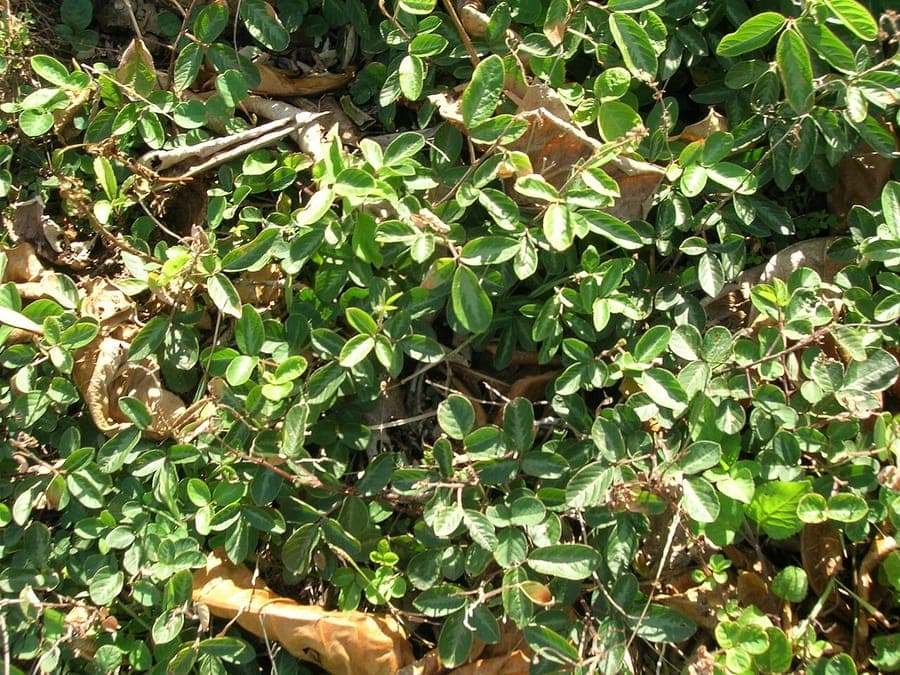
Forest & Kim Starr / CC BY 3.0, via Wikimedia Commons
Tickclover: complete guide
Desmodium incanum
Want to see Tickclover: complete guide in your garden?
1 minute, no credit card
Overview
Tickclover (Desmodium incanum) is a sprawling to semi-erect subshrub and creeping herb belonging to the family Fabaceae, the legumes. Native to tropical and subtropical America, its natural range extends from South Carolina and Florida in the north, south through the Caribbean islands, Central America, and all the way to Uruguay and Argentina. It has also naturalised widely across tropical Africa, Australia, and the Pacific islands, where it arrived as an agricultural and pastoral introduction.
The plant carries a colourful portfolio of common names: tickclover and kaimi-clover in English (the latter particularly common in Hawaii); colle-colle and gros-treffle in French; amor-seco, pega-pega, carrapicho, and barba-de-boi in Portuguese - all referring to the distinctive jointed seed pods that cling tenaciously to clothing, wool, and animal fur. These sticky pods are the plant's primary dispersal mechanism and the source of most of its common names.
In garden terms, Desmodium incanum offers several attractive qualities: a long summer flowering season with delicate pink-purple blossoms, a creeping habit useful for covering bare ground, and the valuable legume ability to fix atmospheric nitrogen through root nodule bacteria. Gardeners planning warm-climate or subtropical garden schemes can use gardenworld.app to visualise how tickclover integrates into a broader planting composition.
Appearance & bloom cycle
Desmodium incanum forms a spreading, branching plant with stems typically 30 to 80 cm long - sometimes exceeding 100 cm in ideal conditions. The stems are light green, densely covered with fine appressed hairs, and grow stoloniferous, meaning they root at the nodes when they contact moist soil. This rooting habit gives the plant its creeping, ground-hugging character and enables it to colonise relatively large areas over a growing season.
The leaves are trifoliate (three leaflets), with individual leaflets 2 to 6 cm long and 1 to 3 cm wide. They are ovate to elliptic, dark green and slightly glossy above, pale and hairy beneath. Small stipules are present at the base of each leafstalk. The overall texture of the foliage is soft and slightly velvety to the touch.
Flowering is prolific and extends from May through September in cultivation, or virtually year-round in tropical conditions. The flowers are borne in axillary and terminal clusters (racemes or panicles). Each individual flower is a typical legume blossom - 6 to 8 mm across, pink to pale purple, with a broad standard petal, two wing petals, and a keel. They attract small bees, hover-flies, and other pollinators consistently throughout the season.
After pollination, distinctive jointed seed pods (loments) develop. Each pod is 2 to 5 cm long, divided into 3 to 6 individual one-seeded segments. The segments are covered with hooked hairs that catch on fabric, fur, and feathers, enabling the seeds to travel considerable distances from the parent plant. This dispersal mechanism is highly effective - anyone who has walked through a colony of tickclover will have left carrying dozens of segments stuck to their trousers.
Ideal location
Tickclover is a warmth-loving plant that thrives in full sun to light partial shade. In its native habitat it occurs on open grassland, roadsides, and disturbed ground at low elevations where temperatures remain above 15 degrees C year-round. In European gardens it is reliably perennial only in the warmest coastal areas - the French Riviera, the Spanish Mediterranean coast, the Canary Islands, and similar USDA zone 9 or warmer locations.
In cooler climates - the Netherlands, Belgium, most of Germany and northern France - Desmodium incanum is best grown as a container plant on a sunny terrace or balcony, brought indoors before the first frost. The plant responds well to pot culture and will flower generously from June to September when given a warm, sheltered position. A south- or west-facing wall provides the ideal background: reflected warmth from masonry extends the effective growing season by several weeks at both ends.
Avoid cold draughts at floor level and north-facing aspects. Temperatures below 10 degrees C slow growth noticeably; below 5 degrees C the plant shows chill injury (yellowing leaves, stem dieback); and frost kills it to ground level. In frost-free winters it behaves as a perennial subshrub.
Soil requirements
Tickclover is well adapted to light, free-draining soils with a pH of 5.5 to 7.0. As a legume, it forms a symbiotic relationship with nitrogen-fixing Rhizobium bacteria in root nodules, making it largely self-sufficient in terms of nitrogen. This makes it particularly valuable on poor or exhausted soils where other plants struggle.
The ideal soil is sandy loam to loam - moderately fertile, well-drained, and warm. On heavy clay, incorporate sharp sand and compost to improve drainage and aeration before planting. Waterlogged soil causes rapid root rot and is invariably fatal. For container cultivation, a mix of 60 percent multi-purpose compost, 30 percent coarse grit or perlite, and 10 percent well-rotted garden compost provides excellent results.
Avoid excessive nitrogen fertilising - the plant's root bacteria already supply much of what it needs. Phosphorus and potassium are the more useful supplements, supporting root development and flower production. A low-nitrogen, high-potassium liquid feed applied fortnightly during the flowering season (June to September) promotes continuous blooming without excessive leafy growth.
Free design
Want to see Tickclover: complete guide in your garden? Make a free design now.
Watering
Desmodium incanum is naturally adapted to climates with alternating wet and dry seasons. In cultivation, water when the top 5 to 10 cm of soil feels dry to the touch. During the growing season (May to September), this typically means watering twice a week under normal conditions, more frequently during hot, dry spells.
The plant tolerates moderate drought once established, but prolonged water stress causes leaf drop, growth stagnation, and early cessation of flowering. Avoid waterlogging at all costs: standing water in the root zone for more than 48 hours risks serious root disease. Water at the base of the plant rather than overhead - wet foliage in warm conditions encourages both fungal disease and whitefly infestations.
During the winter rest period (October to March in temperate climates), reduce watering dramatically. In a cool conservatory at 10 to 12 degrees C, once every 10 to 14 days is sufficient. Increase watering gradually as temperatures rise in spring and new growth appears. Rainwater or softened water is preferred; prolonged use of hard, calcareous tap water can raise soil pH above the optimal range and impair nutrient uptake.
Pruning
Regular pruning is essential to keep tickclover compact, bushy, and free-flowering. After the first major flush of blooms in June or early July, cut the stems back by approximately half their length. This prevents the plant from becoming straggly and woody at the base, and stimulates the development of lateral shoots that produce a second, often equally impressive flush of flowers in August and September.
At the end of the growing season in October, cut all stems back to 10 to 15 cm from the base. This creates a compact overwintering plant that is easier to move indoors and takes up less space. Remove yellowing or damaged leaves throughout the season to improve air circulation and reduce the risk of fungal disease.
In older specimens that have become very woody at the base, a hard renovation cut in early spring - taking all stems down to 10 cm - can rejuvenate the plant effectively. The Rhizobium symbiosis in the root nodules remains intact through hard pruning, so the nitrogen-fixing capacity is not impaired.
Remove seed pods promptly if you wish to prevent self-seeding or the spread of sticky pods into surrounding areas. The hooks on the pod segments are remarkably effective and can carry seeds across substantial distances on clothing or animal fur.
Maintenance calendar
March – April: Move overwintered plants outdoors gradually once nights stay above 10 degrees C; cut back to 10 cm if needed to stimulate fresh growth; resume regular watering.
May: Repot into fresh compost if roots are crowded; add a starter fertiliser (NPK 7-7-7); position in the sunniest spot available.
June: First flowering flush; cut back by half after blooms fade; water twice weekly; begin fortnightly liquid feeding.
July – August: Peak flowering period; maintain consistent moisture; remove seed pods if unwanted; monitor for whitefly and red spider mite.
September: Enjoy second flowering flush; begin reducing watering frequency; collect seed for propagation if desired.
October: Cut back stems to 10 to 15 cm; bring indoors before first frost; reduce watering significantly.
November – February: Winter rest: minimal watering, no fertiliser, maintain temperature above 8 degrees C.
Winter hardiness
Tickclover is not frost-hardy. The species is native to tropical and subtropical climates and has no adaptation for freezing temperatures. It will be killed to ground level by even a light frost and will not survive winter outdoors anywhere in the UK, the Netherlands, Belgium, Germany, or most of France. In horticultural zone terms it is rated USDA zones 9 to 11 - reliable outdoors only where minimum winter temperatures stay above around -6 degrees C.
In the warmest corners of southern Europe - Andalusia, the Algarve, the Mediterranean coastline of France, the Canary Islands - Desmodium incanum can be treated as a perennial subshrub outdoors, especially in sheltered, south-facing positions. A thick mulch of bark or straw over the root zone provides additional protection on borderline sites.
For gardeners in cooler climates, the most practical approach is container cultivation: grow the plant in a large pot on a sunny terrace from May to October, then overwinter it in a frost-free conservatory, greenhouse, or bright indoor location at 8 to 15 degrees C. Under these conditions the plant can live for several years and improve in vigour and floriferousness with age.
Discover warm-climate planting inspiration and garden design ideas at gardenworld.app.
Companion plants
In warm-climate gardens or on sunny terraces, tickclover combines well with other heat-loving, drought-tolerant species:
- Lantana camara - a tropical shrub with multi-coloured flower heads, similar temperature requirements, and equally long-season blooming.
- Portulaca grandiflora - a low-growing succulent with vivid flowers that thrives in the same dry, hot positions.
- Cosmos sulphureus - orange-yellow annual cosmos that shares the preference for light soil and full sun.
- Vigna unguiculata (cowpea) - another nitrogen-fixing legume, useful as a companion in warm vegetable gardens.
- Tropaeolum majus (nasturtium) - a sprawling annual with edible flowers that covers bare soil effectively in warm, sunny positions.
- Plumbago auriculata - pale-blue evergreen climber for warm walls, providing height and structural contrast to the spreading tickclover.
Avoid pairing with frost-hardy perennials that remain in the ground over winter, since the cultural requirements diverge completely once autumn arrives.
Conclusion
Tickclover (Desmodium incanum) is a versatile, long-flowering plant that earns its place in any warm-climate garden or sunny terrace planting scheme. Its ability to fix atmospheric nitrogen makes it genuinely useful as well as ornamental, and its cascading stems covered in delicate pink-purple flowers provide months of colour through the summer months.
For gardeners in temperate climates, treating it as a container plant that moves indoors each autumn is the most reliable approach. The result is a plant that rewards the modest effort with generous, sustained flowering year after year. For personalised planting plans that incorporate heat-loving species like tickclover, gardenworld.app provides the design tools to bring the whole garden picture together.
Want to see Tickclover: complete guide in your garden? Make a free design now.
Upload a photo, pick a style, and get a photorealistic design with plant list in under a minute.
10,000+ gardens designed already
No credit card required


Similar plants
Tall Silky Lupine: complete guide
Lupinus elatus
Tall silky lupine is a fast-growing Californian perennial with silvery foliage and blue-purple flower spikes, ideal for a prairie-style garden.
Garfield Lupine: complete guide
Lupinus garfieldensis
The Garfield lupine is a rare, fast-growing American perennial for alkaline, dry grassland gardens, with striking blue flower spikes.
Lupinus elegans: complete guide
Lupinus elegans
Lupinus elegans, the elegant lupine, is a spectacular blooming plant from Mexico with blue flower spikes. Care, cultivation and garden use.