
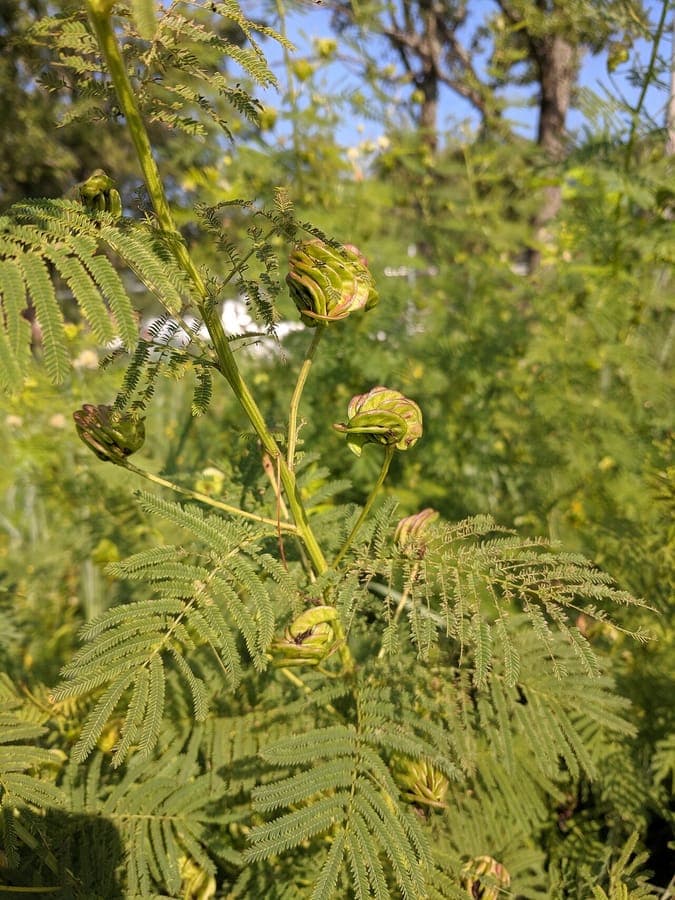
ThumYorky / CC BY-SA 4.0, via Wikimedia Commons
Illinois bundleflower: complete guide
Desmanthus illinoensis
Want to see Illinois bundleflower: complete guide in your garden?
1 minute, no credit card
Overview
The Illinois bundleflower (Desmanthus illinoensis), also known as prairie bundleflower, prairie mimosa or prickleweed, is a native North American perennial from the legume family Fabaceae. It grows wild across a wide swath of the central and eastern United States, from Texas and Oklahoma north through Kansas, Missouri and Illinois all the way to Minnesota, Wisconsin and the Dakotas. The species was formally described in 1908 by MacMillan, Robinson and Fernald, building on earlier work by Michaux, who first collected it in the eighteenth century.
For European gardeners with an interest in prairie planting, wildlife gardens or low-maintenance perennial borders, the Illinois bundleflower offers a genuinely compelling combination of attributes. It is a nitrogen-fixing legume, meaning it harbours symbiotic Rhizobium bacteria in root nodules that convert atmospheric nitrogen into plant-available forms, gradually improving soil fertility without any fertiliser input. Its feathery, bipinnate foliage is elegant and fern-like, its white spherical flower heads attract bees and butterflies, and its twisted seed pods provide food for birds and small mammals well into winter. At gardenworld.app you will find garden design inspiration that integrates prairie-native plants like this one into cohesive and wildlife-friendly planting plans.
Like the familiar sensitive plant (Mimosa pudica), the leaves of Desmanthus illinoensis fold up when touched or disturbed - a touch-sensitive response that adds an element of interactivity to the garden and explains the common name prairie mimosa.
Appearance and bloom cycle
The Illinois bundleflower is a multi-stemmed, upright perennial sub-shrub that grows from a deep, woody rootstock. Depending on site conditions, mature plants reach between 60 and 150 cm in height, occasionally taller in rich, moist prairie soils. The leaves are bipinnate (doubly compound), fine-textured and light green, closely resembling acacia or mimosa foliage. This lacy texture gives the plant an airy, graceful presence in the border even when not in flower.
Flowers appear from June through to August. They are small, white to cream-white, and arranged in round, pom-pom-like spherical heads of around 1 cm diameter, borne on slender stalks in the leaf axils. While individual flowers are modest, a mature plant in full bloom carries dozens of these heads simultaneously, creating a delicate but visually pleasing display. The flowers are rich in nectar and pollen, making the plant a valued resource for native bees, honeybees and butterflies.
After flowering, the plant sets its most distinctive feature: clusters of curved, twisted, brown seed pods that remain on the plant through autumn and into winter. These decorative pods add structural interest and serve as a seed source for ground-feeding birds such as quail, pheasant and sparrows. The seeds are notably protein-rich, and there is ongoing research interest in this species as a potential livestock fodder crop.
Ideal location
The Illinois bundleflower is a full-sun plant that performs best with six or more hours of direct sunlight per day. In partial shade it grows more weakly and flowers far less prolifically. Open, exposed positions - prairie borders, pollinator meadows, dry slopes, road verges and similar sites - suit it best. It also grows well in containers, provided the pot is deep enough (at least 50 cm) to accommodate the developing tap root.
Beyond mainstream borders, the plant is useful for difficult or neglected spots: thin, poor, compacted soils where other plants struggle to establish. Its nitrogen fixation gradually improves such sites and makes them more hospitable for companion plants over time. At gardenworld.app you can explore how native prairie plants can be incorporated into low-maintenance, sustainable garden designs.
Soil
Few perennials match the Illinois bundleflower for soil adaptability. It tolerates a wide pH range from 5.0 to 8.0, grows in sandy, loamy and even clay soils, and tolerates both dry spells and occasional short flooding. This versatility reflects its native range: natural prairie soils vary enormously in texture, depth and fertility across the central United States.
In a garden context, a moderately lean, well-drained soil is ideal. Excessively rich, heavily amended soils encourage leafy growth at the expense of flowering and pod formation, and can make the plant prone to flopping. Avoid heavy clay that stays wet for prolonged periods, as waterlogging around the root crown can cause rot. A light gravel mulch around the base helps stabilise soil moisture and temperature without interfering with the plant's natural growth patterns.
Free design
Want to see Illinois bundleflower: complete guide in your garden? Make a free design now.
Watering
Once established - typically after one full growing season - the Illinois bundleflower is remarkably drought tolerant. Its deep tap root, which can penetrate one metre or more into the soil, provides access to moisture and minerals unavailable to shallower-rooted plants. In practice this means that mature plants in most northern European climates rarely need supplemental watering, even during dry summers.
Newly planted specimens need more careful management during their first season. Water thoroughly once a week during dry periods to encourage deep root development. Once the tap root has reached adequate depth - usually by the second year - supplemental watering can be greatly reduced or eliminated. Overwatering, particularly in cool weather, is detrimental: like most legumes, the plant is sensitive to prolonged waterlogging around the root crown. Always err on the side of too dry rather than too wet.
Pruning
In its native range the Illinois bundleflower behaves as a woody-based perennial sub-shrub, with the stems dying back partially or fully in winter and resprouting from the persistent crown each spring. In northern European gardens, where winters are colder and wetter than in the US prairie belt, the above-ground parts typically die back completely after the first hard frosts.
In early spring, once new shoots begin to emerge from the base, cut back all the old dead stems to about 10-15 cm above ground level. This promotes a compact, tidy shape and removes any overwintering fungal material or pest eggs on the dead stems. If you wish to leave the decorative pods for wildlife over winter - which is encouraged - delay this cut until March, removing the old stems and empty pods together in one pass.
Maintenance calendar
- March-April: Cut back dead stems once new basal growth is visible.
- May: Rapid growth resumes; new feathery foliage unfurls.
- June-August: Main flowering period; white spherical heads open in succession.
- August-September: Seed pods ripen and brown; leave for birds or collect for propagation.
- October-November: Top growth dies back after first hard frosts.
- December-February: Dormant; woody base persists underground; leave dried stems and pods as winter habitat and food source.
Winter hardiness
Desmanthus illinoensis has impressive cold tolerance, naturally spanning USDA hardiness zones 3 through 8. This means it can survive temperatures well below -30 degrees Celsius in its native range - far colder than anything experienced in north-western Europe. In the Netherlands, Belgium and northern Germany (roughly USDA zones 7b-8a), the plant overwinters without difficulty, though top growth may die back to the crown in hard winters.
No special winter protection is needed in most European climates. In areas with very cold or very wet winters, a light covering of straw or coarse leaf mulch over the crown provides additional insurance. The deep tap root insulates the plant against surface temperature fluctuations. Regrowth in spring is reliable and often vigorous, with new stems quickly reaching flowering size by midsummer.
Companion plants
In a prairie border or wildlife garden, the Illinois bundleflower associates beautifully with other North American prairie natives. Excellent companions include butterfly weed (Asclepias tuberosa), purple coneflower (Echinacea purpurea), wild bergamot (Monarda fistulosa), black-eyed Susan (Rudbeckia hirta) and big bluestem (Andropogon gerardii). The fine-textured, feathery foliage of the bundleflower provides a light, airy counterpoint to the bolder textures of coneflowers and grasses.
As a nitrogen fixer, the plant is particularly beneficial when grown alongside nutrient-demanding prairie grasses such as little bluestem (Schizachyrium scoparium), which naturally benefit from the additional nitrogen input. Avoid planting next to aggressive spreaders that could shade out or outcompete the bundleflower in its establishment phase.
Closing
The Illinois bundleflower is a multi-talented prairie native that deserves wider recognition in European gardens. Its drought tolerance, soil-improving nitrogen fixation, wildlife appeal, attractive feathery foliage and decorative seed pods make it a standout choice for prairie borders, wildlife gardens and sustainable low-water planting schemes. Visit gardenworld.app to discover more prairie planting ideas and garden design tools that can help you build a garden that is beautiful, ecologically valuable and easy to maintain.
Want to see Illinois bundleflower: complete guide in your garden? Make a free design now.
Upload a photo, pick a style, and get a photorealistic design with plant list in under a minute.
10,000+ gardens designed already
No credit card required


Similar plants
Tall Silky Lupine: complete guide
Lupinus elatus
Tall silky lupine is a fast-growing Californian perennial with silvery foliage and blue-purple flower spikes, ideal for a prairie-style garden.
Garfield Lupine: complete guide
Lupinus garfieldensis
The Garfield lupine is a rare, fast-growing American perennial for alkaline, dry grassland gardens, with striking blue flower spikes.
Lupinus elegans: complete guide
Lupinus elegans
Lupinus elegans, the elegant lupine, is a spectacular blooming plant from Mexico with blue flower spikes. Care, cultivation and garden use.