
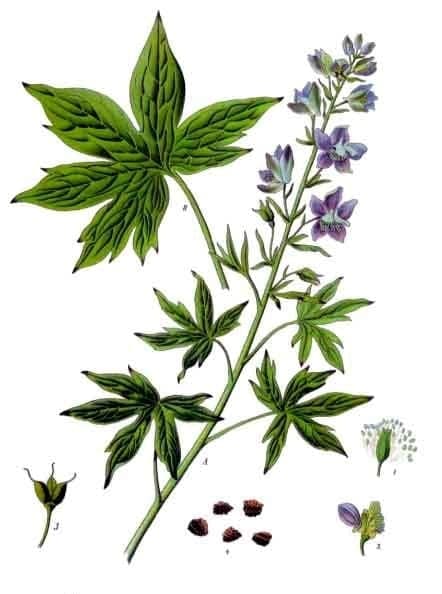
Franz Eugen Köhler, Köhler's Medizinal-Pflanzen / Public domain, via Wikimedia Commons
Stavesacre: complete guide
Delphinium staphisagria
Want to see Stavesacre: complete guide in your garden?
1 minute, no credit card
Overview
Delphinium staphisagria, commonly known as Stavesacre, is a rugged, tall herbaceous plant native to southern Europe and parts of the Mediterranean basin. Unlike its cultivated cousins in the Delphinium genus, this species thrives in poor, dry soils and full sun, making it a resilient choice for naturalistic or gravel gardens in the UK and US. Reaching up to 180 cm, it's a dramatic vertical accent in early summer borders. Though short-lived - often behaving as a biennial - it reliably self-seeds if conditions are right. It's not a common sight in mainstream garden centres, but its striking blue spires make it worth seeking out.
Appearance & bloom cycle
Stavesacre forms upright, stiff stems covered in fine hairs, giving them a slightly fuzzy texture. The deeply lobed, palmate leaves are grey-green and rough to the touch. In June, tall, open racemes of true blue flowers emerge, each with a prominent central spur typical of the genus. Individual blooms last about two to three weeks, depending on weather. After flowering, seed pods develop and split open to release dark, glossy seeds. These can scatter naturally, leading to new plants the following year. The plant dies back completely in winter, leaving dried stalks that add winter texture.
Ideal location
This plant demands full sun - rate it an 8 out of 10 for light - meaning at least 6–8 hours of direct sunlight daily. It performs best in hot, dry spots: south-facing slopes, rock gardens, or raised beds with good air circulation. Avoid shaded or damp corners. In cooler climates like the UK, a sheltered wall or patio container can boost its survival. In USDA zones 7–9, it can be reliably grown outdoors. In colder zones, treat it as an annual or start seeds under cover. On gardenworld.app, you can design a sun-drenched planting scheme tailored to drought-tolerant species like Stavesacre.
Soil requirements
Well-drained soil is non-negotiable. Sandy or gravelly loam with a pH of 7.0 to 7.5 works best. It tolerates limestone soils and even benefits from a light addition of garden lime if your soil is acidic. Avoid heavy clay unless amended with grit or sharp sand. Do not enrich the soil with compost or manure - Stavesacre prefers low fertility. Rich soil leads to floppy growth and fewer flowers. A lean, gritty mix mimics its natural rocky habitat.
Watering
Once established, Stavesacre is highly drought-tolerant. Water young plants weekly during their first growing season, but let the soil dry between waterings. Overwatering is a common mistake and leads to root rot. In summer, rainfall is usually sufficient unless there's a prolonged dry spell. In containers, check the top 2–3 cm of soil; water only if dry. Never let it sit in water.
Free design
Want to see Stavesacre: complete guide in your garden? Make a free design now.
Pruning
Minimal pruning is needed. After blooming, cut back the flower spikes to encourage tidy growth or leave them for seed collection and self-sowing. Remove dead foliage in late autumn or early spring. If growing in formal borders, deadheading keeps the look clean, but for naturalistic plantings, letting it go to seed adds charm.
Maintenance calendar
- Jan: Check stored seeds; start indoors at 15°C
- Feb: Sow seeds in pots under glass
- Mar: Harden off seedlings; protect from late frosts
- Apr: Transplant outdoors after last frost (UK: mid-May)
- May: Monitor for slugs; protect young growth
- Jun: Peak bloom; stake tall stems if needed
- Jul: Allow seed pods to mature; collect or scatter
- Aug: Reduce watering; cut back dead stems
- Sep: Transplant self-sown seedlings
- Oct: Prepare soil for autumn sowing
- Nov: Leave some stalks for winter interest
- Dec: Protect young rosettes with mulch in cold zones
Winter hardiness
Hardy in USDA zones 7–9. In zone 6, it may survive with mulch protection. Below zone 6, it's best grown as a biennial from seed each year. The plant forms a low rosette in its first year and flowers in the second. Cold, wet winters are its biggest threat. Ensure good drainage and avoid overhead watering in autumn. In colder areas, overwinter young plants in unheated greenhouses.
Companion plants
Pair Stavesacre with other drought-tolerant perennials like Echinacea purpurea, Nepeta racemosa, or Verbascum. The blue flowers contrast beautifully with golden yarrow or purple salvias. Low growers like Sedum or Thymus help suppress weeds and reduce soil moisture loss. Avoid aggressive spreaders or plants that need constant watering. On gardenworld.app, you can preview how Stavesacre fits into mixed borders with complementary heights and textures.
Closing
Stavesacre isn't for gardeners who want low-maintenance filler plants. It demands attention to drainage and sunlight but rewards with bold structure and vivid colour. Its naturalising habit brings spontaneity to the garden, and its vertical form adds drama. Seeds can be found at specialist nurseries or online. In the UK, check Triffid Hunter or specialist seed suppliers; in the US, look for them at native plant sales or Mediterranean-focused growers. Always remember: all parts of Delphinium staphisagria are toxic. Wear gloves when handling, and keep away from pets and children. With the right conditions, this wild beauty earns its place in any sun-baked garden.
Want to see Stavesacre: complete guide in your garden? Make a free design now.
Upload a photo, pick a style, and get a photorealistic design with plant list in under a minute.
No credit card required


Similar plants
Drummond's anemone: complete guide
Anemone drummondii
Discover Drummond's anemone (Anemone drummondii): a silvery-grey mountain plant for cool rock gardens and alpine troughs.
Korean clematis: complete guide
Clematis serratifolia
Clematis serratifolia is a hardy climber with fragrant yellow bell flowers in August-September. Pruning group 3, location and care tips.
Aquilegia brevistyla: complete guide
Aquilegia brevistyla
Discover Aquilegia brevistyla, the elegant North American columbine. Growing tips, shade tolerance, and design ideas for woodland and shadowed gardens.