
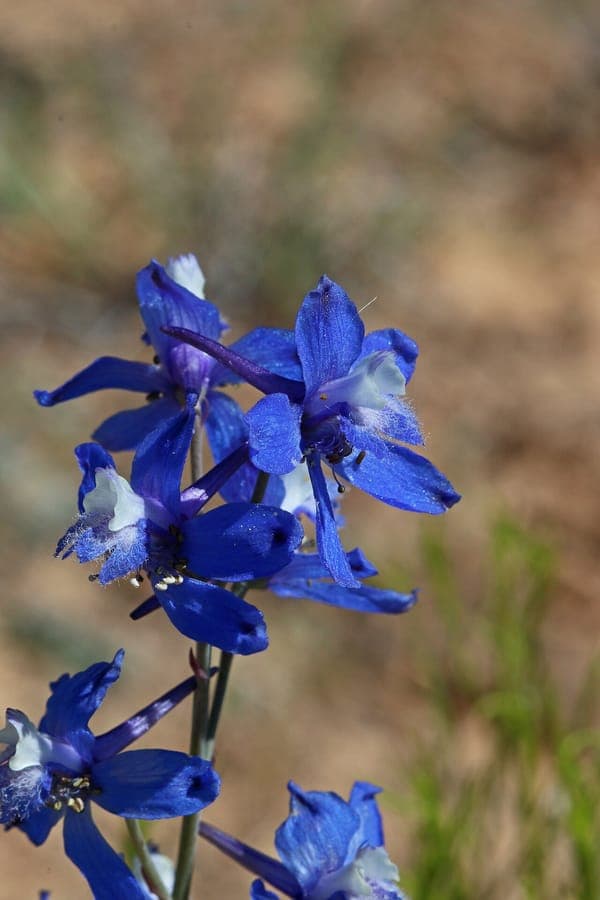
Andrey Zharkikh from Salt Lake City, USA / CC BY 2.0, via Wikimedia Commons
Delphinium scaposum: complete guide
Delphinium scaposum
Want to see Delphinium scaposum: complete guide in your garden?
1 minute, no credit card
Overview
Delphinium scaposum, known as the Tall mountain larkspur, is a striking alpine flower native to the mountain regions of Arizona, Colorado, New Mexico, Utah, and northwestern Mexico. This species belongs to the Ranunculaceae family and is recognized for its stately, spiky flower spikes in shades of blue to purple. The plant grows in rugged mountain terrain at elevations of 2,000 to 3,500 meters, indicating that it is a highly tolerant and resilient plant.
It is becoming popular in rock gardens and alpine gardens because it is both visually striking and low-maintenance. Once established, it regenerates naturally from seed, making it an excellent choice for wild mountain landscapes.
Appearance and Bloom
Delphinium scaposum forms a low rosette of basal leaves that are deeply divided and fern-like in appearance. The plant reaches heights of 30 to 60 cm and has slender, upright stems that carry little foliage.
The flowers are the most striking feature. They grow in densely-packed, long spikes (racemes) at the top of the stems. Each flower is approximately 1.5 to 2 cm long and varies in color from deep blue to purple, often with contrasting lower petals. The flowers appear from May to July, depending on local elevation and climate.
Seed pods follow after the flowering period and can self-seed naturally for subsequent seasons.
Ideal Location
Delphinium scaposum thrives best in fully sunny locations in temperate alpine or subalpine environments. It needs at least 5-6 hours of direct sunlight per day, although it grows well in partial shade.
This mountain flower prefers well-draining, non-rich soils. Rock and gravel-based garden beds are ideal. Avoid low, wet places - the plant wants good drainage.
The plant also does well on steep slopes, stone walls, and raised beds where mountain-like conditions can be simulated.
Soil
Delphinium scaposum grows best in well-draining, moderately fertile soil. Since it is an alpine species, it prefers non-enriched soils. A soil mix consisting of:
- 50% universal potting soil
- 30% coarse sand or perlite
- 20% small gravel or stone fragments
The plant accepts neutral to slightly acidic pH (6.0-7.0). Important: avoid clay-rich or peat-heavy soils that retain moisture.
When planting in alpine gardens, you can add sand and gravel to local soil to improve drainage.
Free design
Want to see Delphinium scaposum: complete guide in your garden? Make a free design now.
Watering
Delphinium scaposum is drought-tolerant once established, although it prefers regular water during growth and flowering periods.
During the growing season (spring and early summer), water when the top inch of soil feels dry. This may be 1-2 weeks between waterings, depending on local temperatures and rainfall.
Once the flowering period is over and seed pods ripen, reduce watering. In autumn and winter, the plant prefers almost dry conditions.
Once established (after the first season), you need not water much except in very dry periods.
Pruning
While removing dead flowers is not necessary, cutting off spent flower spikes increases energy flow and can stimulate further secondary growth.
Remove dead foliage and damaged stems to maintain attractive form and prevent disease.
If you want the seed to self-sow in the wild and propagate, leave some seed pods on the plant for self-seeding. This can ensure annual renewal.
Maintenance Calendar
Spring (March-May): Begin watering young plants. Monitor for weeds. Provide support for slender stems as they grow.
Summer (June-August): Normal watering during hot weeks. Enjoy the beautiful blooms. Allow seed pods to ripen.
Autumn (September-October): Reduce watering. Allow seed to drop or collect seed pods for next year.
Winter (November-February): Plant goes dormant. No watering needed. Protection against very heavy wet snow.
Winter Hardiness
Delphinium scaposum is very winter-hardy. In its natural habitat, it survives winters with heavy snow and frost down to below -20°C. This makes it very suitable for rock gardens in all regions of Northern Europe.
The key to winter survival is good drainage. Ensure that water does not pool around the plant.
Companion Plants
Delphinium scaposum combines wonderfully with:
- Other alpine flowers such as Dianthus alpestris or Sempervivum
- Alpine grasses for contrast
- Small shrubs such as Dryas or Geum
- Stones and rock elements for alpine aesthetics
Plant in groups of odd numbers for visual effect.
Closing
Delphinium scaposum brings the spirit of mountain peaks and alpine adventure to your garden. With its stately flowers and hardy nature, it is a great choice for alpine garden owners. Once established, it requires minimal care and will bloom season after season through self-seeding.
For purchase: Intratuin, Gamma, and gardenworld.app.
Want to see Delphinium scaposum: complete guide in your garden? Make a free design now.
Upload a photo, pick a style, and get a photorealistic design with plant list in under a minute.
No credit card required


Similar plants
Drummond's anemone: complete guide
Anemone drummondii
Discover Drummond's anemone (Anemone drummondii): a silvery-grey mountain plant for cool rock gardens and alpine troughs.
Korean clematis: complete guide
Clematis serratifolia
Clematis serratifolia is a hardy climber with fragrant yellow bell flowers in August-September. Pruning group 3, location and care tips.
Aquilegia brevistyla: complete guide
Aquilegia brevistyla
Discover Aquilegia brevistyla, the elegant North American columbine. Growing tips, shade tolerance, and design ideas for woodland and shadowed gardens.