
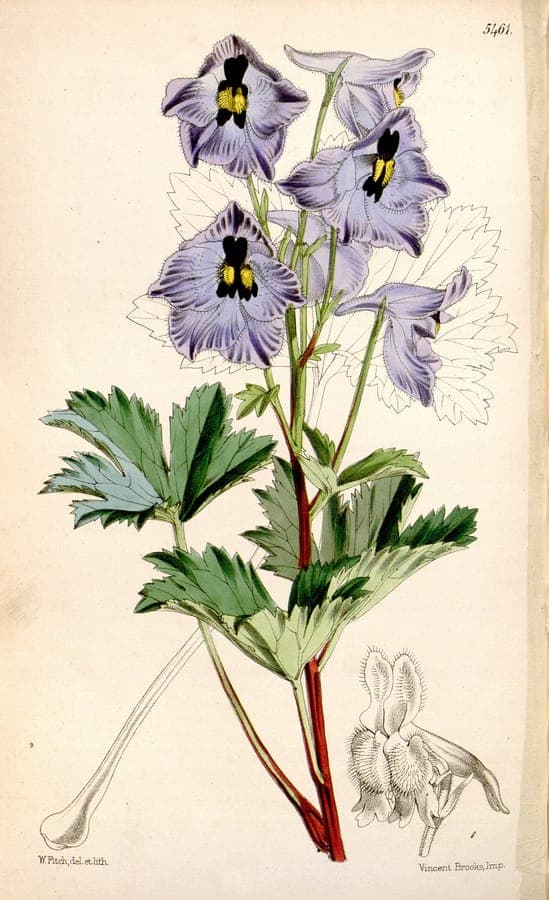
William Curtis / Public domain, via Wikimedia Commons
Musk Larkspur: complete guide
Delphinium brunonianum
Want to see Musk Larkspur: complete guide in your garden?
1 minute, no credit card
Delphinium brunonianum, commonly called Musk Larkspur, is a captivating alpine flower native to the high mountain regions spanning from northeastern Iraq through Central Asia to Nepal, Tibet, and the West Himalayas. Named for its distinctive fragrance, this elegant species belongs to the Ranunculaceae family and was formally described by Royle in 1834.
Musk Larkspur is highly prized by alpine and rock garden enthusiasts for its refined appearance and aromatic qualities. The plant typically grows to approximately 60 centimeters tall, producing slender, upright stems adorned with finely dissected, gray-green foliage. The flowers emerge in compact racemes, displaying characteristic blue or violet hues, though select cultivars may produce white variants, adding versatility to garden compositions.
This larkspur species is particularly well-suited for alpine troughs, rock gardens, and alpine houses where its specific environmental requirements can be met. Flowering extends from May through August, providing valuable summer color in cool-climate gardens. The fragrance is a notable attribute, making it especially appealing to those seeking sensory dimensions in their planting schemes.
Successful cultivation of Delphinium brunonianum demands full sun to partial shade conditions. The plant thrives best at elevations or in climates that mirror its native mountain habitat, where cool temperatures prevail throughout much of the growing season. Although remarkably hardy, it requires specific growing conditions that closely replicate its alpine origins.
Soil composition is critical for success. Musk Larkspur demands excellent drainage and prefers nutrient-poor, gravelly, or sandy substrates. Alpine plants evolved on rocky slopes with minimal organic matter and sharp drainage. A growing medium amended with additional perlite, coarse sand, or gravel is essential to prevent waterlogging, which this species cannot tolerate.
Watering requires careful management. While Delphinium brunonianum displays greater drought tolerance than many Delphinium species, it requires consistent moisture during growth and flowering phases. Maintain the soil at slightly moist levels without waterlogging. In wet climates, elevate drainage further to prevent root rot.
Minimal pruning is required. Remove spent flower spikes to encourage continued blooming and maintain plant vigor. Allow the plant to complete its natural cycle, self-sowing if conditions permit. Seed pods should be left on the plant if you wish to encourage natural propagation.
Winter hardiness is exceptional. This larkspur survives winter without protection in temperate zones, with its root system remaining viable underground throughout dormancy. Spring growth emerges reliably, making it a dependable returning perennial. In harsh alpine regions, it often acts as a short-lived perennial or biennial.
Companion plantings should feature other alpine species: Campanula varieties, Saxifraga, dwarf sedums, and fine alpine grasses create harmonious, naturally integrated compositions. These combinations echo the plant's native mountain meadow habitat and create visual coherence.
Musk Larkspur is rarely stocked in standard UK garden centers. Seek specialized alpine nurseries or botanical plant suppliers. Online resources like gardenworld.app provide detailed care information and source recommendations specific to your region. Many alpine societies maintain lists of specialist suppliers for rare mountain flora.
Want to see Musk Larkspur: complete guide in your garden? Make a free design now.
Upload a photo, pick a style, and get a photorealistic design with plant list in under a minute.
No credit card required


Similar plants
Drummond's anemone: complete guide
Anemone drummondii
Discover Drummond's anemone (Anemone drummondii): a silvery-grey mountain plant for cool rock gardens and alpine troughs.
Korean clematis: complete guide
Clematis serratifolia
Clematis serratifolia is a hardy climber with fragrant yellow bell flowers in August-September. Pruning group 3, location and care tips.
Aquilegia brevistyla: complete guide
Aquilegia brevistyla
Discover Aquilegia brevistyla, the elegant North American columbine. Growing tips, shade tolerance, and design ideas for woodland and shadowed gardens.