
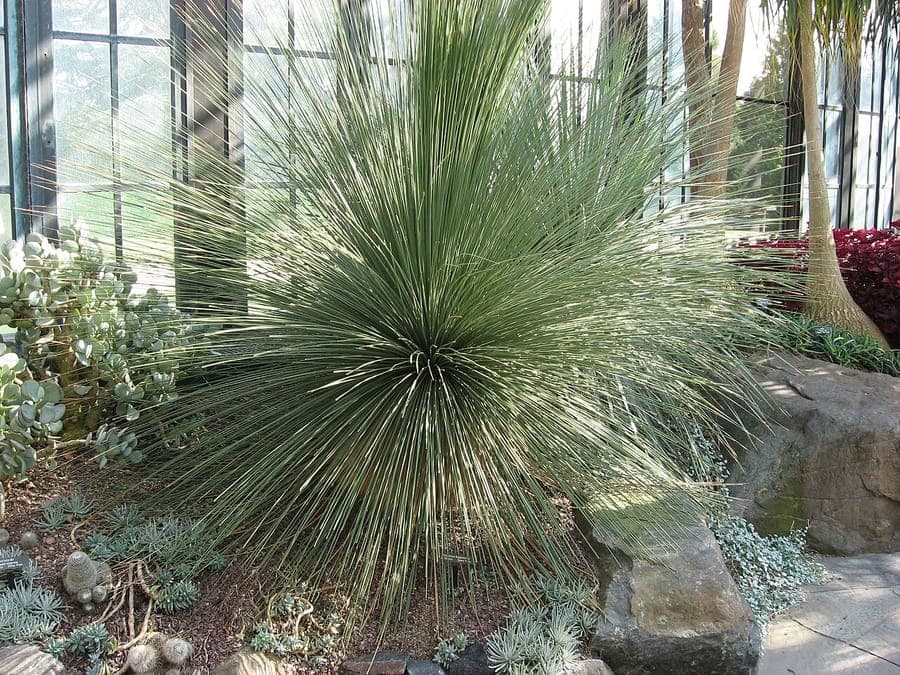
Chhe (talk) / Public domain, via Wikimedia Commons
Dasylirion longissimum: complete guide
Dasylirion longissimum
Want to see Dasylirion longissimum: complete guide in your garden?
1 minute, no credit card
Overview
Dasylirion longissimum, commonly known as Beargrass, is an impressive ornamental plant native to northeastern Mexico. This member of the Asparagaceae family has gained popularity in modern garden design due to its distinctive appearance and low maintenance requirements. The plant thrives in various growing conditions and makes a bold visual statement in any landscape.
The long, elegant leaves cascade gracefully downward, creating a waterfall-like effect that commands attention. For gardeners seeking something different from conventional ornamentals, Dasylirion longissimum offers a fascinating alternative. This plant truly elevates the aesthetic value of any garden setting.
Appearance and bloom
The Beargrass is primarily known for its spectacular foliage. The narrow, ribbon-like leaves can reach 60 to 100 centimeters in length, creating a dense rosette with an elegant, fan-like silhouette. The foliage ranges from green to gray-green, giving the plant a rustic character that blends beautifully with contemporary landscapes.
Flowers emerge in late summer as small, yellow-green clusters held high above the foliage on tall stems. While the blooms themselves are not particularly showy, they add interesting vertical dimension to the plant. Following flowering, seed pods form and persist through the seasons, providing extended interest. The mature plant becomes a sculptural focal point in any garden design.
Ideal location
Dasylirion longissimum performs best in full sun exposure. The plant requires at least 6 to 8 hours of direct sunlight daily to achieve optimal growth and maintain vibrant coloring. In shaded locations, growth becomes sparse and leaf production diminishes noticeably.
The plant is well-suited to warm regions but can also perform acceptably in temperate climates with winter protection. In northern Europe, container cultivation allows the plant to be moved to protected locations during severe winters. Position Dasylirion longissimum where it remains highly visible from the home, as its growth pattern is truly decorative and serves as an architectural accent.
Soil
Beargrass is not particularly demanding regarding soil composition but struggles in waterlogged, heavy clay. The ideal growing medium is well-draining with a sandy component. When planting, amend soil with sand or perlite to improve drainage characteristics. A pH between 6.0 and 7.5 is optimal, though the plant tolerates slightly acidic to neutral conditions.
To prevent waterlogging, ensure the planting hole accommodates the soil type. For naturally moist soils, consider planting in raised beds or amending heavily with organic material. This remarkably adaptable plant tolerates nutrient-poor soils readily, so rich fertilization is not essential for good growth.
Watering
Once established, Dasylirion longissimum is exceptionally drought-tolerant. During the growing season (spring and summer), water regularly, especially in the first years following planting. Water when the top soil layer feels dry to the touch. Avoid waterlogging, as this leads to root rot and plant decline.
During autumn and winter, reduce watering substantially. The plant withstands extended dry periods with remarkable resilience and requires minimal water during dormancy. Container-grown specimens require even more cautious watering practices. In regions with regular precipitation, rainfall often suffices outside the growing season.
Free design
Want to see Dasylirion longissimum: complete guide in your garden? Make a free design now.
Pruning
Dasylirion longissimum requires minimal pruning. Remove only dead or damaged leaves as they appear throughout the year. If the plant becomes oversized, outer leaf rows may be carefully removed while preserving the natural form. Restraint is essential to maintain the plant's characteristic appearance and architectural impact.
Keep pruning to a minimum to preserve the striking silhouette. Avoid cutting healthy green foliage, as this disrupts the growth pattern and aesthetic appeal. The plant's natural form is its greatest asset.
Maintenance calendar
Spring (March-May): Resume regular watering as growth begins. Apply fertilizer if growing in containers. Remove dead foliage and debris.
Summer (June-August): Maintain consistently moist soil without waterlogging. Protect against intense heat and sun damage. Deadhead spent flowers as needed.
Autumn (September-October): Gradually reduce watering frequency. Monitor for pests and diseases. Perform maintenance pruning of damaged leaves.
Winter (November-February): Minimize water application. In harsh climates, use protective wrapping materials. Remove diseased or rotting material promptly.
Winter hardiness
Dasylirion longissimum is not fully winter-hardy in northern European climates. The plant tolerates temperatures around -5 degrees Celsius but prolonged frost proves fatal. In regions with temperatures below -10 degrees Celsius, indoor overwintering becomes necessary.
For garden cultivation in moderately cold climates, protect the plant with burlap or similar materials during severe winters. For extremely harsh conditions, maintain the plant in containers that move indoors during winter. Frost-damaged specimens often recover through basal sprouting if protected properly.
Companion plants
Dasylirion longissimum pairs excellently with other drought-tolerant Mediterranean specimens. Consider agaves, yuccas, feijoas, and other succulents for coordinated plantings. Ornamental grasses like Miscanthus or Pampasgrass create striking visual contrast against the drooping foliage.
Columnar conifers add vertical lines and contrast with the cascading leaves of Beargrass. Low-growing groundcovers suppress weeds and add textural interest. Avoid combining with plants requiring constant moisture, as this creates conflicting care needs.
Closing
Dasylirion longissimum is a remarkable ornamental plant that elevates any garden setting with its distinctive form. With minimal maintenance requirements and exceptional drought tolerance, it makes an excellent choice for contemporary landscapes. Whether establishing a Mediterranean garden or simply seeking an outstanding foliage specimen, this Mexican native absolutely deserves inclusion in your garden plans. With proper positioning and care, your Beargrass will provide years of visual pleasure and architectural interest.
Want to see Dasylirion longissimum: complete guide in your garden? Make a free design now.
Upload a photo, pick a style, and get a photorealistic design with plant list in under a minute.
No credit card required


Similar plants
Narrow-leaved dracaena: complete guide
Dracaena angustifolia
Everything about Dracaena angustifolia - the narrow-leaved dracaena: location, care, overwintering and use as a houseplant or patio plant.
Chaparral yucca: complete guide to Hesperoyucca whipplei
Hesperoyucca whipplei
Hesperoyucca whipplei (Our Lord's candle) is a dramatic rosette-forming plant from California that produces a towering flower spike, ideal for dry and gravel gardens.
False lily-of-the-valley: complete guide
Maianthemum dilatatum
Everything about Maianthemum dilatatum, the false lily-of-the-valley. Care, shade location, propagation and garden combinations for this popular shade ground cover.