
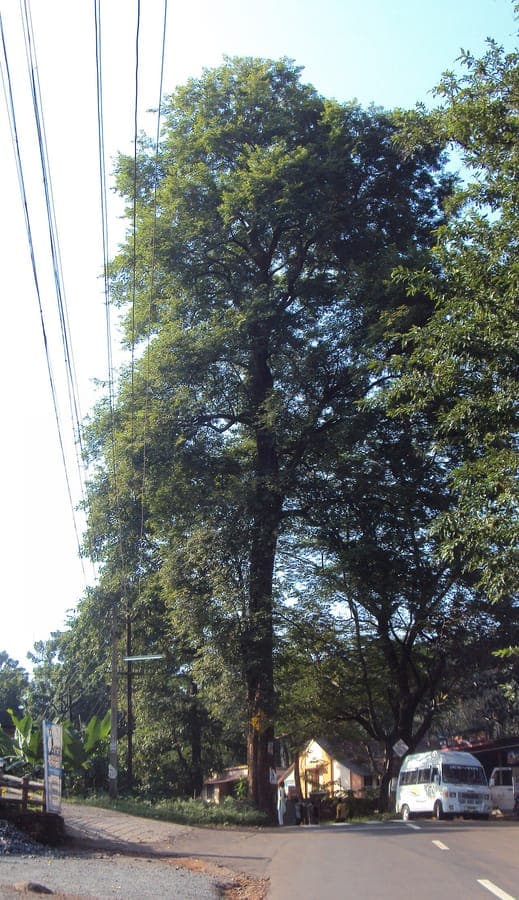
Vinayaraj / CC BY-SA 3.0, via Wikimedia Commons
East Indian Rosewood: complete guide
Dalbergia latifolia
Want to see East Indian Rosewood: complete guide in your garden?
1 minute, no credit card
East Indian rosewood (Dalbergia latifolia), also called Indian rosewood or Bombay blackwood, is a valuable timber tree from the legume family (Fabaceae). The tree originates from the Indian subcontinent, Andaman Islands, and Java.
Overview Dalbergia latifolia is a medium to large tree that can reach 20-25 meters in height. The tree is renowned for its excellent timber that is dark brown to black, extremely dense, and polishes to a beautiful shine. The wood is valued worldwide for fine furniture and musical instrument making.
Appearance The tree has light-gray bark and compound, unequally pinnate leaves. The leaves are dark green and give the tree an attractive appearance. During the growing season, small, whitish to pink flowers appear in loose clusters.
Bloom and Fruiting The flowers are small, approximately 1 cm long, and appear in spring and early summer. The flowers have a pleasant, sweet fragrance. The fruits are flattened, thin legume pods without a continuous pod flesh, yellow-brown in color.
Climate Requirements East Indian rosewood grows in warm, dry to moderately moist tropical climate. The tree tolerates seasonal drought well. The tree grows best under temperatures of 15-35 degrees Celsius. No frost tolerance.
Soil Requirements The tree grows in various soil types. It thrives in heavy clay to light sandy soils. A pH of 5.5-7.5 is ideal. Good drainage is important to prevent water stagnation. The tree tolerates somewhat nutrient-poor soils.
Watering In the first year, the tree should be watered regularly for good establishment. Once established, the tree tolerates drought very well. In very dry growing regions, supplemental watering can be profitable, especially for young trees.
Cultivation and Propagation The tree is grown from seed. Seeds should be lightly scarred or soaked for better germination. Seedlings grow well under warm and moist conditions. The tree grows relatively quickly.
Maintenance Minimal maintenance is needed once established. Young trees may need slight pruning for good shaping. The tree is extremely long-lived and can live a hundred years or older.
Wood Properties The wood is extremely valuable due to its dense, glossy structure. The wood color is dark brown to almost black with beautiful grain patterns. The wood is very durable and resistant to rot and insect damage.
Uses The wood is traditionally used for fine furniture, musical instruments, and decorative articles. From an environmental perspective, sustainably managed cultivation is important because the tree becomes increasingly rare in natural habitats.
Ecological Value The tree serves as a food source for various insects through flowers and leaves. The tree fixes nitrogen in the soil through symbiosis with bacteria in root nodules.
Closing Thoughts East Indian rosewood is a beautiful tree with immensely valuable timber. The tree is suitable for large gardens in tropical areas. For more information on valuable timber and tropical trees, visit GardenWorld.app for expert guidance and inspiration.
Want to see East Indian Rosewood: complete guide in your garden? Make a free design now.
Upload a photo, pick a style, and get a photorealistic design with plant list in under a minute.
No credit card required


Similar plants
Tall Silky Lupine: complete guide
Lupinus elatus
Tall silky lupine is a fast-growing Californian perennial with silvery foliage and blue-purple flower spikes, ideal for a prairie-style garden.
Garfield Lupine: complete guide
Lupinus garfieldensis
The Garfield lupine is a rare, fast-growing American perennial for alkaline, dry grassland gardens, with striking blue flower spikes.
Lupinus elegans: complete guide
Lupinus elegans
Lupinus elegans, the elegant lupine, is a spectacular blooming plant from Mexico with blue flower spikes. Care, cultivation and garden use.