
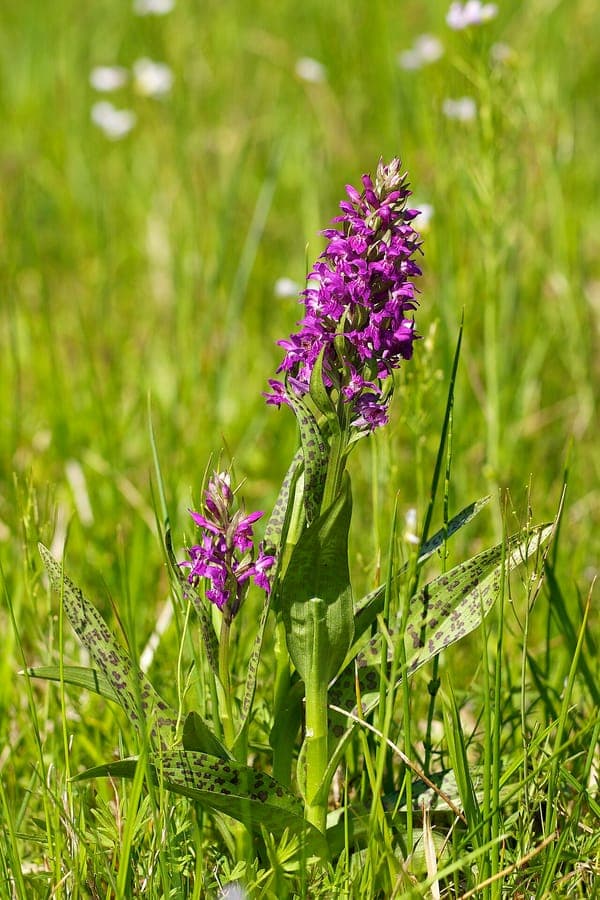
Jörg Hempel / CC BY-SA 3.0 de, via Wikimedia Commons
Broad-leaved marsh orchid: complete guide
Dactylorhiza majalis
Want to see Broad-leaved marsh orchid: complete guide in your garden?
1 minute, no credit card
Overview
Dactylorhiza majalis, commonly known as the Broad-leaved marsh orchid, is a striking native orchid found across damp meadows and wet woodlands in Europe. As a forb or herbaceous perennial in the Orchidaceae family, it brings elegance and ecological value to gardens that mimic natural wetland conditions. Native to regions including the Baltic States, Central Europe and Scandinavia, this orchid thrives where few other ornamentals dare to grow - in consistently moist, cool soils.
Growing this orchid successfully isn't about force-feeding or heavy intervention. It's about matching its natural habitat as closely as possible. On gardenworld.app, you can design a wetland planting scheme that supports moisture-loving species like Dactylorhiza majalis, ensuring your garden works with nature, not against it.
Appearance & bloom cycle
The Broad-leaved marsh orchid grows 20 to 60 cm tall, with a sturdy, upright stem. Its leaves are broad and lance-shaped, rich green with distinctive dark purple blotches that appear in early spring. These markings help identify the plant even before flowering.
Bloom time runs from April through July, peaking in May - hence one of its French names, Orchis de mai. The flower spike is densely packed with small, hooded purple flowers, ranging from pale lilac to deep magenta. Some plants even show white or pink variants, adding variety to naturalistic plantings.
The flowers emit a faint, sweet fragrance, especially in warm afternoons, attracting bumblebees and other long-tongued pollinators. After pollination, seed capsules form and burst open in late summer, releasing thousands of dust-like seeds. Germination is slow and requires a symbiotic relationship with soil fungi - a process that can take years.
Ideal location
This orchid prefers a light level of 8 out of 10 - bright light with partial shade during the hottest part of the day. Full sun is acceptable if the soil remains constantly moist. Avoid deep shade, as it reduces flowering and encourages weak growth.
Ideal spots include the margins of ponds, bog gardens, or damp grassy areas. It's perfect for naturalistic plantings, wildflower meadows, or wildlife-friendly gardens. Do not plant it in dry borders or under dense tree canopies where moisture is limited.
Use gardenworld.app to assess your garden's microclimates and moisture zones. The platform helps identify suitable areas for moisture-dependent plants and recommends companion species for balanced planting.
Soil requirements
Dactylorhiza majalis requires a pH between 6.5 and 7.0 - slightly acidic to neutral. The soil should be rich in organic matter but not overly fertile. Avoid compost-rich or manured soils, as excess nutrients promote algae and competitive weeds that overwhelm the orchid.
A good planting mix includes equal parts peat-free compost, horticultural sand, and leaf mould. The key is moisture retention without waterlogging. Incorporate a base layer of gravel for drainage if planting in heavy clay.
Crucially, this orchid depends on mycorrhizal fungi in the soil. These fungi help the plant absorb nutrients, so always use cultivated stock - never dig up wild plants. Purchase only from reputable nurseries that grow orchids in controlled conditions.
Free design
Want to see Broad-leaved marsh orchid: complete guide in your garden? Make a free design now.
Watering
Consistent moisture is non-negotiable. The soil must never dry out, especially during the growing season (April to August). In dry spells, water weekly using rainwater - tap water is often too alkaline and can raise the pH over time.
In winter, reduce watering but don't let the soil become bone dry. The rhizome remains active and needs some moisture to survive. Overwatering in cold, stagnant conditions can lead to root rot, so ensure good drainage.
Pruning
Pruning isn't necessary. Allow the flower spike to remain after blooming to let the plant reabsorb energy into the tuber. Remove dead foliage in autumn, but leave a short stub to avoid damaging the crown.
Never cut back green leaves prematurely - they photosynthesise and store energy for next year's growth. Patience is key; this orchid builds strength slowly over several seasons.
Maintenance calendar
- January: Check moisture levels. Protect tubers with leaf litter if hard frost is forecast.
- February: No action needed.
- March: Watch for early shoot emergence.
- April: Maintain soil moisture. Monitor for slugs.
- May: Peak flowering. Avoid fertilising.
- June: Continue watering. Prevent shading from fast-growing neighbours.
- July: Flowers fade. Allow seed pods to mature.
- August: Collect seeds if desired, or let them disperse naturally.
- September: Reduce watering unless drought persists.
- October: Remove dead foliage.
- November: No maintenance.
- December: Mulch lightly with organic matter.
Winter hardiness
The Broad-leaved marsh orchid is hardy in USDA zones 5 to 8 (-20°C to -10°C). The tuber survives winter dormancy underground. In areas with fluctuating freeze-thaw cycles, apply a thin mulch of leaf litter or pine needles to insulate the crown.
Avoid plastic covers - they trap moisture and encourage rot. Natural mulches mimic the plant's woodland edge habitat and support beneficial soil life.
Where to buy
In the UK and Europe, purchase Dactylorhiza majalis from licensed nurseries or garden centres that specialise in native or bog plants. Avoid wild-collected specimens. Reputable sources include specialist orchid nurseries and ethical suppliers found at garden centres across the UK.
Companion plants
Pair with other moisture-loving natives: Iris pseudacorus, Molinia caerulea, Eriophorum angustifolium, and Carex species. These create layered, ecologically rich plantings that support pollinators and soil health.
Avoid aggressive spreaders like goldenrod or mint, which can outcompete the orchid. Also, keep fertilised vegetable beds at a distance - nutrient runoff harms sensitive orchids.
Closing
The Broad-leaved marsh orchid isn't for impatient gardeners. It demands specific conditions and rewards only over time. But when it thrives, it becomes a jewel of the damp garden - a living link to vanishing wetland habitats.
With thoughtful planning on gardenworld.app, you can create a space where Dactylorhiza majalis not only survives but flourishes, adding beauty and biodiversity to your garden for years to come.
Want to see Broad-leaved marsh orchid: complete guide in your garden? Make a free design now.
Upload a photo, pick a style, and get a photorealistic design with plant list in under a minute.
No credit card required


Similar plants
Ram's-head lady's slipper: complete guide
Cypripedium arietinum
Everything you need to know about growing Cypripedium arietinum, a rare woodland orchid for cool, moist garden settings. Soil, care and planting tips.
Sparrow's-egg lady's slipper: complete guide
Cypripedium passerinum
Everything about growing Cypripedium passerinum, a cold-hardy subarctic orchid suited to cool, moist, shaded garden spots. Soil, care and companion plants.
Algerian Butterfly-orchid: complete guide
Platanthera algeriensis
Everything about Platanthera algeriensis, the rare Mediterranean orchid with greenish flowers native to Algeria, Morocco, Corsica and Spain.