
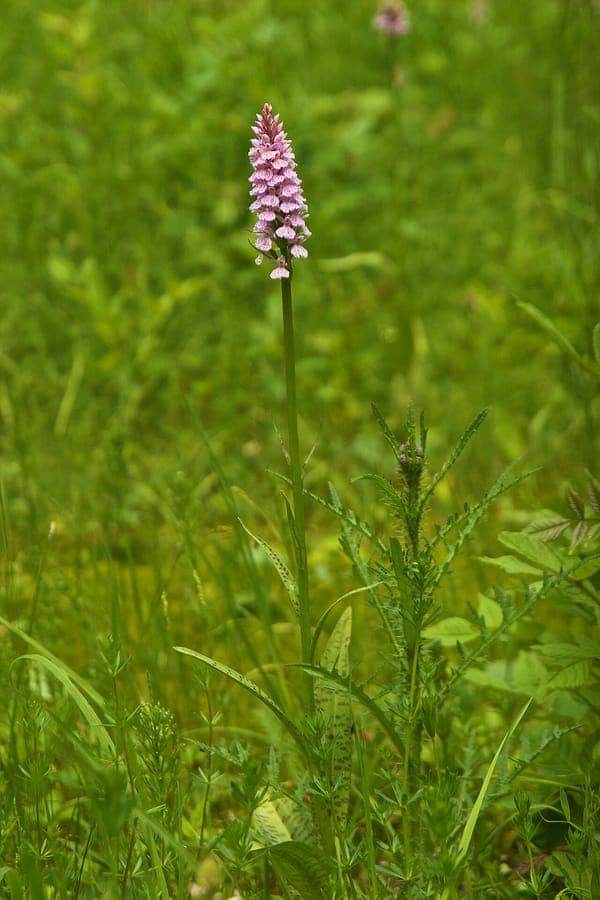
Jörg Hempel / CC BY-SA 3.0 de, via Wikimedia Commons
Heath spotted orchid: complete guide
Dactylorhiza maculata
Want to see Heath spotted orchid: complete guide in your garden?
1 minute, no credit card
Overview
The heath spotted orchid (Dactylorhiza maculata) is a graceful native orchid that brings quiet elegance to damp, wild corners of the garden. Found naturally across heaths, fens and moist meadows from central to northern Europe, this plant is a rewarding choice for gardeners seeking naturalistic planting schemes. Though delicate in appearance, it's surprisingly resilient when grown in the right conditions. On gardenworld.app, you can design a garden layout that matches the orchid's moisture and light needs with precision.
Part of the Orchidaceae family, Dactylorhiza maculata grows 20–50 cm tall and is hardy in USDA zones 4–8. It blooms from May through July, producing spikes of spotted purple and white flowers. It prefers acidic soil (pH 5.5–6.5) and consistent moisture-never soggy, never dry. This isn't a plant for the average flowerbed, but for those willing to mimic its natural habitat, it rewards with years of subtle beauty.
Appearance & bloom cycle
The heath spotted orchid gets its name from the mottled, dark green leaves that emerge early in spring. These lance-shaped leaves are densely packed at the base and lower stem, often with purplish spots. The flower spike rises in late spring, reaching 5–15 cm in length and carrying 15–40 individual blooms. Flowers range from pale pink to deep purple, usually with darker spotting, and have a faint, sweet fragrance most noticeable in the morning.
Bloom time varies slightly by region-earlier in warmer southern areas (late May), later in cooler northern gardens (early July). Each plant flowers for about three weeks. After pollination, seed capsules form and mature by late summer. Use the bloom tracker on gardenworld.app to align this orchid with companion plants like ragged robin or meadowsweet for a continuous mid-season display.
Ideal location
This orchid thrives in light dappled shade to partial sun-about a 7 on the light scale (1–10). That translates to 4–5 hours of morning or late afternoon sun, avoiding harsh midday rays. Full southern exposure will dry out the roots too quickly. A spot at the edge of a pond, in a bog garden, or beneath open-canopy trees like birch or alder works perfectly.
Good air movement is essential. Stagnant, humid air encourages fungal issues. Avoid planting it in crowded borders or beneath dense shrubs. Instead, give it breathing room-pair it with moisture-loving perennials that don't shade it out completely.
Soil requirements
The key to success with Dactylorhiza maculata is replicating its natural fen or heathland soil. Use a mix of peat-free ericaceous compost, horticultural sand, and fine pine bark. The pH should stay between 5.5 and 6.5-avoid lime, manure, or composted garden soil. These are too rich and alkaline, and will harm the delicate root system.
In garden beds, create a shallow bog bed: dig out 30 cm and refill with your acidic mix. Ensure the water table stays high but not flooded. Raised bog beds with liner edges work well in drier gardens. Never use standard multipurpose compost.
Free design
Want to see Heath spotted orchid: complete guide in your garden? Make a free design now.
Watering
Consistent moisture is non-negotiable. The root zone should stay damp year-round, especially from April to August. Use rainwater only-tap water often contains lime that raises pH over time. Water at the base in the morning to prevent leaf wetness and fungal development.
During dry spells, increase watering frequency. Mulch lightly with pine needles or reed to help retain moisture, but keep the crown clear to avoid rot. A rain barrel near your bog area makes irrigation easier and more sustainable.
Pruning
No pruning is needed beyond removing the spent flower spike after blooming. Cut it close to the stem with clean secateurs, but leave the foliage intact. The leaves photosynthesize through summer and store energy in the tuber for next year's growth.
Only remove leaves if they show signs of disease. Use sterilized tools and dispose of infected material-don't compost it. Orchids are sensitive to pathogens lingering in organic waste.
Maintenance calendar
- January: Check for frost heave or animal disturbance
- February: Dormant-no action needed
- March: Watch for early leaf growth; protect from late frosts with fleece
- April: Begin regular watering; watch for slugs
- May: Bloom begins; maintain even moisture
- June: Peak bloom; avoid overhead watering
- July: Flowers fade; cut spike, leave foliage
- August: Reduce watering slowly
- September: Leaves start to yellow; prepare for dormancy
- October: Remove dead foliage; apply light mulch
- November–December: Dormant; no feeding
Winter hardiness
Hardy in USDA zones 4–8, the heath spotted orchid survives cold winters with minimal protection. In zone 7 and above, a light mulch of pine needles or bracken is sufficient. In colder zones (4–5), add a breathable winter cover if prolonged freezing is expected. Avoid plastic-it traps moisture and promotes rot.
If grown in containers, move pots to a sheltered, frost-free spot like a cold frame. Potted roots are more vulnerable to freeze-thaw cycles.
Companion plants
Choose plants with similar needs: moist, acidic soil and partial shade. Good companions include purple moor grass (Molinia caerulea), marsh marigold (Caltha palustris), bog arum (Calla palustris), and ferns like Polystichum setiferum. Avoid vigorous spreaders like mint or goldenrod that could outcompete the orchid.
Plan your planting scheme on gardenworld.app to visualise spacing, height, and seasonal interest.
Closing
The heath spotted orchid isn't for every garden, but for those who appreciate wild beauty and ecological planting, it's a treasure. It demands attention to detail-moisture, pH, light-but repays that care with quiet elegance. Always buy nursery-propagated plants, never wild-dug. In the UK and Ireland, look for reputable suppliers at garden centres or specialist nurseries. With patience and the right conditions, Dactylorhiza maculata can become a lasting feature in your native planting scheme.
Want to see Heath spotted orchid: complete guide in your garden? Make a free design now.
Upload a photo, pick a style, and get a photorealistic design with plant list in under a minute.
No credit card required


Similar plants
Ram's-head lady's slipper: complete guide
Cypripedium arietinum
Everything you need to know about growing Cypripedium arietinum, a rare woodland orchid for cool, moist garden settings. Soil, care and planting tips.
Sparrow's-egg lady's slipper: complete guide
Cypripedium passerinum
Everything about growing Cypripedium passerinum, a cold-hardy subarctic orchid suited to cool, moist, shaded garden spots. Soil, care and companion plants.
Algerian Butterfly-orchid: complete guide
Platanthera algeriensis
Everything about Platanthera algeriensis, the rare Mediterranean orchid with greenish flowers native to Algeria, Morocco, Corsica and Spain.