
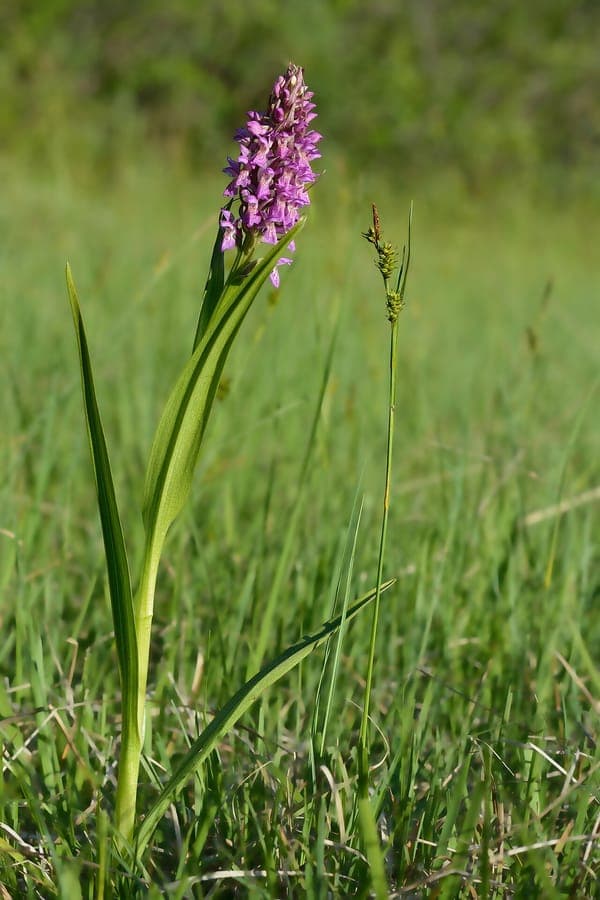
Ivar Leidus / CC BY-SA 3.0, via Wikimedia Commons
Early marsh orchid: complete guide
Dactylorhiza incarnata
Want to see Early marsh orchid: complete guide in your garden?
1 minute, no credit card
Overview
The early marsh orchid (Dactylorhiza incarnata) is a graceful, wild orchid native to damp meadows, fens and wet grasslands across central and northern Europe. It's a hardy perennial in the Orchidaceae family, reaching 20–50 cm in height, and thrives in open, sunny, consistently moist conditions. If you're aiming for a naturalistic garden design with ecological value, this species adds elegance and supports early pollinators. It's winter hardy in USDA zones 5 to 8.
On gardenworld.app, you can design a wetland garden plan that integrates the early marsh orchid with complementary native species.
Appearance & bloom cycle
The early marsh orchid produces upright stems with spotted, lance-shaped basal leaves that are deep green with maroon flecks - a hallmark of the Dactylorhiza genus. The flower spike, 10–20 cm long, carries 20 to 60 individual flowers, blooming from late May through June. Flowers are typically purple to pinkish-purple, with a deeply lobed, intricately patterned lip that attracts bees and hoverflies.
The plant emerges in April, with leaves appearing first, followed by the flower spike. Blooming lasts 3–4 weeks depending on weather. After flowering, seed capsules form, but natural germination is slow and dependent on mycorrhizal fungi in the soil. This makes seed propagation unreliable for home gardeners - it's best to plant established young plants.
Ideal location
This orchid needs full sun to perform well - a 9 out of 10 on the light scale. It requires at least 6 hours of direct sunlight daily. Choose open, south-facing wetlands, bog gardens, or margins of ponds with full exposure. Light dappled shade is acceptable only if morning sun is strong.
Avoid heavy shade or competition from vigorous grasses, nettles, or reeds. These will outcompete the orchid for light and nutrients. Give each plant at least 15 cm of open space around it. On gardenworld.app, you can assess your garden's sun exposure and moisture levels to determine if it's suitable for early marsh orchid.
Soil requirements
The early marsh orchid grows best in mineral-rich, neutral to slightly alkaline soils with a pH of 7.0–7.5. It prefers loamy or sandy-clay soils that stay moist but not waterlogged. Avoid rich compost, manure, or peat-based mixes - these encourage weeds and disrupt the delicate root symbiosis.
This orchid forms a vital relationship with mycorrhizal fungi, which help it absorb nutrients. That's why wild-collected plants rarely survive transplanting. Always source nursery-propagated plants. In nature, Dactylorhiza incarnata grows in areas with calcareous groundwater, so avoid acidic bog conditions.
Free design
Want to see Early marsh orchid: complete guide in your garden? Make a free design now.
Watering
Consistent moisture is non-negotiable. The soil should never dry out, especially from April through July. During dry spells, hand-water with rainwater or pH-neutral tap water. Avoid overhead watering - wet flowers increase fungal risk.
Mulch lightly with reed or straw to retain moisture, but don't smother the crown. In winter, the plant tolerates wet soil, even temporary flooding, as long as it's not stagnant.
Pruning
No pruning is required for health, but you can deadhead spent flower spikes in late June to prevent excessive self-seeding. Leave some if you want natural spread in suitable spots. Never remove green foliage - it builds energy for next year's bloom.
In late autumn, you may cut back brown stems, but leaving them through winter offers some frost protection and visual interest.
Maintenance calendar
- Jan: Check root zone for compaction
- Feb: Prepare potted plants for spring
- Mar: Remove winter mulch, watch for new shoots
- Apr: Keep soil moist, protect from late frosts
- May: Bloom begins, monitor for pests
- Jun: Peak flowering, deadhead after bloom
- Jul: Reduce watering gradually, no feeding
- Aug: Dormancy phase, minimal care
- Sep: Look for seedlings in moist areas
- Oct: Leave old growth in place
- Nov: Apply light reed mulch
- Dec: Winter check, no action needed
Winter hardiness
Hardy in USDA zones 5–8. The tuberous roots tolerate frost down to -20°C if the soil doesn't freeze solid or become waterlogged. In harsh winters, a light mulch of reed or pine needles helps, but avoid thick layers that trap moisture.
This orchid is adapted to cold, open habitats - don't overprotect it.
Companion plants
Pair with other moisture-loving, non-invasive species: tussock sedge (Carex elata), bogbean (Menyanthes trifoliata), cotton grass (Eriophorum angustifolium), and yellow flag iris (Iris pseudacorus) - though the latter can spread aggressively, so monitor it.
Avoid tall, fast-growing perennials that shade the orchid. A balanced planting gives the early marsh orchid space to shine in late spring.
Closing
The early marsh orchid isn't the easiest garden plant, but with the right conditions, it rewards patience. It needs sun, moisture, and neutral soil - and above all, no competition. Buy propagated plants, never wild-dug ones. In the UK and US, look for them at specialty garden centres that focus on native or bog plants.
With proper care, this orchid will bloom reliably each May–June, adding a wild elegance to wet gardens. On gardenworld.app, you can find planting combinations and moisture maps to help your orchid thrive.
Want to see Early marsh orchid: complete guide in your garden? Make a free design now.
Upload a photo, pick a style, and get a photorealistic design with plant list in under a minute.
No credit card required


Similar plants
Ram's-head lady's slipper: complete guide
Cypripedium arietinum
Everything you need to know about growing Cypripedium arietinum, a rare woodland orchid for cool, moist garden settings. Soil, care and planting tips.
Sparrow's-egg lady's slipper: complete guide
Cypripedium passerinum
Everything about growing Cypripedium passerinum, a cold-hardy subarctic orchid suited to cool, moist, shaded garden spots. Soil, care and companion plants.
Algerian Butterfly-orchid: complete guide
Platanthera algeriensis
Everything about Platanthera algeriensis, the rare Mediterranean orchid with greenish flowers native to Algeria, Morocco, Corsica and Spain.