
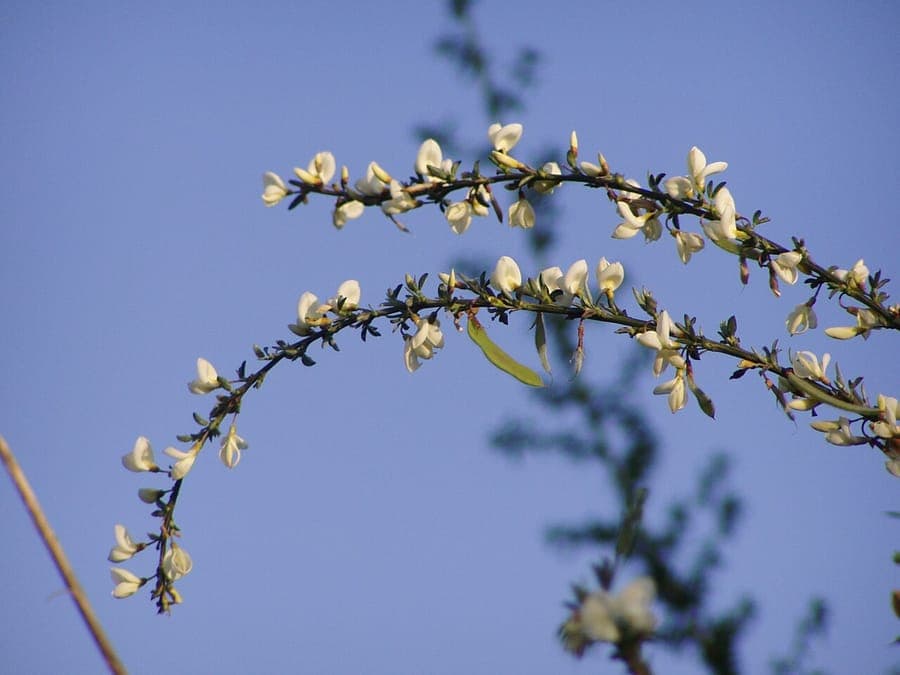
Júlio Reis / CC BY-SA 3.0, via Wikimedia Commons
White spanish broom: complete guide
Cytisus multiflorus
Want to see White spanish broom: complete guide in your garden?
1 minute, no credit card
Overview
White Spanish broom (Cytisus multiflorus) is a tough, elegant shrub native to Portugal and Spain. It's a standout in dry, sunny gardens where few plants thrive. Reaching 150–250 cm in height and spreading 120–180 cm wide, it brings airy structure and a burst of pure white flowers in late spring. If you're designing a Mediterranean-style garden or a drought-prone border, this shrub deserves a spot. On gardenworld.app, you can create a garden layout that highlights its light texture and seasonal rhythm.
Appearance & bloom cycle
This shrub has slender, green first-year stems that mature to gray-brown. The leaves are trifoliate, small (2–3 cm), and light green, giving a fine, open texture. From April to June, it's covered in clusters of white, pea-like flowers. Each flower is about 1.5 cm long, sweetly scented, and loved by bees and bumblebees. After flowering, flat seed pods 4–7 cm long develop and persist into autumn. In dry weather, they pop open with a sharp crack - a satisfying sound in a quiet garden.
The plant grows upright at first, then spreads slightly with age. It doesn't branch heavily from the base, so give it space to develop its natural shape.
Ideal location
Plant White Spanish broom in full sun - aim for an 8/10 on the light scale. South- or southwest-facing spots work best. It hates shade, damp air, and competition from larger plants. Ideal for sandy soils, gravel gardens, or rocky slopes. Avoid low-lying areas where water collects. In the UK and northern Europe, it performs well in coastal gardens or urban settings with good airflow.
Note: This species can be invasive in some climates (e.g., parts of Australia). In temperate zones like USDA 8 and below, it's generally well-behaved, but keep an eye on seed spread, especially near wild areas.
Soil requirements
It thrives in well-drained, acidic to slightly acidic soil with a pH of 4.5–5.0. Sandy or loamy sand is perfect. If planting in clay, amend the hole with 20–30% horticultural grit or perlite to improve drainage. Avoid lime-rich soils - they cause chlorosis (yellow leaves with green veins).
As a member of the Fabaceae family, Cytisus multiflorus fixes nitrogen through root nodules. This means it enriches poor soils and supports future plantings. No fertilizer needed - in fact, too much nitrogen reduces flowering.
Free design
Want to see White spanish broom: complete guide in your garden? Make a free design now.
Watering
Water regularly during the first summer - about 10–15 liters per week during dry spells. After that, it's highly drought-tolerant. Established plants rarely need supplemental water, even in hot summers. Only during prolonged drought (3+ weeks without rain) should you give a deep soak.
Always water at the base. Overhead watering encourages fungal issues and doesn't reach deep roots. Drip irrigation works well if you're setting up a dry garden.
Pruning
Minimal pruning is needed. After flowering (late June to early July), cut back up to one-third of the flowering stems to maintain shape and encourage new growth. Never cut into old, woody stems - this plant doesn't resprout well from old wood.
Avoid pruning in autumn or winter - you'll remove next year's flower buds. Wear gloves and eye protection when pruning; seed pods can burst suddenly and fling seeds several meters.
Maintenance calendar
- Jan: Check for frost damage; remove broken stems.
- Feb: No action.
- Mar: Loosen soil around base; no feeding.
- Apr: Flowering begins; monitor for pests.
- May: Peak bloom; pollinators active.
- Jun: Prune lightly after bloom; seed pods form.
- Jul: No watering unless extreme drought.
- Aug: No maintenance.
- Sep: Do not prune; seeds ripening.
- Oct: Collect or remove pods to reduce self-seeding.
- Nov: Clear fallen debris.
- Dec: No care needed.
On gardenworld.app, you can generate a seasonal care plan that syncs with your local climate and garden layout.
Winter hardiness
Hardy to about -12°C (USDA zone 8). In most of the UK and western Europe, it survives winter well if the soil drains freely. Young plants may benefit from a mulch of gravel or straw around the base in harsh winters. Mature shrubs are self-sufficient.
Avoid wet, frozen soil - that's the real killer. If winters are mild but wet, consider planting on a slope or raised bed.
Companion plants
Pair with other drought-tolerant, sun-loving plants. Try Salvia officinalis (20–50 cm), Eryngium bourgatii (60–80 cm), Stipa tenuissima (40–60 cm), or Lavandula angustifolia. The white flowers contrast beautifully with silver foliage or purple blooms.
Avoid moisture-loving plants like Hosta or Astilbe. Also steer clear of aggressive groundcovers that might smother young shoots.
Closing
White Spanish broom is a reliable, low-fuss shrub for sunny, dry gardens. Its elegant form and clean white flowers make it a standout. Plant it right, prune it once a year, and it'll reward you for years. Buy it at garden centres like those in the UK or through online nurseries. And remember: on gardenworld.app, you can design a garden where Cytisus multiflorus plays a leading role.
Want to see White spanish broom: complete guide in your garden? Make a free design now.
Upload a photo, pick a style, and get a photorealistic design with plant list in under a minute.
No credit card required


Similar plants
Tall Silky Lupine: complete guide
Lupinus elatus
Tall silky lupine is a fast-growing Californian perennial with silvery foliage and blue-purple flower spikes, ideal for a prairie-style garden.
Garfield Lupine: complete guide
Lupinus garfieldensis
The Garfield lupine is a rare, fast-growing American perennial for alkaline, dry grassland gardens, with striking blue flower spikes.
Lupinus elegans: complete guide
Lupinus elegans
Lupinus elegans, the elegant lupine, is a spectacular blooming plant from Mexico with blue flower spikes. Care, cultivation and garden use.