
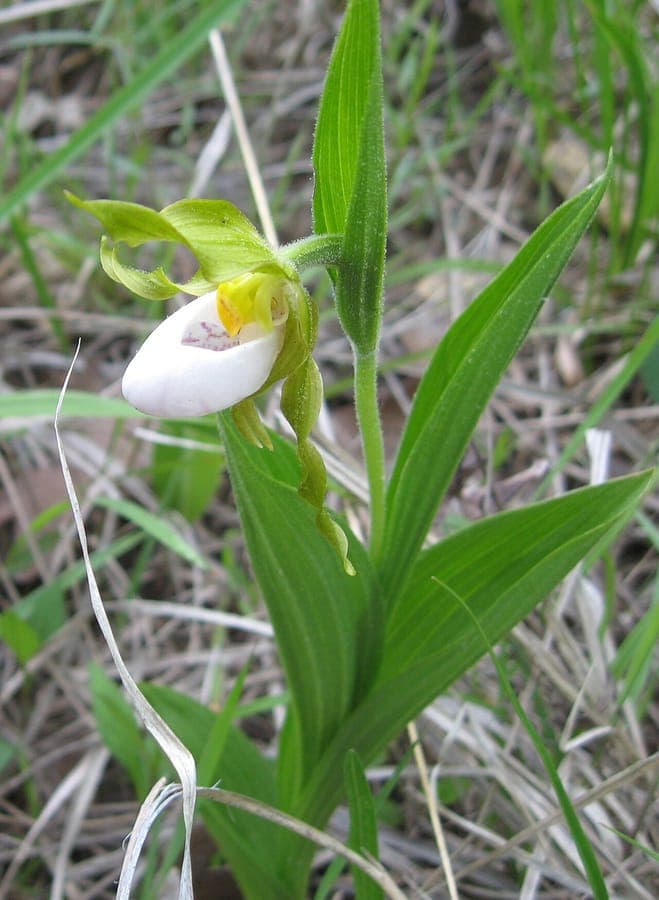
Mason Brock (Masebrock) / Public domain, via Wikimedia Commons
White lady's-slipper: complete guide
Cypripedium candidum
Want to see White lady's-slipper: complete guide in your garden?
1 minute, no credit card
Overview
The White lady's-slipper (Cypripedium candidum) is one of the most captivating and rare orchids of North America. This delicate flower distinguishes itself through its striking white-colored labellum that resembles a lady's slipper. It commands respect through its elegance and rarity. This orchid grows naturally in wetlands and wet meadows of the American Midwest and Canada, where it holds an important place in the ecosystem. Protected areas in Wisconsin, Michigan, and Ontario harbor most remaining wild populations. This plant appears on many threatened species lists due to habitat loss and illegal collection. Growing it in gardens helps preserve this beautiful species for future generations.
Appearance and Bloom Time
The White lady's-slipper reaches a height of 20 to 60 centimeters with two to four elongated leaves. The flowers appear from May to June with usually just one to two flowers per plant, sometimes three. The flowers are truly enchanting: the white pouch (labellum) is surrounded by green to brownish sepals and petals with deep red veins. The flower structure is perfectly adapted for pollination by specific bee species, particularly Andrena bees. Each specimen can produce only a few flowers per season, which increases the value of each bloom. The flowers can bloom for two to three weeks under optimal conditions. Even after flowering, the pseudobulbs remain ornamental with their delicate leaves. The contrast between white and red creates stunning visual interest in spring gardens.
Ideal Growing Location
This orchid thrives best in locations with moist soil and partial shade. In the front garden, choose a spot under deciduous trees where filtered light comes through. An east or north-facing location is ideal, especially in warmer climates. Avoid direct full sun as it can scorch the leaves. In temperate climates (zones 4-6), this plant can grow outdoors if conditions are optimal. Provide good air circulation while avoiding drafts that promote disease. In regions with very cold winters (zone 3), protection with heavy mulch may be needed, although the plant sometimes does better in carefully protected pots. The location should remain consistently moist year-round through natural precipitation or supplemental watering.
Soil Composition
The soil must be very well-draining yet consistently moist. This seems contradictory but is essential. A mixture of heavy sandy soil with peat moss, leafmould, and coarse bark in proportions of 30% heavy soil, 30% peat moss, 20% leafmould, and 20% bark gives excellent results. A pH of 5.5 to 7.0 is ideal. It is essential that the soil never completely dries out but also never has stagnant water. Adding orchid bark and processed humus improves aeration around the roots significantly. Some growers also mix fine gravel through the medium for extra drainage. Testing with a moisture meter helps maintain ideal conditions consistently.
Free design
Want to see White lady's-slipper: complete guide in your garden? Make a free design now.
Watering
Watering must be done carefully. During the growing season (spring and summer), the soil should be consistently moist but not wet. Use rainwater or distilled water to prevent mineral buildup. In fall and winter, the soil can be slightly drier but must never completely dry out. Check regularly with your finger if the soil feels moist at several centimeters depth. In very hot summers, daily misting of leaves with fine spray can help. Prevent water from sitting on the heart of the plant where rot can occur. Consider installing a simple watering system with consistent moisture control for best results.
Pruning
Pruning is minimal. Only remove dead leaves and damaged parts with clean, sterilized shears. After blooming, flowering stems can be carefully removed where they emerge from the plant. Plants grow slowly and need much time to recover from drastic pruning work. Let the plant maintain its natural form. Check regularly for fungal infections or aphids that can attack these delicate plants. Remove any diseased foliage immediately to prevent spread.
Maintenance Calendar
Spring: Begin with moderate orchid fertilizer application (half strength). Check for fungal infections from the winter period. Summer: Maintain consistent moisture. Feed monthly. Check regularly for pests. Fall: Gradually reduce watering. Stop fertilizing in September. Check once more for pests. Winter: Keep dry and cool, ideally between 5 and 10 degrees Celsius. This cold period is essential for flower bud formation. Ensure the plant is not in direct drafts.
Winter Hardiness
The White lady's-slipper is reasonably hardy in zones 4-6 when correctly planted. In harsher winters (zone 3 and colder), it requires protection with mulch or will grow better in a pot that you can protect. In warm regions, it thrives better in cooled greenhouse conditions. Protect young plantings extra with organic mulch. Avoid protection that can retain moisture around the leaves. In very harsh zones, growing in pots indoors offers the most reliable success for year-round enjoyment.
Companion Plants
This species grows perfectly alongside other moisture-loving plants. Ideal companions are ferns, especially Thelypteris, Polystichum species and low Astilbe cultivars. Combine with Primula japonica, Carex nigra and woodland plants like Maianthemum. This composition creates a natural woodland environment where the orchid thrives optimally. Ensure that larger plants do not cast excessive shadow during blooming time. The interplay of different textures and colors makes for a harmonious, natural-looking display.
Conclusion
The White lady's-slipper from gardenworld.app is a plant for the patient gardener who values patience and care. With the right growing conditions and consistent maintenance, you can enjoy its rare, elegant flowers for years. This orchid deserves a special place in every front garden through its rarity and beauty. Visit gardenworld.app for more information about creating the perfect conditions for your delicate orchids and other rare native plants.
Want to see White lady's-slipper: complete guide in your garden? Make a free design now.
Upload a photo, pick a style, and get a photorealistic design with plant list in under a minute.
No credit card required


Similar plants
Ram's-head lady's slipper: complete guide
Cypripedium arietinum
Everything you need to know about growing Cypripedium arietinum, a rare woodland orchid for cool, moist garden settings. Soil, care and planting tips.
Sparrow's-egg lady's slipper: complete guide
Cypripedium passerinum
Everything about growing Cypripedium passerinum, a cold-hardy subarctic orchid suited to cool, moist, shaded garden spots. Soil, care and companion plants.
Algerian Butterfly-orchid: complete guide
Platanthera algeriensis
Everything about Platanthera algeriensis, the rare Mediterranean orchid with greenish flowers native to Algeria, Morocco, Corsica and Spain.