
Wikimedia Commons / Public domain, via Wikimedia Commons
Cyperus serotinus: complete guide
Cyperus serotinus
Want to see Cyperus serotinus: complete guide in your garden?
1 minute, no credit card
Overview
Cyperus serotinus, commonly called Tidal Marsh Flat Sedge, is a decorative sedge from the Cyperaceae family. This grass-like plant grows naturally in temperate Eurasian regions, distributed from Afghanistan to Vietnam and across the Mediterranean. The plant flowers late in the season (July-September), producing characteristic brown inflorescences that distinguish it among water plants.
Appearance and Bloom
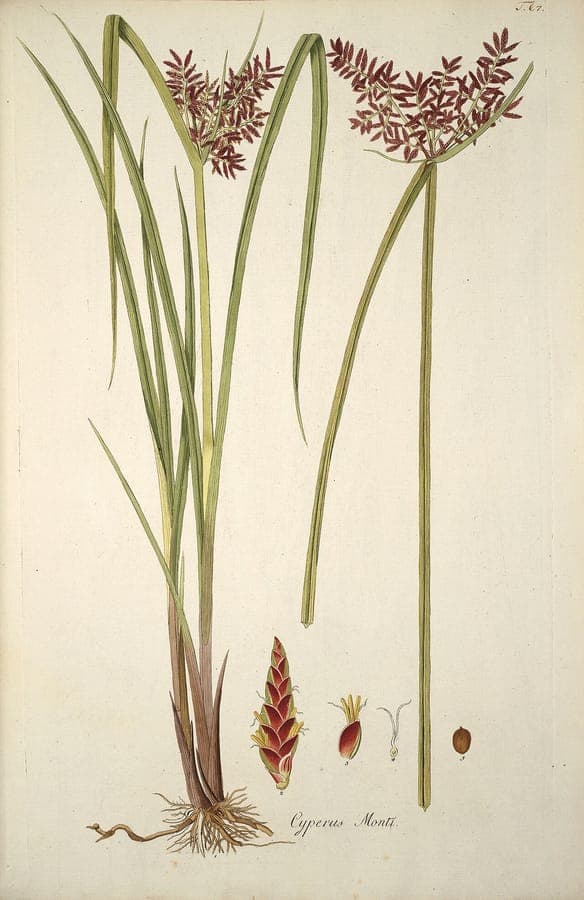
The plant exhibits graminoid growth with slender, strap-like foliage. Blooms appear in rich brown hues, creating an unusual visual among typical wetland vegetation. Leaf texture remains fresh green throughout the growing season. The plant achieves moderate height and forms compact clumps at waterside locations.
Ideal Location
Tidal marsh flat sedge thrives along water margins, marshy areas, and semi-aquatic zones. The plant requires high atmospheric humidity (8 on 10-scale) and full sun to partial shade. Position near artificial ponds, rain gardens, or woodland edges where water remains accessible year-round.
Soil
This sedge prefers neutral to slightly acidic substrate (pH 6.5-7). Soil nutrient content should be moderate (5 on 10-scale) with minimal salinity stress. Water drainage is essential; clay loam works but should alternate with gravel for porosity.
Watering
Maintain consistent moisture without waterlogging. During growing seasons (spring-summer) water 2-3 times weekly. In dry spells check daily. Winter requires drier conditions without complete desiccation.
Free design
Want to see Cyperus serotinus: complete guide in your garden? Make a free design now.
Pruning
Minimal pruning required. Remove dead foliage in spring (March-April) to encourage new growth. After flowering, reduce rhizomes to 5 centimeters above soil surface. Allow wild growth as it mimics natural appearance.
Maintenance Calendar
May: Begin growth season, regular watering. June-July: Prepare for flowering, monitor moisture. August-September: Active bloom period, provide support. October-November: Reduce watering, prepare dormancy. December-February: Minimal care, water only in extreme drought. March-April: Clean up, resume regular maintenance.
Winter Hardiness
Cyperus serotinus shows average hardiness for temperate climates. In North European zones it survives frost to -5 degrees if roots don't freeze solid. In southern areas (Netherlands, Flanders) winter protection rarely needed. Artificial ponds 60+ centimeters deep provide sufficient frost protection.
Companion Plants
Pair Cyperus serotinus with reeds (Phragmites), spiranthes, and swamp cypress (Taxodium). Smaller species like watermint and buttercup form harmonious understory. In garden ponds, combine with yellow primrose and purple loosestrife for striking contrast.
Final Thoughts
Tidal marsh flat sedge deserves greater attention in wet-zone designs. With modest care requirements and extended bloom period, this sedge offers ecological value and visual character. Plant generously along waterbanks for maximum effect and low-maintenance greenery. Available at Intratuin and Gamma.
Explore more water plants and sedge varieties on gardenworld.app for design inspiration and detailed plant guides!
Want to see Cyperus serotinus: complete guide in your garden? Make a free design now.
Upload a photo, pick a style, and get a photorealistic design with plant list in under a minute.
No credit card required


Similar plants
Flat-stemmed club-rush: complete guide
Bolboschoenus planiculmis
Everything about Bolboschoenus planiculmis: growing conditions, watering, care, and use as a pond margin or wetland plant in garden design.
Great Plains flatsedge: complete guide
Cyperus lupulinus
Everything about Great Plains flatsedge (Cyperus lupulinus): growing conditions, care, garden uses, and ecological value. Tips for pond margins and dry sandy soils.
Golden beak sedge: complete guide
Rhynchospora corymbosa
Everything about golden beak sedge (Rhynchospora corymbosa): a dramatic tropical marginal for pond edges, bog gardens, and wet habitats.