
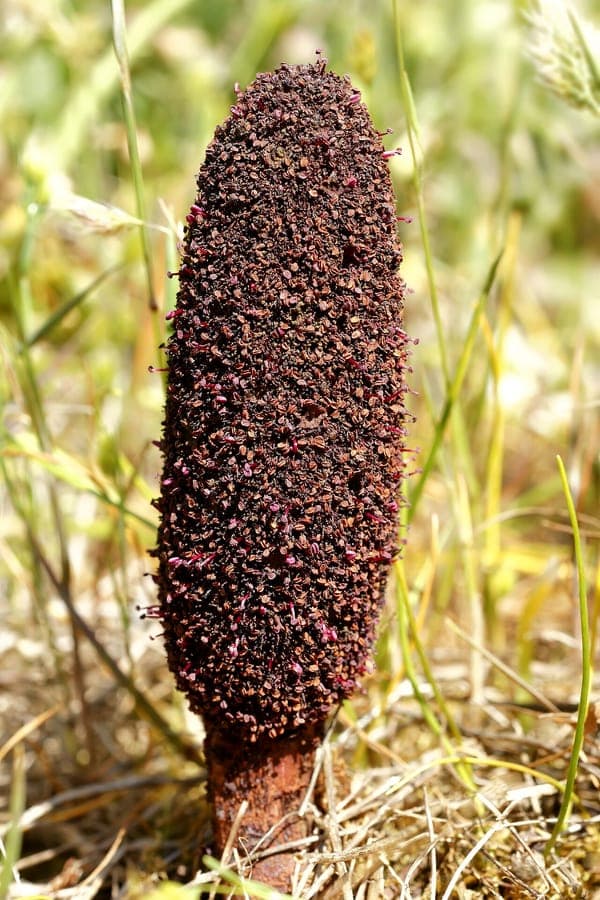
Hans Hillewaert / CC BY-SA 3.0, via Wikimedia Commons
Scarlet synomorium: complete guide
Cynomorium coccineum
Want to see Scarlet synomorium: complete guide in your garden?
1 minute, no credit card
Cynomorium coccineum, commonly known as Maltese mushroom or Scarlet synomorium, is an extraordinary plant that defies convention. This rare parasitic species produces stunning scarlet-red flower clusters and thrives in Mediterranean and semi-arid climates across Africa, the Middle East, and Central Asia.
Overview
Cynomorium coccineum is a completely parasitic plant from the family Cynomoriaceae. Unlike typical plants, it lacks leaves and true roots. Instead, it infiltrates host plants to extract nutrients. Native to Mediterranean regions and extending eastward to Mongolia, this plant demonstrates remarkable evolutionary adaptation. Its presence ranges from the Canary Islands through North Africa to the Middle East.
Appearance and Bloom
The most distinctive feature is the dense, vertical spike of scarlet-red flowers and fruits, reaching 5-15 centimeters in height. These compact flower heads are remarkable in color intensity. Individual flowers are tiny but densely packed into a thick, fleshy inflorescence. The plant blooms spring (March-May) when temperatures warm. Fruit development follows, creating small, fleshy nodules that attract birds for seed dispersal.
Ideal Location
This plant demands warm, dry conditions with full sun exposure. It thrives in Mediterranean gardens and semi-arid zones where humidity remains low. Choose open, south-facing positions without shade. The plant requires host plants: various mustard family members (Brassicaceae) work well. Most host species include sea rocket, charlock, and wild radish, though the parasite adapts to multiple hosts.
Soil
While soil composition matters less than host plant availability, Cynomorium coccineum prefers well-draining soil. Neutral to alkaline pH (7.5-8.0) suits it well. Limestone-rich soils present no problem. Sandy, gravelly mixes enhance drainage for both parasite and hosts. Compact, clay-heavy soils should be amended with sand and gravel before planting.
Free design
Want to see Scarlet synomorium: complete guide in your garden? Make a free design now.
Watering
Minimal watering is needed. This plant evolved in semi-arid regions where annual rainfall is sparse. Natural precipitation typically suffices. Overwatering damages host plants and invites disease. Only during extended droughts (8+ weeks without rain) provide supplemental water to host plants. The parasite absorbs moisture through its host, making direct watering less critical.
Pruning
No pruning is required. Simply allow natural growth and seed dispersal. Remove dead host plant material to prevent disease. Dead flower spikes can be left to feed birds or removed for neatness. The plant's entire life cycle is managed through its host plant's health and vitality.
Maintenance Calendar
Spring (March-May): Monitor flowering and host plant vigor. Check for diseases or pests on hosts. Summer (June-August): Minimal activity needed. Water hosts only during extreme drought. Autumn (September-November): Seeds ripen and disperse naturally via birds. Winter (December-February): Remove dead material. Prepare host plants for the next season.
Winter Hardiness
In true Mediterranean climates, Cynomorium coccineum persists well. In northern European regions (UK, Netherlands, Belgium), it lacks winter hardiness. Temperatures below -5°C can kill the plant. It survives in USDA zones 9-11 without protection. In zone 8 and colder, provide shelter or grow in containers indoors during winter. Garden centers often stock this as an exotic curiosity plant.
Companion Plants
Host plants are the true companions. Sea rocket, charlock, wild mustard, and other Brassicaceae work perfectly. Mediterranean regions support diverse host options. The parasite-host relationship creates fascinating micro-ecosystems worth observing. Position hosts in the same sunny, dry location where you want the parasite to flourish.
Closing
Cynomorium coccineum represents one of nature's most intriguing botanical adaptations. With proper host plants and minimal care, this rare Mediterranean native provides years of visual interest. It rewards gardeners seeking unusual, ecologically significant plants with unforgettable scarlet displays that showcase nature's creative solutions to survival.
Want to see Scarlet synomorium: complete guide in your garden? Make a free design now.
Upload a photo, pick a style, and get a photorealistic design with plant list in under a minute.
No credit card required


Similar plants
Acer pycnanthum: complete guide
Acer pycnanthum
Acer pycnanthum, the Japanese swamp maple, is a fast-growing tree with early red flowers and brilliant autumn color, ideal for damp garden settings.
Freeman maple: complete guide
Acer × freemanii
Everything about the Freeman maple (Acer x freemanii): a fast-growing shade tree with spectacular autumn colour for large gardens.
Silver vine: complete guide
Actinidia polygama
Discover silver vine (Actinidia polygama): a hardy climbing plant with silvery foliage, loved by gardeners and cats alike.