
Fornax / CC BY-SA 3.0, via Wikimedia Commons
Hound's-tongue: complete guide
Cynoglossum officinale
Want to see Hound's-tongue: complete guide in your garden?
1 minute, no credit card
Overview
Hound's-tongue (Cynoglossum officinale) is a biennial herb in the Boraginaceae family, native to large parts of Central and Eastern Europe. Though not commonly found in ornamental gardens, it holds value in wildflower meadows and naturalistic plantings. It grows up to 60 cm tall and forms a rosette of broad, rough leaves in its first year, followed by a flowering stem in the second. The plant thrives in disturbed soils, woodland edges, and dry slopes, making it ideal for low-maintenance or rewilded garden corners.
Despite its modest appearance, Hound's-tongue plays a role in supporting pollinators and adds texture with its unique foliage. It self-seeds via burr-like fruits that stick to clothing and animal fur-a trait to manage if you prefer a tidy border. On gardenworld.app, you can design a planting scheme that accommodates self-seeding plants like Hound's-tongue without letting them dominate.
Appearance & bloom cycle
In year one, Hound's-tongue develops a basal rosette of lance-shaped, dark green leaves up to 30 cm long. The leaves are densely covered in short, stiff hairs, giving them a sandpapery texture. They remain green through winter in milder climates.
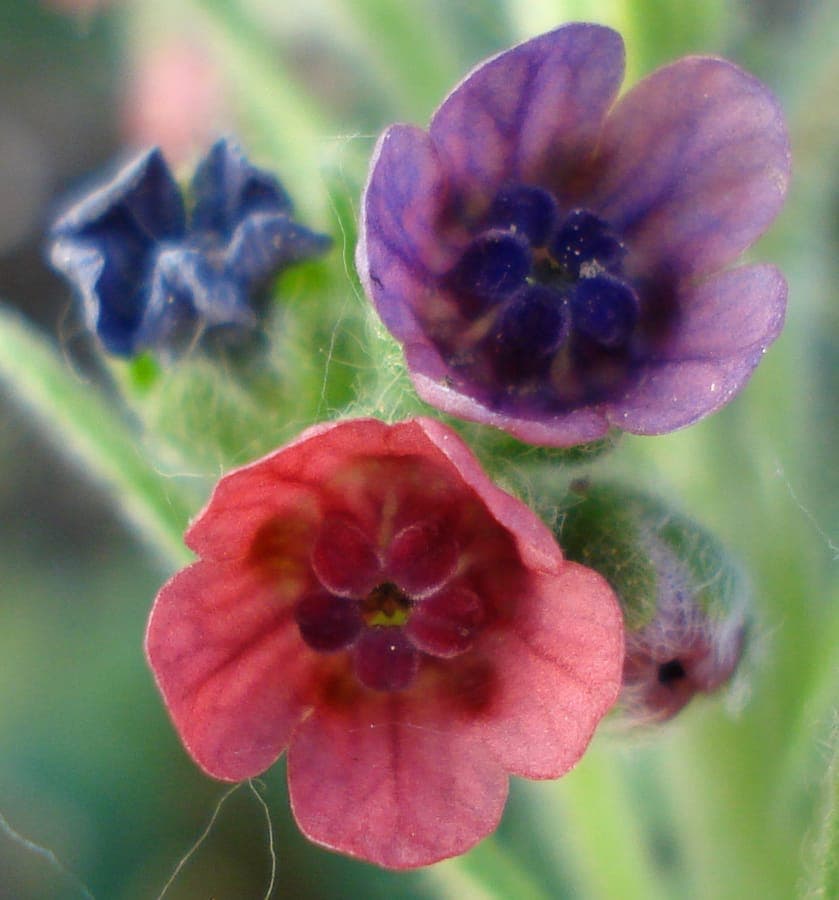
In late spring, a single flowering stem emerges, reaching 40–60 cm. From May through July, clusters of small, nodding, bell-shaped purple flowers open along a coiled inflorescence. Each flower is about 1 cm wide, with five notched lobes. The bloom period lasts 6–8 weeks, peaking in June. After flowering, the calyx swells and forms four nutlets with hooked prickles-classic burs that ensure wide dispersal.
Ideal location
Hound's-tongue prefers partial shade to light sun, scoring a 7 on a 1–10 light scale. That means 4–6 hours of dappled or morning sun per day. Full sun is acceptable if the soil retains moisture; deep shade will stunt growth and reduce flowering.
It suits woodland gardens, wild edges, or gravel beds with native companions. Avoid high-traffic areas due to its clingy seeds. This plant works well under open shrubs or along fence lines where its spread can be monitored. Use gardenworld.app to map out a planting plan that balances its naturalizing habit with structured garden zones.
Soil requirements
Well-drained, humus-rich soil is ideal. Hound's-tongue tolerates clay and sandy loams but performs best in neutral to slightly alkaline conditions (pH 7.0–7.5). Avoid waterlogged or highly acidic soils (below pH 6.0), as these hinder root development.
Amend heavy soils with compost to improve aeration. Light sandy soils benefit from organic matter to retain moisture. Once established, the plant develops a deep taproot, helping it survive dry spells.
Free design
Want to see Hound's-tongue: complete guide in your garden? Make a free design now.
Watering
During the first growing season, keep the soil consistently moist but not soggy. Water weekly during dry spells, especially in spring. Established plants are drought-tolerant and rarely need supplemental watering.
Avoid overhead watering if possible, as wet foliage can encourage fungal issues in humid conditions. Use soaker hoses or water at the base. Rainwater is preferred, as Hound's-tongue can be sensitive to high levels of lime in tap water over time.
Pruning
Pruning isn't required, but deadheading before seeds form prevents unwanted spread. Cut the flowering stalks at the base in late July to early August. Leave the basal rosette intact-it survives winter and fuels next year's growth.
In autumn, remove dead stems and debris to keep the area tidy. Compost healthy material; dispose of any diseased foliage to prevent overwintering pests.
Maintenance calendar
- January: No action needed. Check for slug damage on rosettes in mild winters.
- February: Prepare planting beds. Add compost to improve soil structure.
- March: Sow seeds in pots or directly in the ground. Keep moist until germination.
- April: Transplant seedlings to final positions. Space 30–40 cm apart.
- May: Flowering begins. Monitor for aphids on new stems.
- June: Peak bloom. Attracts bumblebees and nocturnal moths.
- July: Cut back spent flower stalks to limit self-seeding.
- August: Watch for new seedlings. Thin or relocate if overcrowded.
- September: Minimal care. Ensure plants aren't shaded out by taller perennials.
- October: Clear dead material. Apply a light mulch if desired.
- November: Add a top dressing of compost for nutrients.
- December: Dormant period. No maintenance required.
Winter hardiness
Hound's-tongue is hardy in USDA zones 5–8. It overwinters reliably in most of the UK, Ireland, and the northern US. The basal rosette often stays green through winter, acting as an energy store.
In zone 5, a light mulch of straw or leaf litter can protect young plants during prolonged freezes below -15°C. Mature plants usually survive without protection.
Companion plants
Pair Hound's-tongue with shade-tolerant perennials like Alchemilla mollis, Digitalis purpurea, or Athyrium filix-femina. It also complements late-blooming species such as Echinacea and Monarda, creating layered interest.
Avoid aggressive spreaders or dense groundcovers that might smother its rosette. Give it breathing room to develop in year two.
Closing
Hound's-tongue won't win prizes at flower shows, but it brings quiet resilience and ecological value to the garden. Its rough foliage, subtle purple blooms, and wildlife appeal make it a thoughtful choice for naturalistic designs. Manage its spread with timely pruning, and embrace its rustic charm. Seeds or young plants are occasionally available at garden centres like those from Truffaut or Jardiland, often in wildflower or native plant collections.
Want to see Hound's-tongue: complete guide in your garden? Make a free design now.
Upload a photo, pick a style, and get a photorealistic design with plant list in under a minute.
No credit card required


Similar plants
Western waterleaf: complete guide
Hydrophyllum occidentale
Full growing guide for western waterleaf (Hydrophyllum occidentale): shade tolerance, soil needs, watering, winter hardiness and naturalistic garden use.
Limestone phacelia (Phacelia affinis): complete guide
Phacelia affinis
Full guide to Phacelia affinis, the limestone phacelia: sowing tips, purple-blue bee flowers, drought tolerance and uses in dry or wildlife gardens.
Pyrenean viper's bugloss: complete guide
Echium asperrimum
Echium asperrimum is a striking biennial from the western Mediterranean with rough bristly stems and vivid blue flowers. A magnet for bees and a bold border plant.