
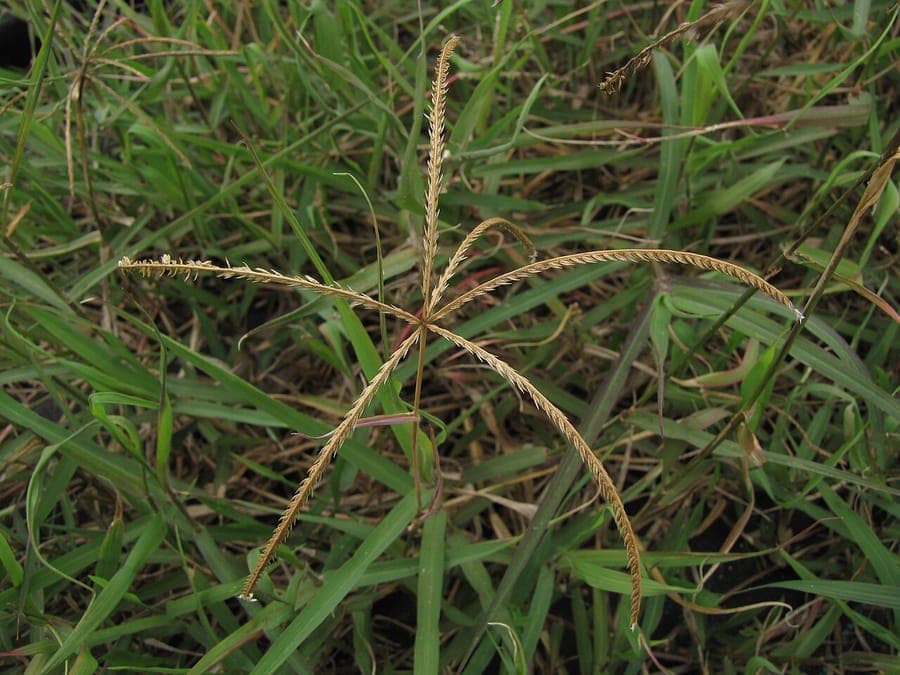
Forest and Kim Starr / CC BY 3.0 us, via Wikimedia Commons
African stargrass: complete guide
Cynodon nlemfuensis
Want to see African stargrass: complete guide in your garden?
1 minute, no credit card
Overview
African stargrass - botanically Cynodon nlemfuensis - is a vigorous, creeping member of the grass family (Poaceae) native to eastern and central tropical Africa. The species is indigenous to Ethiopia, Kenya, Tanzania, Uganda, Rwanda, Burundi and Zimbabwe, where it occupies savanna grasslands and riverbanks. Beyond its native range it has become naturalised across much of tropical and subtropical America, Australia and parts of Asia.
For gardeners in warmer climate zones, Cynodon nlemfuensis is of considerable interest as a resilient lawn and ground-cover plant. It spreads via stolons (above-ground runners) and rhizomes (underground stems), rapidly forming a dense green carpet that suppresses weeds effectively. On gardenworld.app you can explore garden designs that demonstrate how ground-cover grasses like this create low-maintenance, green surfaces in hot, dry settings.
Compared with common bermudagrass (Cynodon dactylon), Cynodon nlemfuensis has broader, larger leaves and a more robust growth habit. This makes it particularly well suited as a forage crop and for use on sports fields in tropical and subtropical environments. Also known as Rhodesian stargrass, robust stargrass and African bermudagrass, this species was formally described by Vanderyst in 1922.
Appearance and bloom cycle
Cynodon nlemfuensis is a low-growing, perennial plant that typically reaches 30 to 60 cm in height when allowed to grow freely, but when regularly mown as a lawn it is kept at 3 to 8 cm. The stems are creeping to ascending, with nodes that readily root on contact with soil - a feature that explains the rapid spread.
The leaves are lanceolate to strap-shaped, 3 to 15 mm wide and 5 to 25 cm long, darker green than most other Cynodon species. The leaf sheaths are ribbed and the ligule is a fringe of short hairs. The colour is a vivid, sometimes blue-green that distinguishes the plant from related species.
The inflorescence consists of three to seven finger-like spikes arranged in a star pattern at the top of the flowering stem - hence the common name stargrass. In its tropical homeland the plant blooms multiple times per year, with peak periods in the wet seasons. In subtropical and Mediterranean environments it flowers during summer, typically from June to September. The small spikelets are white to light purple and characteristically arranged.
After flowering, the above-ground parts die back in cold weather, but the underground rhizomes survive temperatures down to about -3 to -5 degrees Celsius, provided the soil does not freeze deeply and the roots are protected with a layer of mulch.
Ideal location
African stargrass thrives best in an open, sunny position. The plant requires full sun exposure for optimum growth and density: in shade the cover becomes thin and patchy. For use as a ground cover or low lawn alternative, choose a south-facing, well-drained spot.
The plant tolerates foot traffic reasonably well - a quality that makes it suitable for paths, play lawns and sports fields in warmer climates. It recovers quickly from trampling thanks to its robust network of stolons. In temperate climates such as those of northern Europe, Cynodon nlemfuensis is only viable in sheltered, warm microclimates such as a south-facing wall border or a covered courtyard garden.
Optimal growing conditions include temperatures of 25 to 35 degrees Celsius. Below 10 degrees growth slows dramatically and the plant turns yellow to brown. In USDA zones 8 to 10 it survives as a perennial; in cooler zones it should be treated as an annual or grown in containers that can be moved indoors.
Soil
The species makes few demands on soil. Cynodon nlemfuensis grows on sandy, loamy and even light clay soils, provided drainage is adequate. Permanent waterlogging is poorly tolerated. A pH of between 5.5 and 7.5 is suitable, but the plant shows a preference for slightly acid to neutral soils.
For planting as a lawn or ground cover, it is sufficient to cultivate the soil shallowly (10 to 15 cm deep), remove any weed roots and incorporate some well-rotted compost if available. Heavily fertilised, nitrogen-rich soils promote lush, dark-green foliage but can also increase disease susceptibility.
In its African homeland the plant grows on diverse soils, from poor laterite to relatively fertile alluvial river deposits. That soil flexibility makes it an easy-to-establish plant in less-than-ideal garden spots.
Watering
Once established, African stargrass is remarkably drought tolerant. Deep roots and rhizomes give the plant access to moisture deeper in the soil, and the stolons allow rapid recovery after dry periods. This makes the species ideal for gardens where water-saving management is a priority.
During establishment - the first four to eight weeks - regular watering is essential. In dry weather, water every two to three days until the roots are well anchored. After establishment the frequency can be substantially reduced.
During the active growing season in a temperate climate, normal rainfall is usually sufficient. During prolonged drought (two or more weeks without significant rain), water to prevent stress symptoms: yellowing foliage or drooping stolons are signs. In the dormant period or cold weather, additional water is almost never needed.
On gardenworld.app you will find inspiration for water-efficient garden designs centred on drought-tolerant ground covers such as this one.
Free design
Want to see African stargrass: complete guide in your garden? Make a free design now.
Mowing and trimming
Cynodon nlemfuensis used as a lawn or ground cover requires regular mowing for a tidy appearance. As a lawn, keep it at 3 to 5 cm height. During the growing season (in warmer climates from April to October), mow every one to two weeks. Do not allow the plant to become too tall before mowing, as scalping (cutting below 2 cm) damages it.
For use as a ground cover you can let it grow somewhat taller, typically 8 to 15 cm. Edge management is important: the plant spreads aggressively via its stolons and can cross borders into other planting beds. Use a solid edging strip or re-cut the edge every two to three months.
In winter or cold weather, when the plant is semi-dormant, a light clean-up to remove dead, brown foliage is all that is needed. Wait until the first new green shoots appear in early spring before carrying out more thorough tidying.
Maintenance calendar
March-April: Inspect the cover after winter. Remove dead, dried foliage. Fill in any bare patches with stolon cuttings or plug plants. Water during prolonged dry spells to encourage early growth.
May-June: Growth accelerates as temperatures rise. Begin regular mowing. Apply a nitrogen-based fertiliser if needed to encourage dense cover. Check edges and re-cut where necessary.
July-August: Peak growth period. Mow weekly in heat. Watch for drought stress: yellowing foliage or limp stolons signal the need for water. Remove any weeds that push through the cover.
September-October: Growth slows. Reduce mowing frequency. Allow the plant to reach a slightly taller winter height (8 to 10 cm) for better cold tolerance. Apply mulch over the root zone in cooler zones.
November-February: In warmer areas, limited growth and occasional mowing. In temperate climates, rhizome dormancy. Keep the soil lightly moist.
Winter hardiness
Cynodon nlemfuensis is less cold-tolerant than its close relative Cynodon dactylon. The plant survives light frost (down to about -3 degrees Celsius) when roots are protected, but loses all above-ground green colour in cold weather. Rhizomes can generally tolerate -5 degrees Celsius provided the soil does not freeze deeply.
In USDA zone 8 and warmer the plant can be grown as a perennial, but recovery after a cold winter may be slow. In USDA zone 7 and below, Cynodon nlemfuensis is best treated as an annual or grown in containers that are moved indoors for winter.
For gardeners in the Netherlands and Belgium (predominantly USDA zones 7 to 8), the plant can be considered a not-entirely-reliable perennial in sheltered, warm locations (urban gardens, courtyard gardens, spots next to heated building facades). In mild winters it survives well; in harsh winters (below -8 degrees Celsius) even the rhizomes may freeze and die. A thick layer of mulch (10 to 15 cm of leaves or straw) over the root zone greatly improves survival chances. Good garden centres stock this plant alongside drought-tolerant lawn alternatives.
Companion plants
Cynodon nlemfuensis works well as underplanting or a lawn alternative beneath or beside drought-tolerant, warm-climate plants. Good combinations in a warm, sunny garden include:
Agave or Yucca as structural plants with the stargrass as a low carpet around them gives a stylish, low-maintenance design. Lavandula (lavender) and fine-leaved Festuca cultivars match well in colour and site requirements. Rosemary (Salvia rosmarinus) is an excellent companion: both plants love sun and free-draining soil.
In larger gardens you can use Cynodon nlemfuensis as a transition between hard surfaces and planted areas. The low, dense growth habit makes a fine edge beside stone paths or terraces. Avoid combining with shade plants or moisture-loving species: the conflicting site requirements cause problems for one or both plants.
On gardenworld.app you can see how drought-resistant ground covers are combined in clever garden designs with height-providing accent plants and flowering perennials.
Closing
Cynodon nlemfuensis, African stargrass, is a robust, adaptable plant that proves its worth as a ground cover and lawn alternative in warm, dry conditions. Its drought tolerance, rapid spread and traffic tolerance make it particularly suitable for low-maintenance gardens in warm climates.
In northern Europe the plant is available from specialist nurseries and garden centres that stock drought-tolerant perennials and lawn alternatives. Propagation is straightforward via stolon division: cut pieces of 10 to 15 cm bearing at least two nodes, press them into moist soil and water. In warm conditions they root within two to three weeks.
For anyone with a warm urban garden or sunny courtyard looking for a tough, low alternative to conventional lawn, African stargrass is an excellent choice - resilient, low-maintenance, and visually attractive with its fine, star-patterned flowering stems.
Want to see African stargrass: complete guide in your garden? Make a free design now.
Upload a photo, pick a style, and get a photorealistic design with plant list in under a minute.
10,000+ gardens designed already
No credit card required

