
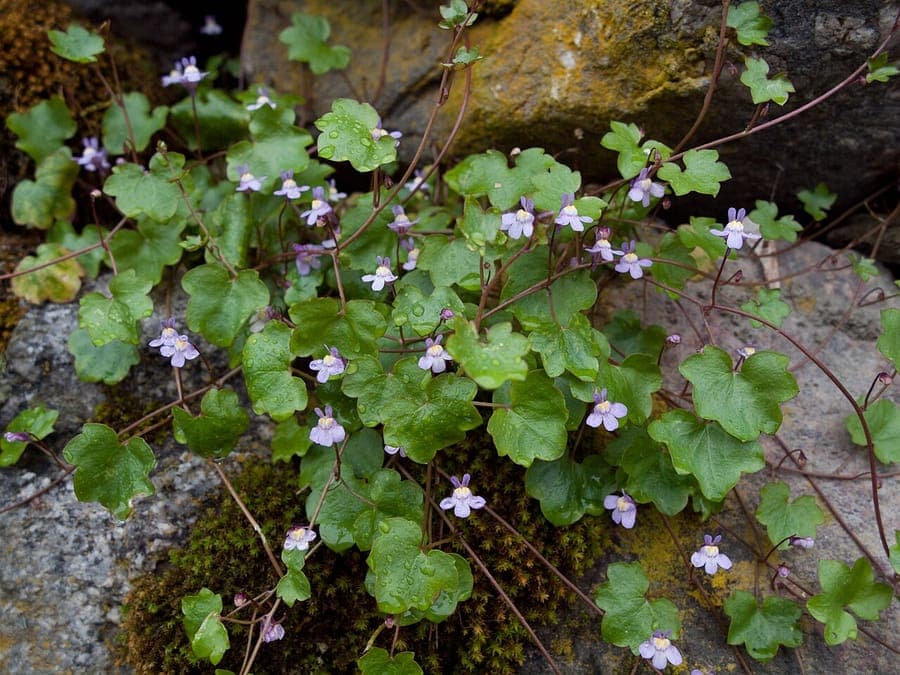
Franco Folini from San Francisco, USA / CC BY-SA 2.0, via Wikimedia Commons
Kenilworth ivy: complete guide
Cymbalaria muralis
Want to see Kenilworth ivy: complete guide in your garden?
1 minute, no credit card
Overview
Kenilworth ivy (Cymbalaria muralis) isn't a true ivy, but its trailing habit and lush foliage make the name stick. Native to Austria, France, Italy, and the Balkans, this charming forb has naturalised in many parts of the UK and US, often appearing spontaneously in stone walls, paving joints, and old garden steps. It's a hardy perennial in USDA zones 6–9, reaching 5–10 cm in height but spreading up to 30 cm, forming a delicate carpet of green with a long bloom season.
Unlike aggressive ground covers, Kenilworth ivy grows gently, filling gaps without overwhelming neighbours. It's perfect for gardeners who appreciate subtle texture and naturalistic planting. On gardenworld.app, you can design a rockery or wall planting scheme that highlights its cascading form and soft blue blooms.
Appearance & bloom cycle
The plant features small, heart-shaped leaves about 1–2 cm wide, deep green and slightly hairy. From May through October, it produces tiny snapdragon-like flowers in soft blue to pale lilac, each about 8 mm across. The blooms have a faint sweet scent, most noticeable on warm afternoons.
Flowering is prolonged, especially if deadheading is done regularly. In mild climates, you might even spot a few straggler blooms in November. The plant self-seeds modestly, so once established, it often returns year after year with little intervention.
Ideal location
Kenilworth ivy thrives in partial shade, scoring a 5 out of 10 on the light scale. It loves north- or east-facing walls, shaded patio cracks, or the edges of raised beds. Full sun is possible, but only if the soil or crevice retains some moisture. In hot, dry southern exposures, the plant may scorch or go dormant early.
It's an excellent choice for heritage gardens, cottage walls, or anywhere you want a soft, aged look. On gardenworld.app, you can simulate how this plant drapes over aged stone or weaves through gravel pathways.
Avoid deep shade – too little light results in sparse growth and few flowers.
Soil requirements
This plant prefers alkaline, well-drained soil with a pH of 7.5–8.0. It naturally grows in limestone crevices, so gritty, sandy mixes work best. Avoid heavy clay or waterlogged soils, which lead to root rot.
For container planting, use a mix of potting soil, coarse sand, and fine gravel. Ensure pots have drainage holes. In walls or paving, no extra soil is needed – the plant survives on minimal organic matter in mortar joints.
Free design
Want to see Kenilworth ivy: complete guide in your garden? Make a free design now.
Watering
Once established, Kenilworth ivy is drought-tolerant. Water weekly during extended dry spells in summer, but let the soil dry between waterings. Overwatering is a bigger risk than underwatering.
When growing in hanging baskets, check moisture levels weekly – the top 2 cm of soil should feel dry before watering. Water at the base to prevent fungal issues on leaves.
Pruning
Pruning isn't essential, but a light trim in midsummer (July) encourages bushier growth. Pinch back leggy stems or remove spent flowers to prolong blooming. In early spring, cut back any winter-damaged foliage to make way for fresh growth.
Avoid heavy pruning – the plant recovers slowly if cut too hard.
Maintenance calendar
- Jan: Check for frost damage; leave dead foliage as insulation
- Feb: Monitor for early growth; no action needed
- Mar: Trim dead stems; apply light alkaline feed
- Apr: Plant cuttings or seedlings in crevices
- May: Blooms begin; watch for slugs
- Jun: Peak flowering; water during drought
- Jul: Trim lightly for denser growth
- Aug: Continue deadheading
- Sep: Allow some seeds to ripen for self-sowing
- Oct: Flowering fades; reduce watering
- Nov: Protect from wet, cold soil
- Dec: Minimal care; mulch lightly if needed
Winter hardiness
Hardy to USDA zone 6 (-23°C), Kenilworth ivy survives most UK and US winters. In zones 7–9, it often stays semi-evergreen. In colder areas, top growth may die back, but roots survive under snow or dry leaf mulch.
The main threat is wet, cold soil in winter – ensure good drainage. Avoid plastic covers, which trap moisture. Use dry bracken or straw instead.
Companion plants
Pair Kenilworth ivy with other wall-loving plants like Sedum acre, Aubrieta, or Thymus praecox. In containers, it complements dwarf lobelia or creeping veronica. Avoid aggressive spreaders like ivy or mint, which will smother it.
For layered planting, place it above taller ground covers like Ajuga or Heuchera, creating depth in wall gardens.
Closing
Kenilworth ivy is a quiet achiever – unobtrusive but reliable. It brings life to forgotten spaces: cracks, steps, and old masonry. With minimal care, it delivers months of soft colour and texture.
You'll find it at garden centres across the UK and US, often sold in small pots or alpine trays. Brands like Thompson & Morgan or local nurseries carry it. Plant in spring or early autumn, and let it settle in. On gardenworld.app, you can plan its placement alongside other low-growers for a seamless, natural look.
Want to see Kenilworth ivy: complete guide in your garden? Make a free design now.
Upload a photo, pick a style, and get a photorealistic design with plant list in under a minute.
No credit card required


Similar plants
White Beardtongue: complete guide
Penstemon albidus
Discover white beardtongue (Penstemon albidus) - elegant perennial with white to cream flowers. Drought-resistant, perfect for prairie and dry gardens.
Longsepal Beardtongue: complete guide
Penstemon calycosus
Discover longsepal beardtongue (Penstemon calycosus) - beautiful perennial with lilac-blue flowers. For partial shade and moist soil. Ideal for naturalized.
Penstemon cusickii: complete guide
Penstemon cusickii
Discover Cusick's beardtongue, a compact alpine flowering plant with violet-pink blooms. Perfect choice for rock gardens and water-wise landscaping.