
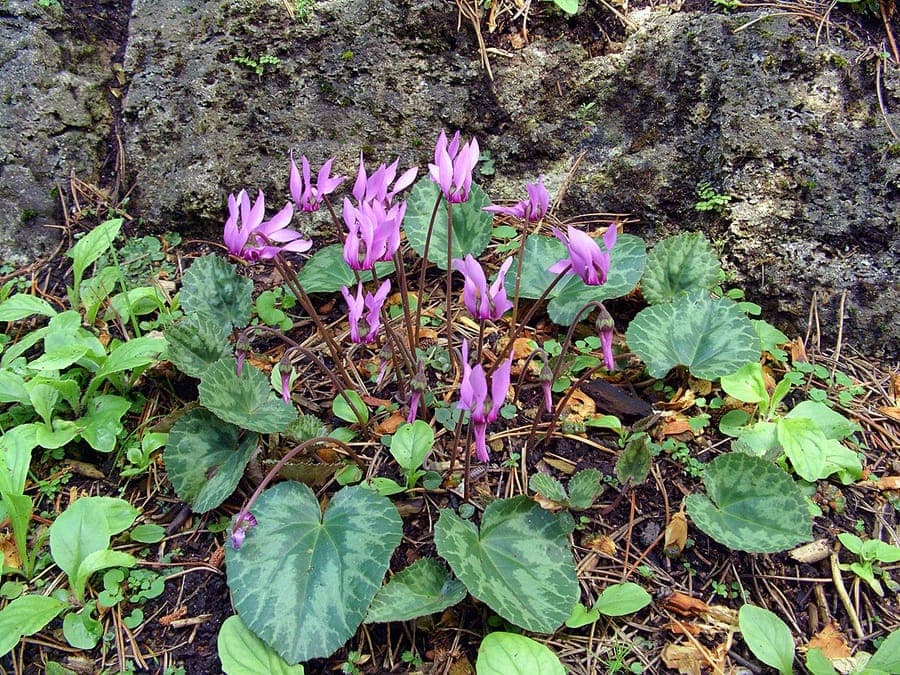
Orchi / CC BY-SA 3.0, via Wikimedia Commons
Cyclamen: complete guide
Cyclamen purpurascens
Want to see Cyclamen: complete guide in your garden?
1 minute, no credit card
Overview
Cyclamen purpurascens, often just called Cyclamen in garden circles, isn't your average potted florist's plant. This is the wild, hardy cousin of the winter-blooming houseplant, and it belongs firmly in the garden. Native to forested slopes across central and southern Europe - from Austria to Greece and Switzerland to Yugoslavia - it thrives in cool, shaded woodlands. Unlike the short-lived indoor varieties, this one sticks around for years, slowly forming lush colonies under trees and along borders.
What sets it apart is its blooming season: summer into autumn. While most people think of cyclamen as a winter bloomer, this species wakes up in July and keeps going until November, especially in milder zones. It's evergreen, tough, and surprisingly drought-tolerant once established. On gardenworld.app, you can design a shaded garden layout that highlights its long bloom season and silvery foliage, syncing perfectly with other late-season performers.
Appearance & bloom cycle
The flowers are delicate, held on slender stems 15–20 cm tall, with five reflexed petals in soft pink to deep magenta. Each bloom is about 2–3 cm across and has a faint, sweet fragrance that's most noticeable in the late afternoon. They emerge from July through October, peaking in late summer. The leaves are equally striking - heart-shaped, dark green, and marbled with silver-gray patterns that stand out beautifully in low light.
Foliage appears in spring and persists all year, making it a reliable structural plant even in winter. The corm sits just below the soil surface, so plant shallow - no deeper than 1–2 cm. Over time, it self-seeds gently, forming natural-looking drifts without becoming invasive.
Ideal location
This is a plant for shade. Think woodland edge, under deciduous trees like beech or birch, or on the north-facing side of a hedge. It loves dappled light, especially morning sun with afternoon shade. Full sun, particularly in warmer regions, will scorch the leaves and shorten the bloom period. Avoid south-facing beds unless they're heavily shaded by trees.
It's perfect for naturalising in wilder garden areas, under shrubs like Viburnum or Cornus, or tucked into rock crevices. Use it to soften hardscapes or line a shaded path. On gardenworld.app, you can simulate light patterns in your garden to find the best microclimate for Cyclamen purpurascens, especially in urban backyards with variable sun exposure.
Soil requirements
The soil should be humus-rich, well-drained, and slightly acidic to neutral (pH 6.0–7.0). Avoid heavy clay unless amended with leaf mold and grit. Sandy soils benefit from added compost to retain moisture. The key is balance - moist but never waterlogged. If your soil stays soggy in winter, mix in perlite or fine gravel to improve drainage.
Do not over-fertilise. Cyclamen purpurascens evolved in nutrient-poor forest soils and can suffer from root burn in overly rich conditions. Plant corms 10–15 cm apart; they'll fill in over 3–4 years.
Free design
Want to see Cyclamen: complete guide in your garden? Make a free design now.
Watering
Keep the soil consistently moist from April to October, especially during dry spells. Water at the base to avoid wetting the foliage, which can encourage fungal issues. Once established, it tolerates short dry periods, but prolonged drought will reduce flowering. In winter, leave it alone - natural rainfall is usually sufficient.
Young plants need more attention in their first year. If you're gardening in a region with hot summers (like USDA zone 7b+), mulch lightly with leaf litter to keep roots cool.
Pruning
No pruning needed. Simply remove dead or damaged leaves with clean snips if they look unsightly. Leave spent flower stems intact - they develop seed pods that naturally disperse, helping the colony expand. If you want to limit spread, snip stems after bloom but before seeds form.
Maintenance calendar
- Jan: Check for slug damage on new leaves. Remove any rotting foliage.
- Feb: Dormant period. No action required.
- Mar: Watch for emerging growth. Protect from hungry slugs.
- Apr: Begin regular watering as soil dries. Foliage fills in.
- May: No feeding. Soil should be naturally fertile.
- Jun: Monitor for aphids on new shoots.
- Jul: Bloom begins. Maintain even moisture.
- Aug: Peak flowering. Keep soil moist in dry spells.
- Sep: Flowers continue. Reduce watering as days shorten.
- Oct: Let fallen leaves accumulate - they act as natural mulch.
- Nov: Dormancy begins. No intervention needed.
- Dec: Ensure corms aren't sitting in wet soil.
Winter hardiness
Hardy in USDA zones 5–8. It survives temperatures down to -20°C when planted in well-drained soil. In colder zones, a light mulch of leaves or bark helps insulate the corms. Foliage may yellow in harsh winters but usually rebounds in spring. Avoid mulching too heavily - it can trap moisture and cause rot.
Companion plants
Pair with other shade lovers: Helleborus, Epimedium, Anemone nemorosa, and Carex species. It also works well under Fagus sylvatica or Acer pseudoplatanus. Avoid aggressive spreaders like Lamium or Vinca minor that might outcompete it. Combine with early spring bulbs like Narcissus for a layered effect.
Closing
Cyclamen purpurascens is a quiet achiever in the garden. It doesn't shout for attention, but it delivers consistent beauty from summer to frost. Let it naturalise in drifts, and it'll become a backbone of your shady borders. You'll find it at garden centres across the UK and US, especially those specialising in alpine or woodland plants. With the right spot and minimal care, it becomes a long-term asset - and a conversation starter for those who thought all cyclamen were just for Christmas windowsills.
Want to see Cyclamen: complete guide in your garden? Make a free design now.
Upload a photo, pick a style, and get a photorealistic design with plant list in under a minute.
No credit card required


Similar plants
Primula incana: complete guide to silvery alpine primrose
Primula incana
Silvery primrose (Primula incana), a delicate alpine flower with white blooms and powdered grey-green leaves. Growing, care, and cultivation guide.
Mealy cowslip: complete guide
Primula pulverulenta
Grow the Mealy cowslip (Primula pulverulenta): striking candelabra flowers in red and purple tones, moisture-loving and ideal for shady, damp garden corners.
Cliff dwarf-primrose: complete guide
Androsace laevigata
Full guide to growing Androsace laevigata, a rare Pacific Northwest alpine cushion plant. Planting, care, and garden design tips explained.