
Hans Hillewaert / CC BY-SA 3.0, via Wikimedia Commons
Majorca cyclamen: complete guide
Cyclamen balearicum
Want to see Majorca cyclamen: complete guide in your garden?
1 minute, no credit card
Overview
Cyclamen balearicum, commonly known as Majorca cyclamen, is a refined perennial that hails from the Balearic Islands and parts of southwest France. Unlike the common florist cyclamen you might pick up in winter, this one's built for the garden - provided you respect its needs. It's part of the Primulaceae family and stands out for its understated elegance. No flashy pinks or reds here - just soft white blooms that emerge in early spring, quietly announcing the season's shift.
This is a plant for gardeners who appreciate subtlety. It stays low, grows slowly, and asks for little - just the right spot and a light touch. If you're after something that thrives under a tree or between rocks without demanding attention, this could be your next find.
On gardenworld.app, you can design a shaded planting scheme that highlights Cyclamen balearicum's delicate presence, pairing it with ferns, hellebores, or creeping evergreens.
Appearance & bloom cycle
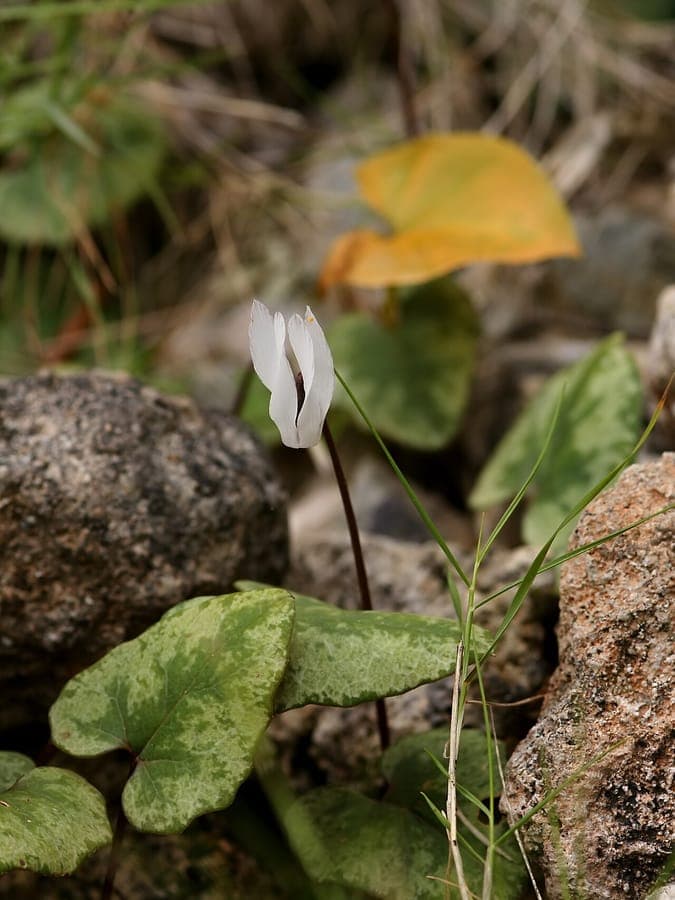
The flowers of Cyclamen balearicum are pure white, with five slightly reflexed petals and a pale pink or magenta centre at the base. They bloom from March through May, depending on local conditions. Each flower sits on a slender, upright stem, about 10–12 cm tall, rising above the foliage. The scent is faint - more of a whisper than a statement - but the visual clarity against dark groundcover makes it stand out.
The leaves are heart-shaped, glossy, and deep green, marked with a silvery, marbled pattern that varies from leaf to leaf. This natural variation gives each plant a unique fingerprint. The foliage emerges in autumn and persists through winter, turning semi-deciduous only in extreme cold. Mature plants reach 10–15 cm in height, making them ideal for front borders, rock gardens, or woodland edges.
Ideal location
Think dappled shade. Cyclamen balearicum thrives under deciduous trees, where it gets early spring sun before the canopy fills in, then shade through summer. It also does well on north-facing banks or under shrubs like Daphne or Viburnum. Avoid full afternoon sun - it scalds the leaves and dries the soil too quickly.
Air circulation matters. Stagnant, damp air encourages fungal issues, especially in humid springs. Choose a spot with gentle airflow, but out of strong winds. If your garden has a microclimate - like a sheltered corner near a stone wall - that's ideal. Use gardenworld.app to map light patterns and airflow across your space before planting.
Soil requirements
This cyclamen likes well-drained, humus-rich soil with a neutral to slightly alkaline pH (6.5–7.5). It naturally grows on limestone slopes, so a gritty, stony mix works best. If your soil is heavy clay, amend it with coarse sand, leaf mould, and fine gravel. A top dressing of grit helps shed excess moisture and keeps the crown dry.
Plant the tubers 3–5 cm deep, eyes facing up, spaced 10–15 cm apart. Don't bury them too deep - that invites rot. And never plant in waterlogged areas. These aren't pond-side plants.
Free design
Want to see Majorca cyclamen: complete guide in your garden? Make a free design now.
Watering
Keep the soil lightly moist from autumn to late spring, especially during dry spells. Water at the base - avoid wetting the leaves and crown, which can lead to rot. Once flowering ends in May, gradually reduce watering. By June, stop completely. The tuber goes dormant and will rot if kept wet through summer.
If you're in a region with dry summers, a light mulch of pine needles or oak leaves helps, but keep it away from the plant's base. Rainwater is preferred - these plants dislike hard, chlorinated tap water.
Pruning
Pruning isn't needed. Just deadhead spent flowers by pinching the stem at the base. Remove yellow or damaged leaves with clean snips, cutting close to the crown without disturbing it. Don't pull - tugging can damage the tuber.
Leave healthy foliage intact. It feeds the tuber for next year's growth. Even in dormancy, let old leaves decompose naturally.
Maintenance calendar
- January: Check for rot. Keep soil dry if wet. No feeding.
- February: Watch for emerging buds. Avoid wet foliage.
- March: Bloom begins. Water moderately.
- April: Peak flowering. Keep area tidy.
- May: Flowers fade. Reduce watering.
- June: Dormancy starts. Stop watering.
- July: Full dormancy. No action.
- August: Check tubers. No disturbance.
- September: New leaves appear. Resume light watering.
- October: Foliage full. Loosen soil gently.
- November: Active growth. Water during dry spells.
- December: Continue care. No fertiliser.
Winter hardiness
Cyclamen balearicum is hardy to about -5°C (USDA zone 8a). In colder zones (7 and below), it may survive with heavy mulch - think pine boughs or dry bracken. But prolonged wet and freeze cycles are deadly. In exposed gardens or heavy soils, lift the tubers and store them in a cool, dry place over winter.
In the UK and Pacific Northwest, it often overwinters well in well-drained spots. In colder inland areas, treat it as a borderline perennial or grow in pots to move under cover.
Companion plants
Pair it with plants that share its preferences: shade, good drainage, and low competition. Excellent choices include:
- Helleborus orientalis
- Epimedium spp.
- Anemone nemorosa
- Pachysandra terminalis
- Ferns like Polystichum or Dryopteris
Avoid aggressive spreaders like ivy or mint. Stick to slow, open growers that let light reach the ground. A naturalistic look with moss, stones, or bark chips enhances its charm.
Closing
Cyclamen balearicum isn't loud. It doesn't shout for attention. But for those who notice, it delivers quiet beauty - a carpet of silver-green leaves topped with nodding white flowers in spring. It asks for little: the right soil, a sheltered spot, and a hands-off approach in summer.
You'll find tubers at garden centres in autumn, especially in Europe. Look for plump, firm tubers without mould or soft spots. Plant them straight away or store in a cool, dark, dry place until autumn.
In the UK and Ireland, check Truffaut, Jardiland, or local nurseries for stock. On gardenworld.app, you can simulate planting density and seasonal appearance to plan your display with precision.
Want to see Majorca cyclamen: complete guide in your garden? Make a free design now.
Upload a photo, pick a style, and get a photorealistic design with plant list in under a minute.
No credit card required


Similar plants
Primula incana: complete guide to silvery alpine primrose
Primula incana
Silvery primrose (Primula incana), a delicate alpine flower with white blooms and powdered grey-green leaves. Growing, care, and cultivation guide.
Mealy cowslip: complete guide
Primula pulverulenta
Grow the Mealy cowslip (Primula pulverulenta): striking candelabra flowers in red and purple tones, moisture-loving and ideal for shady, damp garden corners.
Cliff dwarf-primrose: complete guide
Androsace laevigata
Full guide to growing Androsace laevigata, a rare Pacific Northwest alpine cushion plant. Planting, care, and garden design tips explained.