
Wikimedia Commons / CC BY-SA 3.0, via Wikimedia Commons
Cycas revoluta: complete guide
Cycas revoluta
Want to see Cycas revoluta: complete guide in your garden?
1 minute, no credit card
Overview
Cycas revoluta, commonly known as the Sago cycad or Sago palm, is a classic, slow-growing plant from the Cycadaceae family. Originally native to Japan and Taiwan, this plant has been cultivated for centuries as an ornamental in many parts of the world.
Contrary to what many people believe, Cycas revoluta is not a true palm, but one of the oldest plant groups on Earth. The plant is a favorite among plant enthusiasts because of its dramatic, spiral-shaped leaves and its ability to last a very long time.
Appearance and growth
Cycas revoluta grows as a slow-growing plant with a thick, brown trunk covered with old leaf sheath remnants. From the top emerge spectacular, spiral-shaped leaves that can reach up to 1.5 meters long. These leaves are dark green and have a very regular, feathery appearance.
The plant grows extremely slowly - only a few centimeters per year. A mature plant can grow from 60 centimeters to 1.5 meters tall. Because it grows so slowly, a young plant can take up to 20 years to reach maturity.
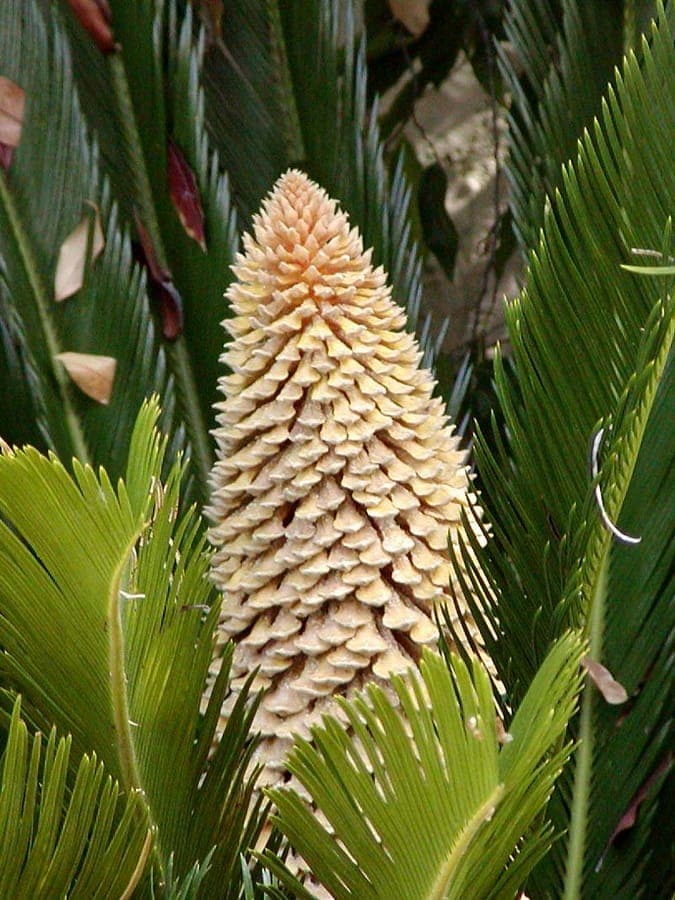
The plant produces beautiful cone fruits, with male cones being yellow-brown and female cones orange-yellow. The plant is highly decorative throughout the year.
Ideal location
Cycas revoluta thrives best in indirect light. The plant prefers bright, filtered sun rather than direct full sun. Place the plant near a window where it receives morning light but not direct sun.
The plant is highly suitable for indoor cultivation. Place it in a warm room with temperatures between 15 and 25 degrees Celsius. Avoid drafts and cold locations. The plant tolerates mild drought better than overwatering.
In warmer climates, the plant can stay outdoors, but bring it indoors for winter protection in temperate climates.
Soil
Cycas revoluta prefers very well-draining potting mix. Use a mixture of 40% standard potting soil, 30% perlite, and 30% coarse sand or orchid bark. This ensures that water does not stagnate around the roots.
The pH should be between 6.0 and 7.5. Heavy clay soils will cause waterlogging and damage roots. Repot the plant every two to three years, but be careful with the root system.
Free design
Want to see Cycas revoluta: complete guide in your garden? Make a free design now.
Watering
Watering Cycas revoluta carefully is critical to success. Water the plant only when the top 2-3 centimeters of soil feel dry. This is usually once per week in summer and once every two weeks in winter.
Never overwater - this is the most important cause of death for Cycas. The plant tolerates drought better than overwatering. In the growing season (spring/summer), you can water slightly more often, but always check if the soil is dry first.
Never spray water on the leaves. This increases the risk of leaf rot and fungal disease.
Pruning
Cycas revoluta requires virtually no pruning. The plant grows naturally as a compact, beautiful form. Remove only dead leaves. Never remove healthy, green leaves - these store nutrients the plant needs.
If a leaf becomes severely damaged, you can gently remove it from the base. However, let the plant maintain its natural form.
Maintenance calendar
Spring: Begin regular watering as new growth emerges. Check for winter frost damage. Move outdoors if temperatures stay above 15 degrees.
Summer: Water regularly (but carefully). Place outdoors in a dappled shade location. Fertilize once monthly.
Autumn: Gradually reduce watering as temperatures decline.
Winter: Minimal watering. Keep indoors at temperatures above 10 degrees Celsius. No fertilizing.
Winter hardiness
Cycas revoluta is semi-hardy. In many European locations, it must be brought indoors for winter. In Southern Europe (Southern France, Southern Spain, Southern Italy), it can overwinter outdoors with protection.
In the Netherlands, Belgium, Germany, and Northern France, the plant must be brought indoors before the first frost. A warm house location is ideal.
Young plants are more sensitive to frost than older, larger plants.
Companion plants
Cycas revoluta is a statement plant. Cultivate it as a solo piece or in combination with:
- Low growers such as succulents or small-leafed plants
- Other large-leafed plants for a tropical look
- Ornamental grasses around the base
- In an elegant terracotta pot for maximum effect
Closing
Cycas revoluta is a classic plant that can last for decades. With patience and careful maintenance, you will have a beautiful, healthy plant that brings joy year after year. The plant is especially suitable for those seeking something unique and long-lasting.
Start with gardenworld.app and add this classic plant to your collection. This is a plant for life!
Want to see Cycas revoluta: complete guide in your garden? Make a free design now.
Upload a photo, pick a style, and get a photorealistic design with plant list in under a minute.
No credit card required


Similar plants
Cycas pectinata: complete guide
Cycas pectinata
The pectinate cycad from the Himalayas. Complete guide for growing this rare palm-like plant. Information about care, maintenance and ideal growing conditions.
Cycas rumphii: complete guide
Cycas rumphii
Discover the queen sago or queen sago palm fern. Learn all about care, location, growth and cultivating this tropical ornamental plant.
Cycas circinalis: complete guide
Cycas circinalis
The queen sago is a spectacular palm-like plant with elegantly unfurling fronds. Learn how to cultivate this exotic cycad successfully in temperate climates.