
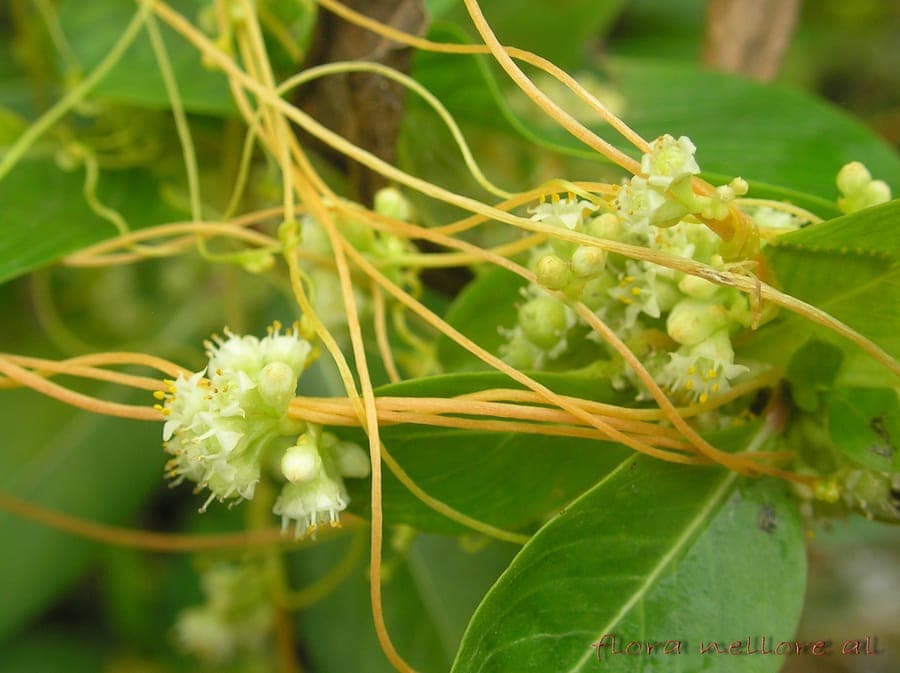
Lalithamba from India / CC BY 2.0, via Wikimedia Commons
Giant Dodder: complete guide
Cuscuta reflexa
Want to see Giant Dodder: complete guide in your garden?
1 minute, no credit card
Giant dodder (Cuscuta reflexa) is a remarkable parasitic plant from the morning glory family (Convolvulaceae), native to regions from Afghanistan to Indochina and Java. This is one of the largest Cuscuta species and is known by many different common names across Asian languages.
Overview Giant dodder is a completely parasitic plant without chlorophyll. Rather than sending roots into soil, this plant physically connects to the stems of host plants. The plant then grows along the host, extracting nutrients directly from its tissue.
Appearance and Growth The plant consists of thin, thread-like stems that are yellow to orange in color. During the growing season, long strands can grow many centimeters and coil around host plants. Small, white to pink flowers appear in clusters and are followed by tiny seed capsules.
Host Plants Giant dodder can grow on a wide range of host plants, especially herbs and shrubs. This makes it challenging to manage in gardens. The plant primarily grows on natural hosts in tropical and subtropical areas.
Climate Requirements This plant thrives in warm, humid climates. It occurs naturally in Afghanistan, Bangladesh, India, and Southeast Asian countries. Giant dodder tolerates dry periods well once established.
Soil and Growth Since giant dodder is parasitic, it doesn't require soil directly. It grows independently of soil types and conditions. The host plant determines growing conditions more than the parasite itself.
Watering Giant dodder as a cultivated plant requires watering of its host plants. During dry periods, hosts may need water, which indirectly ensures the parasite's survival. Naturally, the plant thrives during seasons with regular rainfall.
Maintenance and Control In gardens, giant dodder must be managed because it extracts nutrients from hosts. Completely remove affected plant parts to prevent spread. Mechanical wiping of stems and removal of seed capsules prevents new infection.
Botanical Features The plant displays shallow, heart-shaped stems with many fine hairs. The root-like structures with which it touches hosts are actually adaptations for nutrient absorption, not true roots. This makes it biologically unique.
Natural Dispersal In natural environments, giant dodder spreads through seeds dispersed by animals. The plant produces abundant seeds that can dry and remain viable for years. This explains its wide distribution in Asian regions.
Closing Thoughts Giant dodder is a fascinating plant to study from a biological perspective but challenging in gardens. For more information on plant interactions and garden management, visit GardenWorld.app for expert guidance and horticultural resources.
Want to see Giant Dodder: complete guide in your garden? Make a free design now.
Upload a photo, pick a style, and get a photorealistic design with plant list in under a minute.
No credit card required


Similar plants
Spreading alkaliweed: complete guide
Cressa truxillensis
Full growing guide for Cressa truxillensis, the salt-tolerant groundcover of alkaline flats: location, soil, watering, pruning and winter care.
Betony-leaved bindweed: complete guide
Convolvulus betonicifolius
Full guide to betony-leaved bindweed (Convolvulus betonicifolius): origin, appearance, ideal site, soil, watering and garden uses.
Ivyleaf morning glory: complete guide
Ipomoea hederacea
Everything about Ipomoea hederacea: location, soil and climbing care. A fast-growing annual vine with blue funnel flowers for sunny walls and pergolas.