
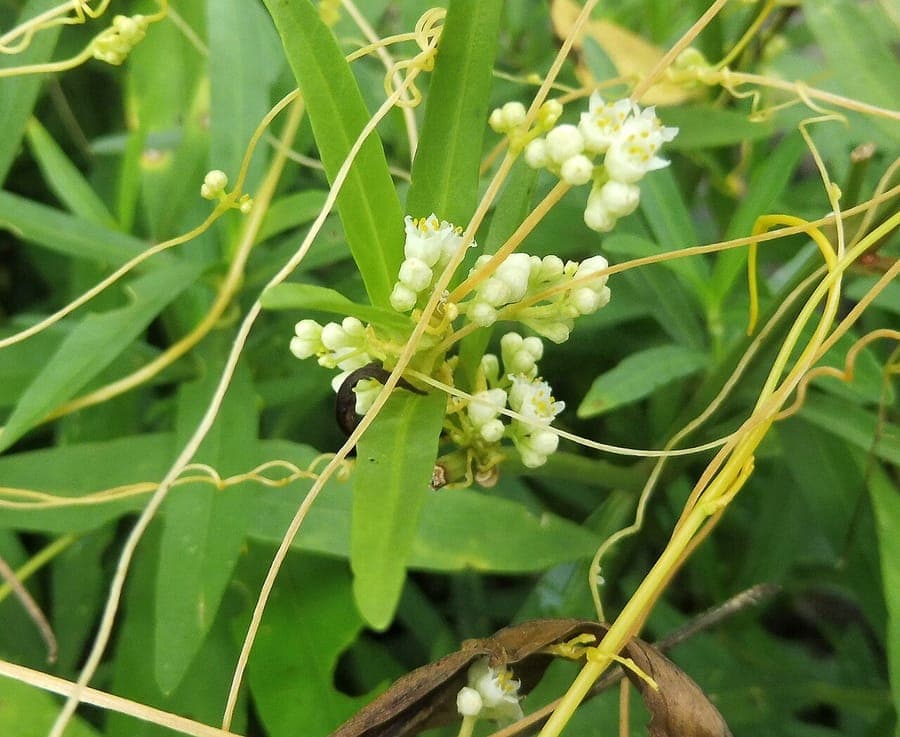
Mason Brock (Masebrock) / Public domain, via Wikimedia Commons
Five-angle Dodder: complete guide
Cuscuta pentagona
Want to see Five-angle Dodder: complete guide in your garden?
1 minute, no credit card
Overview
Five-angle dodder (Cuscuta pentagona), also known as bushclover dodder, is a remarkable parasitic plant from North America and Central America. This plant belongs to the Convolvulaceae family and distinguishes itself through its characteristic pentagon flowers and complete dependence on hosts for nutrition. Although technically a parasite, it plays a unique ecological role in natural landscapes.
This plant is primarily of botanical interest and not recommended for typical gardeners. However, it serves as an educational example of parasitic adaptation in the plant world.
Appearance and Bloom
Five-angle dodder forms no normal roots or leaves. Instead, thin, thread-like stems without leaves wind around host plants. The stems are yellow to reddish-brown in color.
The characteristic pentagon flowers appear in small clusters along the stems during summer and fall. They are small, white to pink, and have a mathematically ordered pentagon shape.
After blooming, small seed capsules form that disperse naturally.
Natural Occurrence
Five-angle dodder grows in diverse habitats from North America to Belize and Cuba. It prefers warm, dry areas and occurs on bushes and herbaceous host plants.
In Europe, it is sometimes found in gardens as a weed, especially in warmer regions. Recognition and removal are important to prevent plague problems.
Free design
Want to see Five-angle Dodder: complete guide in your garden? Make a free design now.
Identification and Management
Five-angle dodder can be recognized by its characteristic thread-like stems without leaves, its parasitic growth pattern and its pentagon flowers. The plant should be prevented in mixed gardens, as it can damage many other plants.
Best practices for management are:
- Carefully remove all visible stems
- Ensure regular inspection of host plants
- Avoid contact with seeds, which remain viable for long
- Place fallen stems in garbage, not in compost heap
Ecological Significance
Although parasitic, five-angle dodder plays a role in natural ecosystems by breaking down biomass and returning nutrients to soils. It also serves as host for certain insects.
In gardens, however, it should be prevented because of potential damage to desirable plants.
Research and Educational Value
Five-angle dodder is an important study object for botanists studying parasitic adaptations. Its lack of leaves and normal roots illustrates extreme specialization.
Universities and botanical institutes study this plant for insights into plant physiology and parasitic relationships.
Conclusion
Five-angle dodder is not a recommended garden plant because of its parasitic nature. Gardeners who encounter this plant should carefully remove it to protect other plants.
For gardeners interested in unusual or educational plants, gardenworld.app can recommend personalized garden designs with non-parasitic, exotic alternatives that offer similar botanical interest without risk to other crops.
Want to see Five-angle Dodder: complete guide in your garden? Make a free design now.
Upload a photo, pick a style, and get a photorealistic design with plant list in under a minute.
No credit card required


Similar plants
Spreading alkaliweed: complete guide
Cressa truxillensis
Full growing guide for Cressa truxillensis, the salt-tolerant groundcover of alkaline flats: location, soil, watering, pruning and winter care.
Betony-leaved bindweed: complete guide
Convolvulus betonicifolius
Full guide to betony-leaved bindweed (Convolvulus betonicifolius): origin, appearance, ideal site, soil, watering and garden uses.
Ivyleaf morning glory: complete guide
Ipomoea hederacea
Everything about Ipomoea hederacea: location, soil and climbing care. A fast-growing annual vine with blue funnel flowers for sunny walls and pergolas.