
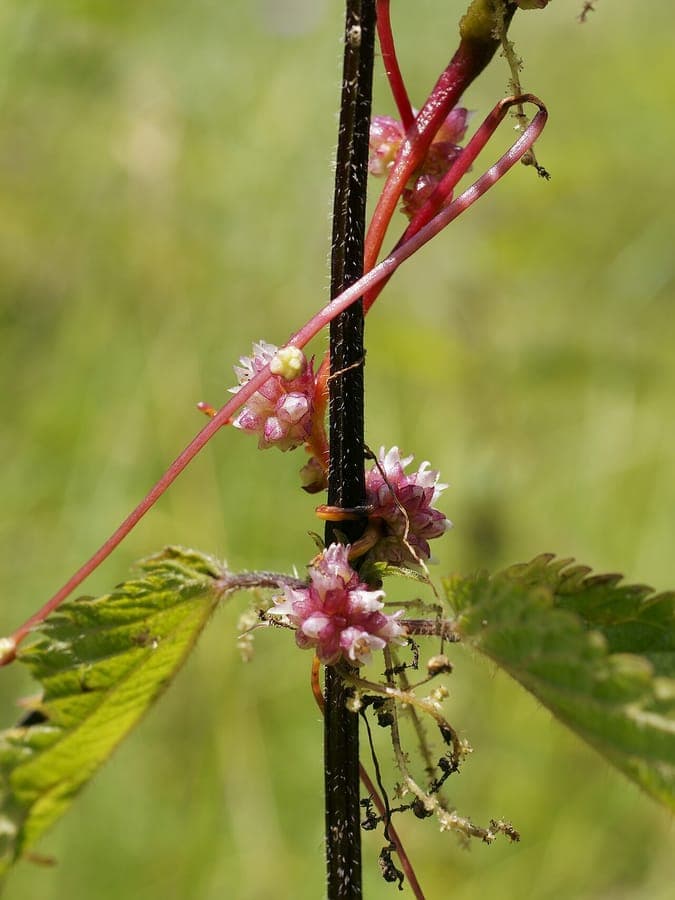
Hans Hillewaert / CC BY-SA 3.0, via Wikimedia Commons
European dodder: complete guide
Cuscuta europaea
Want to see European dodder: complete guide in your garden?
1 minute, no credit card
Overview
European dodder (Cuscuta europaea) is a striking parasitic plant that commonly appears in wild areas, crop fields, and increasingly in home gardens across Europe. Unlike most garden plants, it lacks chlorophyll and true leaves, relying entirely on host plants for water and nutrients. Native to Central and Eastern Europe, it spreads quickly through seeds and can infest herbaceous vegetation, especially thistles, nettles, and clovers. While it occasionally appears ornamental with its thread-like stems and tiny white flowers, it's best managed before it takes hold.
As a gardener, recognising European dodder early is crucial. It doesn't harm humans, but it can severely weaken or kill host plants by draining their resources. Since it's not sold in garden centres, most encounters are accidental. If you're designing a resilient garden layout, gardenworld.app offers tools to map high-risk zones and select resistant plant species.
Appearance & bloom cycle
European dodder has thin, yellow-orange stems that grow in tangled coils around host plants. It produces no proper leaves-only tiny, scale-like remnants. The flowers are small, white, and clustered in dense, rounded umbels at the stem tips. Each flower is about 2–3 mm wide and appears from June through September, peaking in July and August. After pollination, the plant forms spherical seed capsules (3 mm diameter) containing one or two seeds.
The seeds are hardy and can remain viable in the soil for up to five years. Germination occurs in spring when soil temperatures reach 10°C. Seedlings must locate a host within 5–7 days or they die. Once attached, dodder develops haustoria-specialised structures that penetrate the host's vascular system to extract nutrients.
Ideal location
European dodder thrives in full sun (light level 8/10) and targets plants in open, uncultivated areas. It commonly infests disturbed soils, field margins, and neglected garden corners where host plants like creeping thistle or stinging nettle grow unchecked. It avoids deep shade and dense woodland.
To reduce risk, maintain tidy borders and avoid letting potential host weeds proliferate. The plant spreads most aggressively in warm, humid conditions. If you're assessing your garden's vulnerability, gardenworld.app provides visual planning tools to identify sun-exposed zones prone to parasitic weeds.
Soil requirements
Since dodder is fully parasitic, it has no direct soil needs. However, its seeds germinate best in well-drained, neutral to slightly alkaline soils (pH 7.0–7.5). Heavy clay or compacted soils may slow germination but don't prevent it. The presence of organic matter can encourage host weed growth, indirectly supporting dodder establishment.
Avoid over-enriching soil with compost in areas where dodder has been spotted. Clean tools and footwear to prevent seed transfer. Rotating crops and using cover crops like rye may help suppress host weeds and limit dodder outbreaks.
Free design
Want to see European dodder: complete guide in your garden? Make a free design now.
Watering
You never need to water European dodder directly-it draws all moisture from its host. Overwatering host plants, especially in spring, can encourage lush growth that attracts dodder seedlings. During dry periods, dodder may appear less vigorous, but if the host survives, so will the parasite.
Watering practices should focus on strengthening desirable plants while discouraging weak, weedy hosts. Drip irrigation can help by reducing humidity around plant bases, making conditions less favourable for dodder germination.
Pruning
Cutting dodder provides only temporary relief. For effective control, remove the entire plant-including all attachment points-by hand while wearing gloves. Even small stem fragments left behind can reattach and regrow. Dispose of infected material by burning or sealed landfill disposal; do not compost.
Sterilise pruning tools with a 10% bleach solution after use. Repeated manual removal over several seasons may reduce seed bank levels. Herbicides are generally ineffective without harming the host, and selective options are limited.
Maintenance calendar
- March–April: Watch for early seedlings as soil warms. Inspect areas with previous infestations.
- May: Monitor known host plants. Remove young dodder before it flowers.
- June–August: Peak flowering and seed production. Avoid mowing infested areas-this spreads fragments.
- September–October: Remove all remaining dodder before seeds mature. Consider soil solarisation in small beds.
- November–February: No active growth, but seeds persist in soil. Plan next season's prevention strategies.
Winter hardiness
European dodder is an annual. Mature plants die with the first frosts. However, its seeds are highly resilient and can survive winter freezes down to -20°C. In USDA hardiness zones 6–9, seeds remain dormant in soil until spring. There is no above-ground overwintering structure.
Companion plants
There are no beneficial companion plants for dodder-it's a parasite, not a partner. Instead, grow species that resist infestation, such as woody shrubs, grasses, or plants with tough, hairy stems that deter attachment. Avoid planting common hosts like nettles, thistles, or clovers in vulnerable areas.
Choose robust perennials and ground covers to outcompete weeds. Garden centres often stock native species less prone to parasitic attack. Designing a diverse, densely planted garden reduces open niches for dodder establishment.
Closing
European dodder is a fascinating but unwelcome visitor in any garden. Its thread-like stems and lack of leaves make it easy to overlook until it's too late. Prevention, early detection, and consistent removal are your best defences. By understanding its lifecycle and choosing resilient plant combinations, you can minimise its impact. For tailored garden planning, visit gardenworld.app to create a layout that reduces parasitic weed risks.
Want to see European dodder: complete guide in your garden? Make a free design now.
Upload a photo, pick a style, and get a photorealistic design with plant list in under a minute.
No credit card required


Similar plants
Spreading alkaliweed: complete guide
Cressa truxillensis
Full growing guide for Cressa truxillensis, the salt-tolerant groundcover of alkaline flats: location, soil, watering, pruning and winter care.
Betony-leaved bindweed: complete guide
Convolvulus betonicifolius
Full guide to betony-leaved bindweed (Convolvulus betonicifolius): origin, appearance, ideal site, soil, watering and garden uses.
Ivyleaf morning glory: complete guide
Ipomoea hederacea
Everything about Ipomoea hederacea: location, soil and climbing care. A fast-growing annual vine with blue funnel flowers for sunny walls and pergolas.