
Jan Kops / Public domain, via Wikimedia Commons
Flax dodder: complete guide
Cuscuta epilinum
Want to see Flax dodder: complete guide in your garden?
1 minute, no credit card
Overview
Flax dodder, or Cuscuta epilinum, isn't your average garden plant. It doesn't belong in a flower border for colour or texture - it belongs in the story of nature's cunning strategies. This parasitic vine, part of the Convolvulaceae family, lacks chlorophyll and true leaves, surviving entirely by tapping into host plants for water and nutrients. Native to regions like Iran, Kazakhstan, and the North Caucasus, it primarily targets flax (Linum usitatissimum), but can also latch onto clover, thistles, and other broadleaf plants.
In the UK and North America, flax dodder is rarely cultivated intentionally, but it may appear in gardens where flax or related crops are grown. It's not invasive in most temperate zones, but it can weaken host plants if left unchecked. As a gardener, you'll need to decide: is this an interesting oddity or an unwanted pest?
If you're curious about integrating unusual plants like flax dodder into your space, gardenworld.app offers garden design tools that help you plan around host dependencies and sunlight needs.
Appearance & bloom cycle
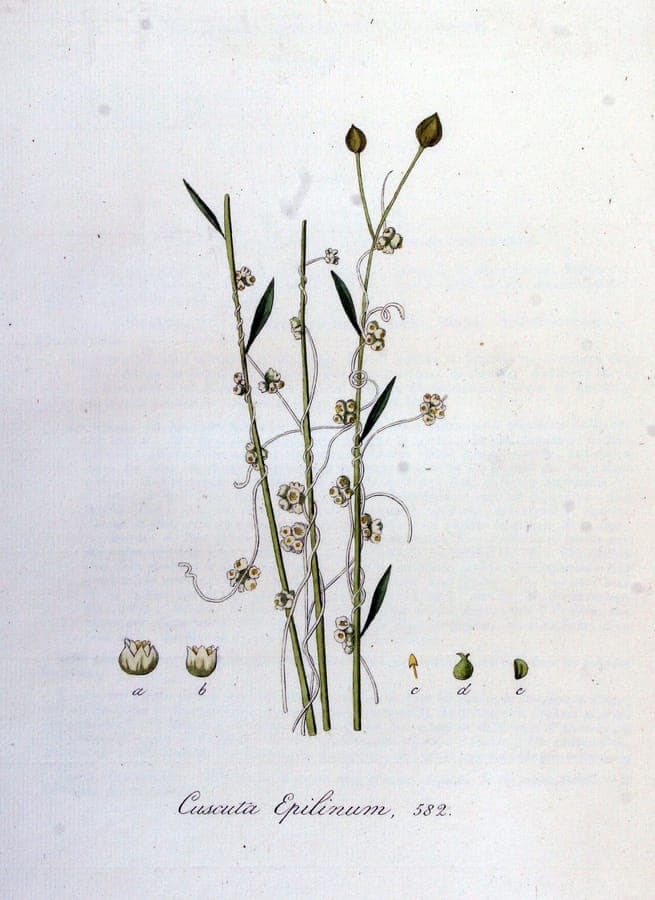
Flax dodder is instantly recognisable by its thin, yellow-orange, thread-like stems that twist and coil over host plants like living spaghetti. It forms dense mats that can smother smaller vegetation. The stems are smooth, often with a slightly glossy sheen, and grow rapidly in warm conditions.
From June to August, tiny white flowers appear in clusters along the stems. Each bloom is only 2–3 mm wide, with five petals curled backward. They're not showy, but up close, they have a delicate, almost ethereal beauty. After pollination, small capsule fruits develop, each containing 2–4 seeds that drop into the soil and can remain dormant for years.
This bloom period aligns with peak summer heat, which makes sense given its origins in continental climates with hot, dry summers.
Ideal location
Flax dodder thrives in full sun to light shade - around level 7 on a light scale of 10. It needs a host plant that receives at least 5–6 hours of direct sunlight daily. In deep shade, growth slows and flowering rarely occurs.
Because it spreads via seed and creeping stems, it's best grown in a contained area - a raised bed or pot - if you're experimenting. Avoid planting near sensitive crops like lettuce, carrots, or herbs, which could be weakened by parasitic attachment.
Good air circulation helps prevent fungal issues, especially since the dense growth can trap moisture. Check your garden layout on gardenworld.app to see if your sunny patches are suitable for hosting dodder and its preferred plants.
Free design
Want to see Flax dodder: complete guide in your garden? Make a free design now.
Soil requirements
Since flax dodder relies entirely on its host, it doesn't have direct soil needs. However, the host's soil conditions are critical. Flax prefers well-drained, light loamy or sandy soils with a pH between 6.5 and 7. Avoid heavy clay or waterlogged ground, as flax is prone to root rot.
Amend dense soils with compost or coarse sand to improve drainage. A neutral pH ensures optimal nutrient uptake for the host, which in turn supports the dodder.
Watering
Watering should focus on the host. Flax needs consistent moisture - about 2.5 cm per week during active growth. In dry spells, increase watering, especially in the first six weeks after sowing.
Dodder itself loses little water due to lack of leaves, so overwatering is a bigger risk than underwatering. Saturated soil leads to root diseases in the host, and once the host fails, the dodder dies too. Use rainwater when possible - it's gentler on sensitive plants.
Pruning
Flax dodder doesn't need pruning for shape, but you may want to control its spread. Remove unwanted stems with clean scissors, cutting close to the attachment point without damaging the host.
Do this before seeds form - typically by late August. Dispose of cuttings by burning or binning; don't compost, as seeds may survive.
Maintenance calendar
- March–April: Sow flax seeds. Clear any dodder debris from previous year.
- May: Watch for dodder seedlings. They emerge when soil hits 15°C.
- June–August: Peak bloom. Monitor for flowering and insect visitors.
- September: Cut back dying stems. Prevent seed drop.
- October–February: Dormant period. No care needed, but inspect occasionally.
Winter hardiness
Flax dodder is an annual. Stems die back at temperatures below -2°C. However, seeds survive winter in the soil and germinate the next spring. It's hardy in USDA zones 7–9, where winters are mild and soil rarely freezes deeply.
Mulch lightly to reduce erosion, but avoid thick layers that might protect dodder seeds. Remove mulch in early spring to spot seedlings.
Companion plants
Flax dodder doesn't have companions - it has hosts. Flax is the primary one, but it may also parasitize red clover, alfalfa, or thistles. Keep it away from vegetables and ornamentals you want to thrive.
If growing for study or curiosity, isolate it in a container with flax only. This prevents accidental spread to other garden areas.
Closing
Flax dodder isn't a plant for show - it's a plant for thought. It challenges how we see gardening: cooperation versus competition, beauty versus function. If you're up for a challenge, it can be a fascinating subject.
But treat it with caution. One season's escape can become next year's problem. Buy seeds only from reputable garden centres, and never introduce it near natural habitats.
For gardeners who love the unusual, gardenworld.app provides design templates and ecological pairing suggestions, including options for hosting curious species like flax dodder.
Want to see Flax dodder: complete guide in your garden? Make a free design now.
Upload a photo, pick a style, and get a photorealistic design with plant list in under a minute.
No credit card required


Similar plants
Spreading alkaliweed: complete guide
Cressa truxillensis
Full growing guide for Cressa truxillensis, the salt-tolerant groundcover of alkaline flats: location, soil, watering, pruning and winter care.
Betony-leaved bindweed: complete guide
Convolvulus betonicifolius
Full guide to betony-leaved bindweed (Convolvulus betonicifolius): origin, appearance, ideal site, soil, watering and garden uses.
Ivyleaf morning glory: complete guide
Ipomoea hederacea
Everything about Ipomoea hederacea: location, soil and climbing care. A fast-growing annual vine with blue funnel flowers for sunny walls and pergolas.