
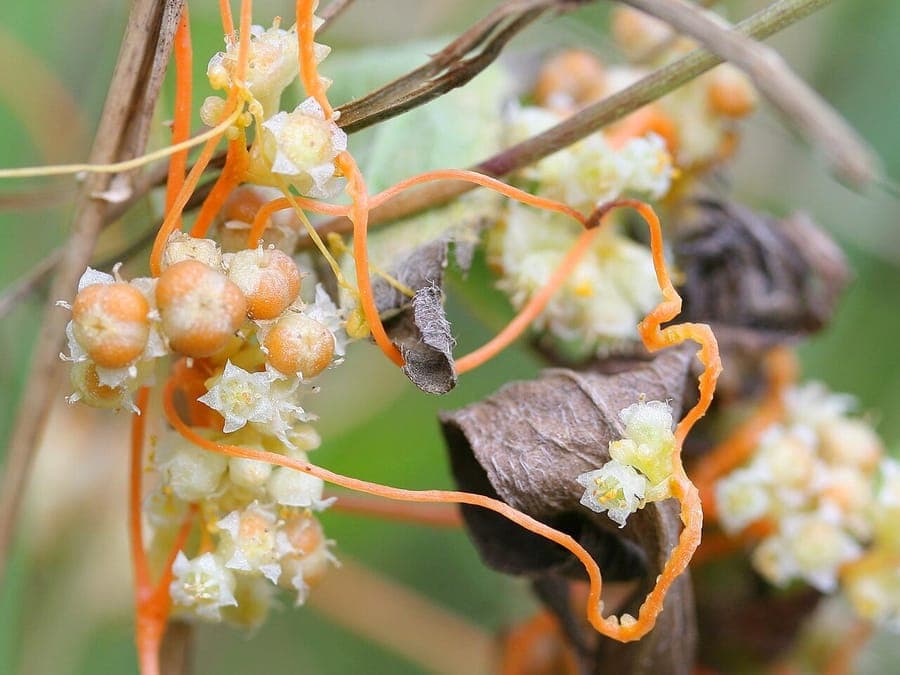
Kristian Peters -- Fabelfroh 11:46, 16 September 2007 (UTC) / CC BY-SA 3.0, via Wikimedia Commons
Dodder: complete guide
Cuscuta campestris
Want to see Dodder: complete guide in your garden?
1 minute, no credit card
Overview
Dodder (Cuscuta campestris) isn't a plant you want showing up in your garden uninvited. It's a relentless parasite that attaches to healthy plants and drains them of moisture and nutrients. Though it might look like a decorative golden vine at first glance, it's actually an aggressive invader that can quickly spread to berry bushes, vegetables, and herbs. A member of the Convolvulaceae family, it originates from regions like Alabama, California, and parts of South America but has now been spotted in temperate gardens across Europe and North America. It's commonly found on fallow ground, along field edges, and in gardens rich in clover or alfalfa. Since it lacks chlorophyll and true leaves, it depends entirely on its host. Spot it early - control starts the moment you see it.
Appearance & bloom cycle
Dodder is unmistakable: thin, yellow-orange to pale red stems that snake over other plants, coiling tightly like thread. Stems are usually less than 1 mm thick but can stretch up to 2 meters. Leaves are nearly absent, reduced to tiny scales under 2 mm long. From June to September, small bell-shaped flowers appear in clusters of 3 to 5. These are cream to pale yellow, only 3 to 5 mm wide. After pollination, round capsule fruits form, each holding 2 to 4 seeds. These seeds can remain dormant in the soil for up to 10 years, which is why dodder is so persistent and hard to eradicate.
Ideal location
Dodder actively seeks hosts. It germinates in soil but must find a suitable plant within 5 to 7 days or it dies. It thrives in full sun to light shade, commonly found in open areas where clover, alfalfa, nettles, or young vegetables grow. In gardens, it often appears on strawberry beds, spinach, or fennel patches. It spreads rapidly through seed and broken stem fragments that reattach to new hosts. Prevent spread by covering bare soil quickly or planting dense ground covers. On gardenworld.app you can create a garden design that fits perfectly around [plant].
Soil requirements
The soil where dodder grows is typically well-drained, slightly sandy to loamy, with a pH between 6.0 and 7.5. But dodder itself doesn't root into the soil - instead, its seedling forms haustoria, hook-like structures that penetrate the host's stem. So soil conditions matter less than the health and type of host plant. If you grow clover or alfalfa, be extra cautious. These plants attract dodder, especially on fertile, slightly moist ground.
Free design
Want to see Dodder: complete guide in your garden? Make a free design now.
Watering
You don't need to water dodder - it pulls all moisture from its host. If your garden plants are well-irrigated, the parasite thrives too. To reduce risk, avoid overhead watering, especially in summer. Excess moisture on leaves encourages young dodder seedlings. Water at the base instead, particularly for sensitive plants like strawberries or fennel. Keep irrigation consistent but targeted.
Pruning
You can't prune dodder like a regular plant. The only effective method is complete removal. Cut or pull the vines off, but ensure no fragments remain on the ground. Even a 2 cm piece can re-root. Burn the debris or dispose of it in general waste - composting is risky. Check your garden weekly from June to September. At the first sign of regrowth, remove immediately. Wear gloves - the stems can irritate sensitive skin.
Maintenance calendar
- January: Inspect compost piles for remnants; plan garden upgrades
- February: No action needed
- March: Prepare beds; cover bare soil quickly
- April: Monitor clover patches; sow dense crops
- May: Watch for germination; remove seedlings early
- June: Daily checks on vulnerable plants; remove aggressively
- July: Continue removal; prevent seed formation
- August: Stay alert for new tendrils
- September: Stop seed maturation; remove fruit capsules
- October: Clean garden thoroughly; remove all debris
- November: Check for fallow areas
- December: No action needed
Winter hardiness
Dodder isn't winter-hardy in the traditional sense. Above-ground growth dies back with frost, but seeds survive easily at temperatures down to -15°C in the soil. They can remain dormant for years. In milder winters, fragments may survive under mulch or debris. USDA zones 6 to 9 are especially vulnerable to overwintering risks. While cold winters slow growth, they don't eliminate the seed bank. That's why covering bare soil in winter with cover crops is essential.
Companion plants
There are no good companion plants for dodder - it's not a plant you want to support. Avoid companions that attract it, like clover, alfalfa, spinach, strawberries, and fennel. Instead, use dense cover crops like rye, oats, or mustard. They blanket the soil fast and reduce germination chances. Plant hardy perennials like sage or thyme, which are less appealing to parasitic invaders. On gardenworld.app you can create a garden design that fits perfectly around [plant].
Closing
Dodder is a serious threat to your garden's health. It may look harmless, but it can overrun half a garden in weeks. Prevention is key: keep soil covered, monitor regularly, and act fast at the first sign. Buy seed from trusted sources - contaminated seed is a common spread route. Garden centres often carry warnings about invasive weeds, but it's up to you to stay vigilant. Protect your plants and your effort by stepping in early.
Want to see Dodder: complete guide in your garden? Make a free design now.
Upload a photo, pick a style, and get a photorealistic design with plant list in under a minute.
No credit card required


Similar plants
Spreading alkaliweed: complete guide
Cressa truxillensis
Full growing guide for Cressa truxillensis, the salt-tolerant groundcover of alkaline flats: location, soil, watering, pruning and winter care.
Betony-leaved bindweed: complete guide
Convolvulus betonicifolius
Full guide to betony-leaved bindweed (Convolvulus betonicifolius): origin, appearance, ideal site, soil, watering and garden uses.
Ivyleaf morning glory: complete guide
Ipomoea hederacea
Everything about Ipomoea hederacea: location, soil and climbing care. A fast-growing annual vine with blue funnel flowers for sunny walls and pergolas.