
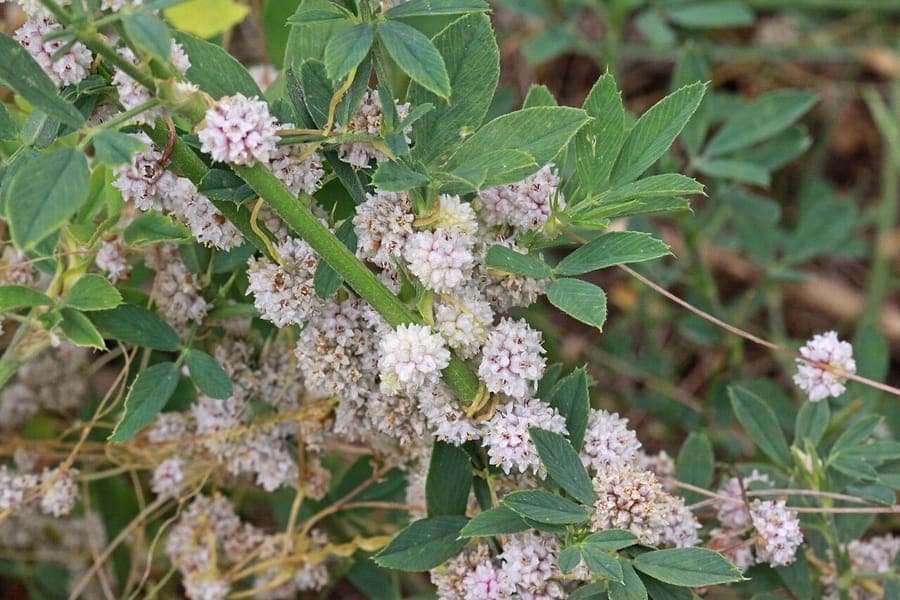
Andrey Zharkikh from Salt Lake City, USA / CC BY 2.0, via Wikimedia Commons
Alfalfa dodder: complete guide
Cuscuta approximata
Want to see Alfalfa dodder: complete guide in your garden?
1 minute, no credit card
Alfalfa dodder (Cuscuta approximata), also called smooth-seed alfalfa dodder, is a remarkable and utterly unique parasitic plant from the Convolvulaceae (morning glory) family. Unlike most plants, this species does not grow from seed in soil. Instead, it germinates in the vicinity of a host plant, twines around its stems, and penetrates it with specialized suction-like structures (haustoria) to extract water and nutrients directly from the host's vascular system.
Native to the Mediterranean region through Southwest Asia to Indo-China, Cuscuta approximata is of global agricultural importance as a weed on alfalfa (lucerne) fields and other legume crops. While it represents a genuine agricultural pest, it is also ecologically fascinating and scientifically valuable, offering insights into parasitic plant adaptations.
Appearance & Growth
Alfalfa dodder forms thread-like, reddish-orange stems without leaves, which twine tightly around host plants. These stems contain no chlorophyll and are entirely dependent on their hosts for nutrition and water. Growth begins from seed germination near a host plant, after which the seedling locates the host through chemical cues and growth-response mechanisms.
The characteristic smooth seeds (about 1-2 mm diameter) are the primary means of dispersal. One infected plant can produce thousands of seeds, ensuring rapid spread across fields if unchecked.
Ecological Role & Agricultural Significance
In natural settings, Cuscuta approximata occurs on various host plants in semi-arid and Mediterranean regions, where it likely plays a role in plant evolution and resistance development. However, in agricultural systems, it is a serious pest, particularly on alfalfa (Medicago sativa) and other legume crops, where it significantly reduces yields by depleting host plants of nutrients.
Management strategies include sanitation (preventing seed production), hand-removal of infested material, and selective herbicides that target the dodder while protecting the host crop.
Free design
Want to see Alfalfa dodder: complete guide in your garden? Make a free design now.
Identification
The characteristic reddish-orange colour distinguishes Cuscuta approximata from many other dodder species. The absence of leaves and fine, thread-like structure are distinctive. When flowering, tiny yellow flowers appear in compact clusters. Seeds are smooth and small.
Host Plants
Alfalfa (Medicago sativa) is the primary host of agricultural concern. In nature, Cuscuta approximata parasitizes wild bergamot, chicory, and numerous herbaceous plants. The species shows apparent preference for legumes (pea family plants).
Botanical & Scientific Interest
Dodders like Cuscuta approximata fascinate botanists because of their:
- Highly specialized parasitic adaptations (haustoria)
- Absence of roots
- Reduction or loss of leaves
- Evolution of extreme nutrient dependence
- Chemical signalling and host-location mechanisms
Research on dodder-host interactions reveals much about plant communication, nutrient transfer, and defence mechanisms.
In Home Gardens
Alfalfa dodder is unlikely to appear in ornamental home gardens because its host range is relatively narrow and it does not spread through commercial seeds or plants. However, gardeners growing alfalfa as a cover crop or forage should remain vigilant for early signs of infestation.
In Conclusion
Alfalfa dodder is not a plant for home gardeners to cultivate! It is an ecologically fascinating parasite of significant agricultural concern. Its study advances our understanding of parasitic plant adaptations and plant-to-plant interactions. For gardeners: focus on healthy plant cultivation and weed prevention. For farmers: monitor legume fields carefully for early dodder detection. Visit gardenworld.app for more on sustainable gardening practices.
Want to see Alfalfa dodder: complete guide in your garden? Make a free design now.
Upload a photo, pick a style, and get a photorealistic design with plant list in under a minute.
No credit card required


Similar plants
Spreading alkaliweed: complete guide
Cressa truxillensis
Full growing guide for Cressa truxillensis, the salt-tolerant groundcover of alkaline flats: location, soil, watering, pruning and winter care.
Betony-leaved bindweed: complete guide
Convolvulus betonicifolius
Full guide to betony-leaved bindweed (Convolvulus betonicifolius): origin, appearance, ideal site, soil, watering and garden uses.
Ivyleaf morning glory: complete guide
Ipomoea hederacea
Everything about Ipomoea hederacea: location, soil and climbing care. A fast-growing annual vine with blue funnel flowers for sunny walls and pergolas.