
Themodoccypress / CC BY 3.0, via Wikimedia Commons
Baker Cypress: complete guide
Cupressus bakeri
Want to see Baker Cypress: complete guide in your garden?
1 minute, no credit card
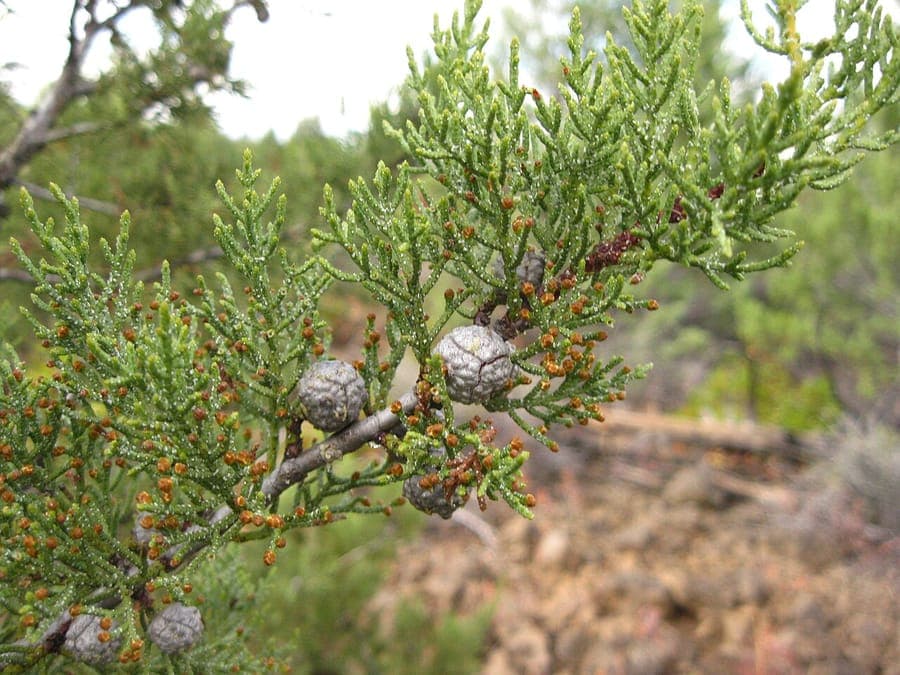
Baker Cypress (Cupressus bakeri), also known as Modoc Cypress or Siskiyou Cypress, is an elegant conifer native to the mountain regions of northern California. This stately tree belongs to the Cupressaceae family and is prized for its narrow, columnar growth habit and grey-green foliage that appears faintly blue-tinted in sunlight.
Baker Cypress grows slowly to an average of 15-20 meters at maturity, though older specimens can reach 25-30 meters under ideal conditions. The tree naturally forms a narrow, upright silhouette that is perfect for accent plantings, formal gardens, or windbreaks. The foliage is small, scale-like, and tightly arranged, giving the tree a fine, feathery texture.
The bark is grey to reddish-brown and exfoliates in thin strips, offering winter interest. The tree produces inconspicuous flowers in spring. The fruits are small, round cones roughly the size of a pea, initially green before fading to grey as they mature.
Ideal location
Baker Cypress thrives in full sun, requiring 6-8 hours of direct sunlight daily. It is extremely drought-tolerant and suited to USDA zones 7 to 10. Once established, the tree can survive extended periods without supplemental water, making it ideal for water-wise gardens in warm, dry climates. Avoid exposed windy sites or areas with heavy snow loads, though young trees can be carefully trained to develop wind resistance.
The tree tolerates both coastal climates and continental summer drought, provided winters are not severely harsh. In cooler regions, Baker Cypress can grow in protected locations such as south-facing walls or sheltered front gardens.
Soil and drainage
Drainage is critical: Baker Cypress absolutely requires well-draining soil. Heavy clay or permanently wet soils almost always result in root rot and tree death. Sandy, gravelly, and rocky soils are ideal. Fill planting holes with at least 50% coarse sand, gravel, or perlite mixed with nutrient-rich topsoil.
Soil pH can range from neutral to slightly alkaline (pH 6.5-8.0). Add organic matter (bark chips, leaf compost) for water retention in very dry soils, but ensure excess water drains rapidly. Plant on slightly raised ground or in raised beds in rainy climates.
Planting and establishment
Plant Baker Cypress in spring or early autumn. In maritime climates (Benelux), spring is preferable so the tree can establish throughout summer. Dig a planting hole twice as wide but no deeper than the root ball. Position the tree so the top of the root ball is level with the ground surface.
Backfill with your drainage mix, firm gently without excessive pressure. Water thoroughly but avoid waterlogging. Apply a 5-7 cm mulch layer of tree bark, keeping it 7-10 cm from the trunk to retain moisture and suppress weeds. Staking may be needed for young trees in windy sites.
Watering
During the first growing season (months 1-6), soil should remain moist but not saturated. Water deeply 2-3 times weekly during dry spells, depending on rainfall. After establishment (2-3 months), gradually reduce watering frequency.
Mature trees need little supplemental water beyond local rainfall. Even in dry summers in Mediterranean regions, natural precipitation usually suffices. During frost periods (particularly in temperate zones), water in late autumn or early winter if there has been no rain for more than 2 weeks. In wet climates, no supplemental watering is necessary.
Pruning and maintenance
Baker Cypress naturally develops a graceful, upright form; intensive pruning is rarely required. Remove only dead, diseased, or damaged branches in early spring. If the tree grows too wide or you want a more compact form, light pruning in May-June (after spring growth but before summer heat) is acceptable. However, cutting old wood often does not stimulate new growth in cypresses.
To maintain a crisp, columnar shape, pinch out young shoots in May-June, particularly lateral branches. Mature trees need minimal maintenance and naturally form a beautiful silhouette.
Free design
Want to see Baker Cypress: complete guide in your garden? Make a free design now.
Maintenance calendar
January-February: Inspect branches for frost damage. Remove heavy snow from young specimens to prevent breakage. Water during dry frost periods.
March-April: New growth begins; monitor moisture balance. Remove dead wood.
May-June: Peak growth period. Light pruning possible. Scout for pests.
July-September: Minimal water needed; only during extreme drought.
October-November: No feeding. Provide shelter against late autumn storms.
December: Protect against frost in zones 7-8; avoid late pruning.
Winter hardiness
Baker Cypress is hardy in USDA zones 7b to 10, tolerating temperatures down to approximately -10 degrees Celsius. However, young trees may suffer frost damage after mild spells followed by sudden cold snaps. In zones 7a and colder, sheltered positioning and winter protection are essential.
In mixed climates (Netherlands, Belgium, southern Germany), protected placement against a warm wall or in a sheltered front garden is necessary. Heavy snow can damage young branches, so gently remove accumulated snow from young specimens.
Companion planting
Baker Cypress combines beautifully with other drought-tolerant and Mediterranean plants. Pair with lavender, rosemary, santolina, or sage for foliage and flower contrast. Low groundcovers such as creeping thyme or Sedum create attractive foreground plantings. In formal gardens, two or four specimens flanking an entrance create dramatic effect.
Avoid plantings with moisture-loving groundcovers such as forget-me-nots or hosta, as these attract excess moisture that cypress dislikes. Stone, gravel, and drought-tolerant succulents create a harmonious composition.
Propagation
Baker Cypress is usually grown from seed in propagation chambers, though semi-hardwood cuttings in summer are possible. Seed requires no special pretreatment and germinates best at temperatures around 15-20°C. Young seedlings must be in very well-draining seed compost and gradually hardened to outdoor light.
Cuttings of young material can be taken mid-July to September; use coarse sand with some topsoil, maintain high humidity but ensure good drainage. Rooting takes 8-12 weeks. Seedlings and rooted cuttings are susceptible to overwatering and fungal issues.
Pests and diseases
Baker Cypress is generally very robust. Root rot (from Phytophthora and related fungi) is the greatest hazard, occurring in poorly drained soil. Once brown, sinking branches appear, it is often too late. Prevention through good drainage is essential.
In warm, humid climates, scale insects occasionally occur; treat with winter oil spray in January-February. Cypress bark moth is a threat in North America but is limited in Europe.
Recommendations for gardenworld design
Baker Cypress is excellent for formal gardens, Mediterranean themes, and drought-tolerant designs. Use as a solitary accent (3-5 meters at maturity), as a windscreen element, or in pairs flanking garden entrances. Also suits larger gardens (300+ square meters) where screening is desired.
For smaller gardens, seek compact cultivars (Cupressus bakeri 'Compacta'), though these are less readily available. Natural height makes it unsuitable for very small urban gardens.
Nureries in NL/BE: Intratuin, Gamma (limited stock). Germany: OBI, Hornbach. France: Truffaut, Jardiland. UK: larger garden centres with Mediterranean selections.
Conclusion: Baker Cypress offers elegance, water-efficiency, and minimal maintenance - invaluable for future-proofing gardens against drought and neglect.
Want to see Baker Cypress: complete guide in your garden? Make a free design now.
Upload a photo, pick a style, and get a photorealistic design with plant list in under a minute.
No credit card required


Similar plants
Cupressus macnabiana: complete guide
Cupressus macnabiana
The Fragrant Cypress offers elegant growth with fine, aromatic foliage. Perfect for temperate climates and as specimen trees in contemporary gardens.
Cupressus guadalupensis: complete guide
Cupressus guadalupensis
The Guadalupe cypress: an elegant conifer for gardens. Complete cultivation guide for this Mexican cypress. Information about care, location, form and maintenance.
Austrocedrus chilensis: complete guide
Austrocedrus chilensis
Discover Austrocedrus chilensis, the Chilean Cedar ornamental conifer. Elegant specimen with fine foliage and columnar form for permanent structure.