
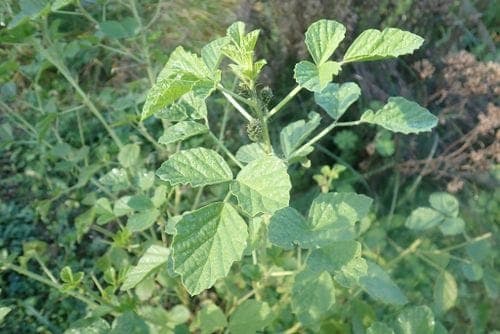
Thomas Gyselinck / CC BY 4.0, via Wikimedia Commons
Cullen americanum: complete guide
Cullen americanum
Want to see Cullen americanum: complete guide in your garden?
1 minute, no credit card
Overview
Cullen americanum, also known as American scurfpea or psoralée d'Amérique, is a legume species naturally occurring in North Africa and the Mediterranean region, though it is also naturalized in North America. This plant belongs to the Fabaceae family and offers multiple benefits for sustainable gardens, including nitrogen fixation and ecological value for pollinators.
The plant is renowned for its resilience and adaptability to various growing conditions. With its compact growth and efficient root development, Cullen americanum is a sensible choice for the modern front garden.
Appearance & Bloom
Cullen americanum is a sturdy, compact-growing plant, typically 30-60 cm tall, with strong, upright stems. The leaves are compound, small, and lanceolate, giving the plant a refined appearance. The flowers are small, fragrant blooms in violet-tinted colors, grouped in dense spikes along the stems.
The fruits are small pods containing seeds, giving the plant value for cultivating future generations. The plant offers significant nutritional value for livestock and was historically used as a fodder crop.
Ideal Location
Cullen americanum thrives best in sunny positions with 6-8 hours of direct sunlight daily. While the plant can tolerate light shade, optimal growth and flowering are achieved in full sun. The plant is highly tolerant of wind and drought, making it ideal for exposed garden locations.
The plant is well-suited to warm, dry conditions and grows well even on poor soils. It is perfect for dry gravel plantings and xeriscaping gardens.
Free design
Want to see Cullen americanum: complete guide in your garden? Make a free design now.
Soil
Cullen americanum grows in a broad spectrum of soils, from heavy clay to light sand. The plant is not particular and can even grow on very poor soils. The plant prefers well-draining soils; waterlogged conditions can cause problems.
The plant can grow on both acidic and alkaline soils. As a legume, Cullen americanum contributes to soil quality improvement through nitrogen fixation via symbiosis with nodule-forming bacteria in root nodules.
Watering
Once well-established, Cullen americanum is highly drought-tolerant. Regular watering is important only in the first growing year after planting. Water deeply, less frequently, to encourage the plant to develop deep roots.
Toward the end of the growing season (August-September), watering can be reduced. In normally rainy periods, extra watering is unnecessary.
Pruning
Cullen americanum requires minimal pruning. After flowering, remove spent flowers to maintain a neat appearance. In spring, the plant can be cut back to approximately 15-20 cm from the ground to encourage fuller growth.
Avoid heavy autumn pruning.
Maintenance Calendar
March: Cut back. Check for pest or disease issues. May-July: Regular observation. Removal of spent flowers. August-September: Reduction of watering. Seed collection. October-February: Minimal maintenance.
Winter Hardiness
Cullen americanum is moderately winter-hardy in temperate European climates. In zones 6-9, the plant usually survives winter without protection. In colder climates, protection may be beneficial.
Companion Planting
Cullen americanum pairs well with other drought-tolerant plants and legume species. The plant works well in underplanting with other legume types.
Closing Thoughts
Cullen americanum is a reliable, low-maintenance plant with many practical benefits. For more plant recommendations and garden inspiration, visit gardenworld.app, your source for complete garden designs. Gardenworld.app also offers complete plant packages perfect for these types of species.
Want to see Cullen americanum: complete guide in your garden? Make a free design now.
Upload a photo, pick a style, and get a photorealistic design with plant list in under a minute.
No credit card required


Similar plants
Tall Silky Lupine: complete guide
Lupinus elatus
Tall silky lupine is a fast-growing Californian perennial with silvery foliage and blue-purple flower spikes, ideal for a prairie-style garden.
Garfield Lupine: complete guide
Lupinus garfieldensis
The Garfield lupine is a rare, fast-growing American perennial for alkaline, dry grassland gardens, with striking blue flower spikes.
Lupinus elegans: complete guide
Lupinus elegans
Lupinus elegans, the elegant lupine, is a spectacular blooming plant from Mexico with blue flower spikes. Care, cultivation and garden use.