
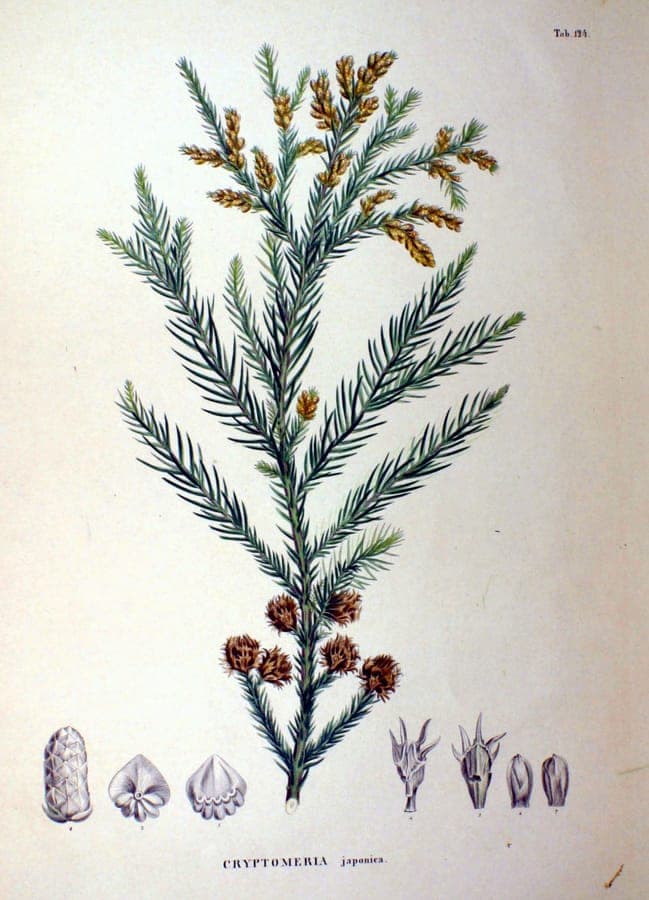
Philipp Franz von Siebold and Joseph Gerhard Zuccarini / Public domain, via Wikimedia Commons
Japanese red-cedar: complete guide
Cryptomeria japonica
Want to see Japanese red-cedar: complete guide in your garden?
1 minute, no credit card
Overview
Cryptomeria japonica, commonly known as Japanese red-cedar, is a majestic evergreen conifer native to Japan. It's a popular choice in UK and US gardens for its elegant form, year-round foliage, and natural screening ability. Mature trees reach 15–25 m tall and 4–6 m wide, growing at a steady 20–30 cm per year. It's not a true cedar, but a member of the Cupressaceae family, closely related to cypresses. This tree thrives in temperate climates and is suitable for USDA zones 5 to 8. Whether used as a focal point, windbreak, or tall hedge, it brings structure and greenery long after deciduous plants have gone dormant. On gardenworld.app, you can design a layout that accounts for its mature size and seasonal impact.
Appearance & bloom cycle
Japanese red-cedar has a conical to columnar shape with dense, upward-sweeping branches. The foliage is soft and feathery, ranging from bright emerald green to golden bronze in certain cultivars. 'Elegans' shows golden new growth in spring, while 'Vilmoriniana' stays compact with gracefully arching tips. Needles are 4–8 mm long and arranged in flat sprays, giving a lush texture. It produces small, round cones about 1.5 cm wide that ripen in autumn. True flowering is inconspicuous-tiny male and female cones appear in spring-but the ornamental value lies in its consistent foliage and strong silhouette. Unlike many conifers, it doesn't turn brown in winter, making it ideal for winter interest.
Ideal location
Plant in full sun to light shade. Full sun promotes denser growth and better color. In deep shade, the tree becomes leggy and sparse. Allow at least 3–4 m between specimens if planting as a screen. Avoid exposed, windy sites-especially coastal areas with salt spray, which can scorch foliage. Young trees benefit from shelter during first winters. In colder zones (5–6), plant on a south- or west-facing slope to reduce frost stress. Consider microclimates in your garden-areas near walls or fences can offer extra protection.
Soil requirements
Prefers moist, well-drained, acidic to neutral soil (pH 5.0–6.5). It struggles in alkaline or compacted clay soils. Amend heavy soils with compost and sand to improve drainage. For container planting, use ericaceous compost with added perlite. Raised beds work well in poorly drained sites. Avoid waterlogged conditions-root rot is a risk. A 5–8 cm mulch layer of pine bark helps retain moisture and suppress weeds.
Free design
Want to see Japanese red-cedar: complete guide in your garden? Make a free design now.
Watering
Young trees need consistent watering for the first two years. Water deeply once a week during dry spells, especially in summer. Mature trees are moderately drought-tolerant but perform best with even moisture. Water at the base-overhead spraying encourages fungal issues. Reduce watering in winter when growth slows. During prolonged dry periods, even established trees benefit from supplemental irrigation.
Pruning
Minimal pruning is needed-Cryptomeria japonica naturally maintains a neat shape. If used as a hedge, light trimming in June or early July keeps it dense. Avoid cutting into bare wood; regrowth is unreliable. Use sharp, clean shears and only remove the soft new growth. Over-pruning causes brown patches that may not recover. For formal shapes, prune annually. Remember: slow growth means mistakes take years to correct. Use gardenworld.app to visualise pruning zones and spacing before planting.
Maintenance calendar
- January: Inspect for winter damage. Remove dead or broken branches.
- February: No action needed unless protecting young plants from late frost.
- March: Check for pests. Apply slow-release conifer fertiliser.
- April: Top up mulch. Monitor soil moisture as temperatures rise.
- May: Water if dry. Watch for aphids or spider mites.
- June: Light formative pruning if required.
- July: Deep water during heatwaves. Avoid fertilising now.
- August: No pruning-growth is slowing.
- September: Stop feeding. Check for fungal spots or pests.
- October: Clear fallen cones and debris.
- November: Protect young trees with burlap wraps in exposed areas.
- December: Final inspection for rodent damage or snow load.
Winter hardiness
Hardy in USDA zones 5–8 (-23°C to -12°C). In colder zones, winter desiccation can occur, especially in sunny, windy spots. Foliage may bronze but generally recovers in spring. Young trees are more vulnerable-use anti-desiccant sprays or windbreaks. Mulch heavily around the base to insulate roots. In zone 5, choose sheltered locations and avoid late-season fertilising.
Companion plants
Pair with shade-tolerant, moisture-loving plants like ferns, hostas, and heucheras. Avoid aggressive root competitors like maples or birches. Underplant with dwarf conifers or hellebores for year-round interest. For contrast, use variegated ivies or carex. Avoid planting near shallow-rooted vegetables or lawn areas that require frequent watering.
Closing
Cryptomeria japonica is a long-term investment in your garden's structure and beauty. With proper placement and care, it will thrive for decades. Buy from trusted garden centres that offer healthy, well-established specimens. If you're unsure about spacing or design, use gardenworld.app to plan your layout and avoid overcrowding. This tree rewards patience with elegance and resilience.
Want to see Japanese red-cedar: complete guide in your garden? Make a free design now.
Upload a photo, pick a style, and get a photorealistic design with plant list in under a minute.
No credit card required


Similar plants
Cupressus macnabiana: complete guide
Cupressus macnabiana
The Fragrant Cypress offers elegant growth with fine, aromatic foliage. Perfect for temperate climates and as specimen trees in contemporary gardens.
Cupressus guadalupensis: complete guide
Cupressus guadalupensis
The Guadalupe cypress: an elegant conifer for gardens. Complete cultivation guide for this Mexican cypress. Information about care, location, form and maintenance.
Austrocedrus chilensis: complete guide
Austrocedrus chilensis
Discover Austrocedrus chilensis, the Chilean Cedar ornamental conifer. Elegant specimen with fine foliage and columnar form for permanent structure.