
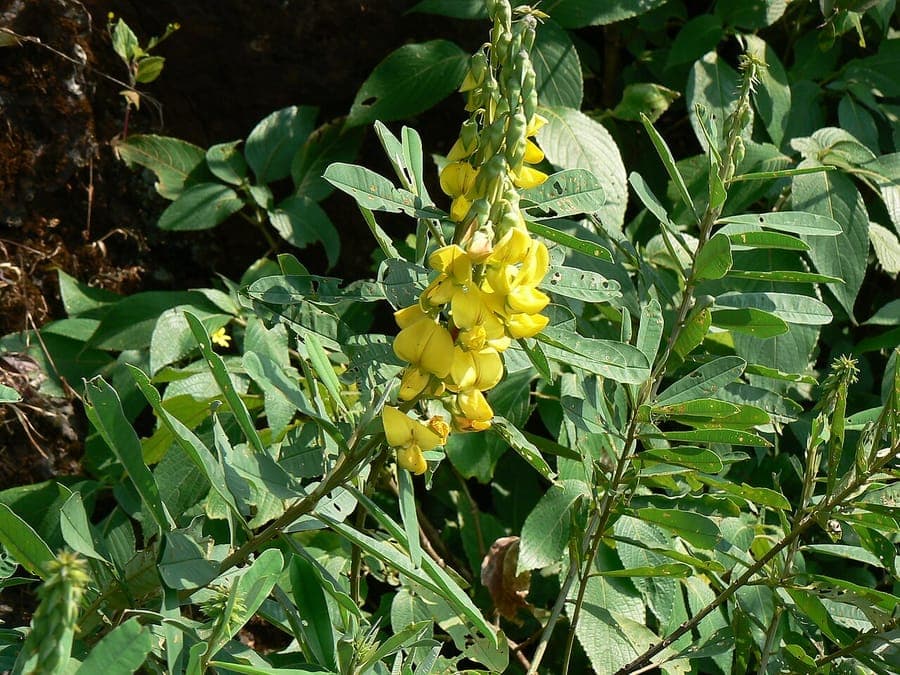
Dinesh Valke from Thane, India / CC BY-SA 2.0, via Wikimedia Commons
Showy rattlebox: complete guide
Crotalaria spectabilis
Want to see Showy rattlebox: complete guide in your garden?
1 minute, no credit card
Overview
Crotalaria spectabilis, commonly known as showy rattlebox or showy rattlepod, is a fast-growing annual herb in the legume family (Fabaceae). Native to the Indian subcontinent and Southeast Asia - from Pakistan and Nepal through to Vietnam and Taiwan - it has naturalized widely across tropical and subtropical regions worldwide, including parts of the Americas, Africa, and Australia. This global spread reflects the plant's remarkable adaptability to varied soils and climates.
The genus name Crotalaria derives from the Greek krotalon, meaning rattle or castanet, a reference to the mature seed pods in which loose seeds rattle audibly at the slightest breeze. This charming characteristic has earned it folk names like 'cats bell' and 'rattleweed' in different parts of its range. The species epithet spectabilis means 'showy' or 'remarkable' in Latin, and the plant certainly lives up to that description.
For the keen gardener, showy rattlebox offers a compelling combination of ornamental value - towering spikes of bright lemon-yellow flowers up to 40 cm tall - and practical benefit as a nitrogen-fixing cover crop that improves soil fertility. Whether used as a summer annual in borders, grown in large containers on a sunny terrace, or incorporated into a vegetable garden as a green manure, this plant rewards attention with generous returns. Browse the gardenworld.app plant library for more ideas on combining nitrogen-fixing annuals with ornamental borders.
Appearance and bloom cycle
Crotalaria spectabilis develops as an upright, single-stemmed herb typically reaching 60 to 120 cm in height, occasionally growing to 150 cm under ideal conditions. The single-crown growth form means the plant emerges from one central point, developing lateral branches higher up the main stem as the season progresses.
The leaves are simple, obovate to oblong in shape, measuring 6 to 12 cm in length, and are mid-green with a medium-textured surface. Both leaf undersides and stems carry a fine, silky pubescence that gives the plant a soft, almost velvety quality when examined closely.
The flowers are the undisputed highlight. Arranged in upright racemes 20 to 40 cm long that rise well above the foliage, each individual bloom is a classic papilionaceous (butterfly-shaped) legume flower measuring roughly 2 to 2.5 cm across. The standard petal - the large banner petal - is bright lemon-yellow and typically shows subtle purple veining near the base, which provides a charming contrast. In British and European garden centres, showy rattlebox is sometimes sold as an ornamental annual alongside more common legume flowers like sweet pea and bird's foot trefoil.
Flowering begins in July and continues through October, with peak abundance in August and September. After pollination, the distinctive seed pods develop: broad-ovoid capsules 3 to 5 cm long, initially green and turning black as they ripen. The loose seeds inside rattle audibly when shaken, which children find particularly delightful. Ripe pods can be collected for dried arrangements or seed saving.
Ideal location
Showy rattlebox demands a position in full sun, receiving at least six hours of direct sunlight daily. As a pioneer species of open, sun-baked habitats in tropical Asia, the plant has a deep-rooted affinity for warmth and strong light. In partial shade, it grows somewhat smaller and produces fewer flower spikes, though it will still bloom.
In the UK and northern Europe, sow seeds outdoors from late May onwards, once night temperatures remain reliably above 10°C. Pre-soak seeds in warm water for 24 hours to improve germination rates. The plant will not survive frost and should be treated as a half-hardy annual. Choose a sheltered spot, preferably against a south-facing wall or in a sun-trap corner of the garden, where ambient temperatures run slightly warmer than the open garden.
Crotalaria spectabilis also works beautifully as a container plant in pots at least 30 cm in diameter and 35 cm deep, placed on a sunny patio or terrace. Its upright habit makes it naturally dramatic in large planters. In mild urban gardens, the plant can reach remarkable size by late summer, providing a tropical aesthetic that gardenworld.app features prominently in its warm-climate garden design examples.
Soil requirements
One of the great virtues of Crotalaria spectabilis is its tolerance of a wide range of soil types. It grows well in sandy, loamy, and light clay soils, provided drainage is adequate. It will not perform in waterlogged ground. The acceptable pH range is notably broad, from 4.9 to 8.0, making it suitable for the vast majority of garden soils without amendment.
Thanks to the nitrogen-fixing bacteria housed in its root nodules - a symbiosis typical of legumes - showy rattlebox actually performs better on moderately poor soils than on overly rich ones. Excessively fertile ground tends to stimulate leafy growth at the expense of flowering. When preparing the planting area, incorporate a modest amount of garden compost for structure improvement but avoid heavy applications of nitrogen-rich fertiliser.
Where the plant is grown specifically as a green manure, it should be turned into the soil after flowering but before seed set, allowing the nitrogen-rich organic matter to decompose and gradually release nutrients to subsequent crops. This practice is widely used in tropical and subtropical organic farming systems.
Free design
Want to see Showy rattlebox: complete guide in your garden? Make a free design now.
Watering
Showy rattlebox has moderate water needs. During the establishment phase and in the first weeks after outdoor sowing, consistent moisture supports germination and early growth. Germination typically occurs within 7 to 14 days at a soil temperature of at least 18°C.
Once established in open ground, the plant shows reasonable drought tolerance and rarely needs supplemental irrigation during an average British or European summer. During extended dry spells lasting more than two weeks, however, a deep, thorough watering is beneficial - watering slowly and deeply rather than lightly sprinkling, to encourage the roots to reach down into the soil profile.
Container-grown plants require more frequent attention, especially during hot, sunny spells. Check soil moisture by pressing a finger 3 to 4 cm into the compost; water when the compost feels dry at that depth. Ensure containers have adequate drainage holes and never allow pots to stand in saucers of water for extended periods, as root rot can develop quickly in waterlogged conditions.
Pruning
As an annual, Crotalaria spectabilis requires no structural pruning. The plant completes its life cycle from germination through growth, flowering, and seed production within a single growing season. Removing spent flower spikes keeps the plant looking tidy, but has little effect on new flower production as fresh spikes continue to emerge from the upper stem.
If seed saving is the goal, leave selected spikes to mature fully until the pods turn black and begin to feel papery. Harvest them on a dry day and spread them in a single layer in a warm, well-ventilated place to complete drying before extracting seeds for storage. Store seeds in a sealed paper or foil envelope in a cool, dry place - they maintain viability for two to three years under these conditions.
In glasshouses or in Mediterranean garden climates where the plant can persist for more than one year, a light trim after the main flowering flush can encourage a second wave of blooms.
Maintenance calendar
March–April: Sow seeds indoors on a warm, bright windowsill or in a heated propagator at 20–24°C. Use free-draining seed compost. Pre-soak seeds for 24 hours in warm water to soften the seed coat and improve germination speed.
May: Once night temperatures are reliably above 10°C (typically after mid-May in southern Britain), harden off seedlings gradually over 7 to 10 days before transplanting outside. Space plants 40 to 60 cm apart in well-drained, sunny ground.
June–July: Rapid vegetative growth. The plant can reach 60 to 80 cm by mid-June in a warm season. Watch for the first flower buds appearing at the tips of the main stem and upper branches.
July–September: Peak flowering. The lemon-yellow spikes attract bumblebees, honeybees, and various butterfly species. Immature pods begin forming alongside open flowers by late July.
September–October: Seed ripening. Pods turn black and seeds rattle audibly. Harvest pods for seed saving in dry weather. Plant continues to produce new flowers at the tips until frost.
November: The plant is killed by the first hard frost. Remove or compost plant material, or incorporate into the soil as green manure.
Winter hardiness
Crotalaria spectabilis is not frost-hardy and is treated as a tender annual in the UK and northern Europe. It corresponds to USDA hardiness zones 9 to 11 for perennial cultivation. In colder climates, it must be raised fresh from seed each year.
Seed storage is straightforward: keep seeds dry, cool (8 to 12°C), and in a sealed container away from light. Under these conditions, seed viability can be maintained for two to three years. Seeds are available from specialist annual seed suppliers and online tropical plant nurseries.
Companion plants
The bright lemon-yellow flower spikes of Crotalaria spectabilis pair beautifully with contrasting colour combinations. Blue-purple Salvia farinacea 'Victoria Blue' (45 cm) alongside the taller Crotalaria creates a complementary pairing that garden designers often recommend. For a warmer, more tropical effect, combine with orange Zinnia elegans 'Benary's Giant Orange' (70 to 90 cm) or brick-red Tithonia rotundifolia (Mexican sunflower, 100 to 120 cm).
In naturalistic plantings, Crotalaria pairs well with tall ornamental grasses such as Pennisetum setaceum 'Rubrum' (60 to 90 cm) or Panicum virgatum (switch grass, 90 to 120 cm), whose fine-textured foliage contrasts with the bold flower spikes. For a cottage-garden feel, combine with Cleome hassleriana (spider flower, 80 to 120 cm) or Cosmos bipinnatus 'Sensation Mixed' (80 to 100 cm).
Because showy rattlebox fixes nitrogen, it makes an excellent predecessor or companion for nitrogen-hungry crops in a kitchen garden rotation. Following Crotalaria with brassicas or leafy salad crops the next growing season allows them to benefit from the residual nitrogen. Gardenworld.app offers detailed layout plans for mixed ornamental and productive garden spaces that integrate nitrogen-fixing plants into a cohesive design.
Closing thoughts
Crotalaria spectabilis is a plant that genuinely earns its place in the summer garden. Its towering spikes of lemon-yellow flowers, its rattling seed pods, its rapid growth from seed, and its soil-improving nitrogen fixation make it one of the more rewarding annuals available to the adventurous gardener. Whether used as a bold border accent, a wildlife-friendly flowering plant, or a practical green manure, this showy rattlebox delivers on every front from July through to the first autumn frosts.
Want to see Showy rattlebox: complete guide in your garden? Make a free design now.
Upload a photo, pick a style, and get a photorealistic design with plant list in under a minute.
10,000+ gardens designed already
No credit card required


Similar plants
Tall Silky Lupine: complete guide
Lupinus elatus
Tall silky lupine is a fast-growing Californian perennial with silvery foliage and blue-purple flower spikes, ideal for a prairie-style garden.
Garfield Lupine: complete guide
Lupinus garfieldensis
The Garfield lupine is a rare, fast-growing American perennial for alkaline, dry grassland gardens, with striking blue flower spikes.
Lupinus elegans: complete guide
Lupinus elegans
Lupinus elegans, the elegant lupine, is a spectacular blooming plant from Mexico with blue flower spikes. Care, cultivation and garden use.