
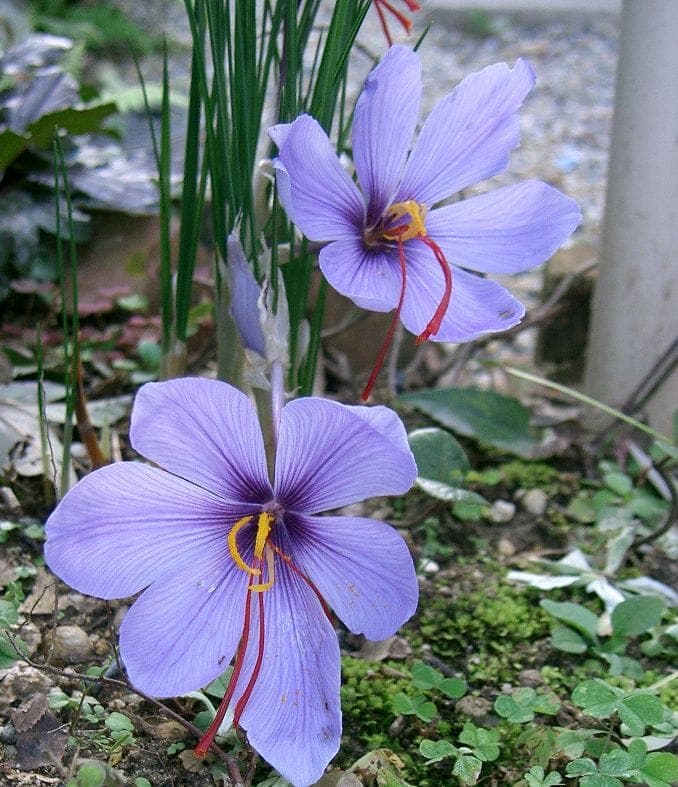
KENPEI / CC BY-SA 3.0, via Wikimedia Commons
Saffron: complete guide
Crocus sativus
Want to see Saffron: complete guide in your garden?
1 minute, no credit card
Overview
Crocus sativus, commonly known as saffron, is the source of the world's most expensive spice. This sterile triploid plant doesn't produce seeds and must be propagated manually by dividing corms. Originating from Greece, it's adapted to Mediterranean climates but grows surprisingly well across temperate zones, including USDA hardiness zones 6 to 8. If you're gardening in the UK, northern Europe, or the northern US, you can still grow it successfully with a bit of attention to drainage and winter moisture.
The real prize lies in the three vivid red stigmas inside each lilac-purple flower. Harvested by hand in the cool of the morning, these delicate threads are dried to produce saffron. You'll need about 150 flowers to yield just one gram, so don't expect to replace your spice rack overnight. But growing your own saffron is a deeply satisfying experience-connecting you to centuries of culinary and medicinal tradition.
On gardenworld.app, you can design a seasonal garden layout that highlights autumn bloomers like saffron, ensuring your garden stays vibrant when most others fade.
Appearance & bloom cycle
Saffron crocus grows to a modest 10–15 cm in height. The flowers emerge in autumn, typically from late October to early November, depending on local conditions. Each bloom features six narrow, pointed petals in a soft lilac-purple hue. At the heart, three long, thread-like red stigmas stand out dramatically. These are the saffron threads.
Leaves appear after flowering-slender, grass-like, and dark green, reaching up to 20 cm. They persist through winter and die back naturally in late spring. The plant remains dormant from June through August.
For visual impact, plant in groups of 50 or more. A mass planting in a rock garden, border, or even in containers will create a striking display. Remember: no two flowers open at once, so peak bloom is staggered over 2–3 weeks.
Ideal location
Full sun is essential-aim for at least 6 hours of direct sunlight daily. A south- or southeast-facing spot works best. Good air circulation helps prevent fungal issues, especially in damp autumns. Avoid areas prone to waterlogging. Raised beds, slopes, or containers with drainage holes are ideal. If you're short on garden space, a terracotta pot on a sunny patio will do just fine.
On gardenworld.app, you can simulate sun exposure for your garden space and pinpoint the best spot for planting saffron corms based on your yard's microclimate.
Free design
Want to see Saffron: complete guide in your garden? Make a free design now.
Soil requirements
Well-drained soil is non-negotiable. Heavy clay retains too much moisture and risks rotting corms. Amend with coarse sand, perlite, or fine grit to improve drainage. A pH between 6.0 and 7.0 is ideal. Incorporate well-rotted compost to boost fertility, but avoid high-nitrogen fertilizers that encourage foliage over flowers.
If your soil is persistently wet, grow in containers using a mix of loam, sand, and compost in equal parts.
Watering
After planting corms in September, water lightly if conditions are dry. Once established, rely on natural rainfall. Overwatering is the biggest threat-saffron corms are highly susceptible to rot in soggy soil. Water only during prolonged droughts in spring, when leaves are active. Stop watering completely once foliage begins to yellow in May.
Pruning
No pruning required. Allow leaves to die back naturally to feed energy back into the corm for next year's bloom. Cutting them too early weakens the plant. Remove dead foliage only after it's fully brown and dry.
Maintenance calendar
- September: Plant corms 10–15 cm deep, spaced 8–10 cm apart
- Late October–November: Flowers emerge-harvest stigmas early morning
- November–February: Dormant period-minimal intervention
- March–April: Leaves grow-light feeding with balanced fertilizer
- May: Foliage yellows-stop watering
- June–August: Full dormancy-store or leave in ground
Winter hardiness
Saffron is hardy in zones 6–8. In zone 6, a light mulch of straw or leaf litter can help protect corms during harsh freezes. In wetter regions, consider lifting corms in summer, drying them thoroughly, and storing in a cool, dark, dry place until replanting in autumn.
Companion plants
Pair saffron with other autumn bloomers like colchicum, anemone hupehensis, or sedum 'Autumn Joy'. The soft purple flowers contrast beautifully with golden or white companions. It also works well in herb gardens with sage, thyme, or oregano. Avoid aggressive spreaders like mint that could overtake the corms.
Closing
Growing your own saffron isn't about yield-it's about the ritual. The quiet morning harvest, the scent of autumn soil, the thrill of drying your first threads. It's a slow garden pleasure. Buy firm, plump corms in late summer from garden centres or online suppliers. Plant them promptly in well-drained soil, and in a few weeks, you'll see the first purple tips breaking through. With care, each corm can multiply over the years, expanding your patch naturally. Whether you use the saffron in paella or simply admire the blooms, it's a plant that rewards patience. Explore planting combinations on gardenworld.app to create a garden that's both productive and beautiful.
Want to see Saffron: complete guide in your garden? Make a free design now.
Upload a photo, pick a style, and get a photorealistic design with plant list in under a minute.
No credit card required


Similar plants
Iris tingitana: complete guide
Iris tingitana
Iris tingitana, the Morocco iris, is the bulb species behind the Dutch iris: early blue-violet blooms that need a sunny, well-drained position.
Iris hookeri: complete guide
Iris hookeri
Hooker's Iris is a compact North American native plant with blue flowers. Low-growing and moisture-loving water plant.
Siskiyou iris: complete guide
Iris bracteata
Complete guide to Iris bracteata, the Siskiyou iris: location, soil, bloom cycle, watering, pruning and companion plants for this rare Pacific Coast iris.