
George Chernilevsky / Public domain, via Wikimedia Commons
Yellow crocus: complete guide
Crocus flavus
Want to see Yellow crocus: complete guide in your garden?
1 minute, no credit card
Overview
Crocus flavus, commonly known as the yellow crocus, is a modest yet vibrant spring-flowering bulb in the Iridaceae family. Native to southeastern Europe-specifically Bulgaria, Greece, Romania, Turkey, and the former Yugoslavia-this hardy perennial thrives in temperate climates and brings one of the first splashes of colour to the garden after winter.
Reaching just 8 to 12 cm in height, Crocus flavus is ideal for naturalising in lawns, rock gardens, or under deciduous trees. As a herbaceous forb, it dies back completely after flowering, allowing surrounding plants to take over as the season progresses. It multiplies steadily through offsets and, given time, can form dense colonies in suitable conditions.
On gardenworld.app, you can visualise how clusters of yellow crocus will look across your garden layout before you plant a single bulb.
Appearance & bloom cycle
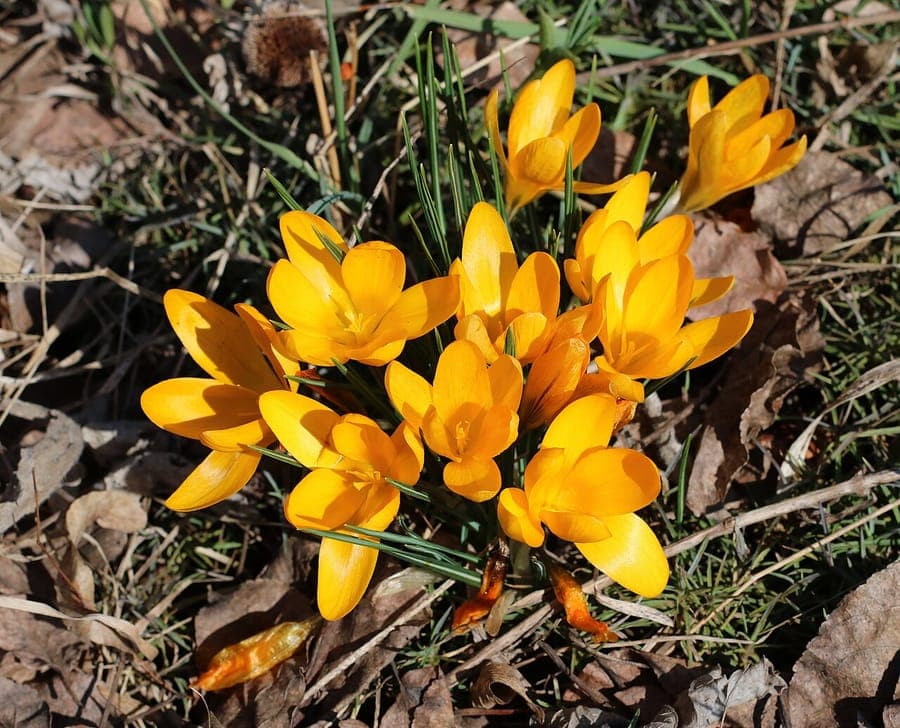
The blooms of Crocus flavus are a rich, golden yellow with prominent orange stigmas that contrast beautifully against the petals. Each flower spans 3 to 4 cm across and opens fully in direct sunlight, closing at night or on overcast days to protect its reproductive parts from cold and moisture.
Bloom time typically runs from late February to early April, depending on local climate and microclimate. In milder zones like USDA 7 and 8, flowering may begin as early as mid-February. The narrow, grass-like leaves emerge alongside the flowers, displaying a central greyish stripe that helps with identification.
Individual flowers last about a week, but with staggered blooming across a group, the overall display can last 3 to 4 weeks. This makes Crocus flavus a reliable performer for early-season interest.
Ideal location
For best results, plant yellow crocus in full sun to partial shade. A minimum of 5 to 6 hours of direct sunlight ensures strong flowering. It performs especially well in open grassy areas or beneath light-canopy trees like birch or alder, which leaf out late and don't block early spring light.
Avoid heavy shade from evergreens or dense shrubs. Also, remember that while the crocus flowers in early spring, it needs sunlight during this period-once surrounding trees are fully leafed out by May, the spot may become too dark for reliable re-blooming.
Use gardenworld.app to map sun exposure in your garden and pinpoint the perfect planting zones for your crocus display.
Soil requirements
Crocus flavus is adaptable but demands well-drained soil. It tolerates a range of soil types-sandy, loamy, or even clay-as long as water doesn't pool around the bulbs. Poor drainage is the leading cause of bulb rot, especially during summer dormancy.
The ideal pH range is between 6.0 and 7.0. If planting in heavy clay, amend the soil with horticultural grit or compost to improve aeration. In containers, use a mix of two parts potting soil to one part perlite or coarse sand.
Free design
Want to see Yellow crocus: complete guide in your garden? Make a free design now.
Watering
During the active growing season (February to May), yellow crocus relies mostly on natural rainfall. Only supplement with watering during prolonged dry spells, especially if the soil feels dry 2–3 cm below the surface.
Once foliage begins to yellow and die back in late spring, stop watering entirely. The bulbs enter dormancy and can rot if exposed to excess moisture over summer.
Pruning
No pruning is required. After flowering, allow the foliage to remain intact for at least six weeks. This period is crucial for photosynthesis, which feeds the bulb for next year's blooms.
Never cut or tie the leaves. If planted in a lawn, delay mowing until at least six weeks after the last flower fades. This simple step ensures healthy bulb development and stronger returns in subsequent years.
Maintenance calendar
- January: Check for emerging shoots; protect from extreme frost with a light mulch if needed.
- February: Flowers begin to open; keep area free of fallen leaves.
- March: Peak bloom; guard against slugs if present.
- April: Flowering ends; let seed capsules mature if you want natural spread.
- May: Foliage dies back; stop watering.
- June–August: Dormant period; no care needed.
- September–October: Ideal planting window-set bulbs 8–10 cm deep, spaced 10 cm apart.
- November–December: Leave undisturbed unless relocating.
Winter hardiness
Crocus flavus is winter-hardy in USDA zones 3 to 8. It handles temperatures down to -35°C when properly planted. In colder zones, a thin layer of leaf litter or straw can help buffer freeze-thaw cycles, but avoid thick, moisture-trapping covers.
In zone 8, ensure bulbs are planted deep enough (at least 10 cm) to stay cool and avoid premature sprouting during warm spells.
Companion plants
Pair yellow crocus with other early bloomers like glory-of-the-snow (Chionodoxa), snowdrops (Galanthus), or winter aconite (Eranthis hyemalis). In rock gardens, combine with dwarf irises or sedums for layered texture.
Under trees, plant alongside wood anemones or bluebells. Later-emerging perennials like hostas or ferns will cover the fading crocus foliage without competing for early-season resources.
Closing
Crocus flavus is a dependable, cheerful addition to any garden. Its bright yellow flowers cut through late winter greyness, and its minimal care needs make it a favourite among both novice and experienced gardeners.
Plant in groups of 25 or more for a striking visual impact. Purchase fresh, firm bulbs in autumn from garden centres like B&Q, Wyevale, or local independents. Avoid soft or mouldy bulbs. Plant promptly after purchase to ensure strong root development before winter.
Want to see Yellow crocus: complete guide in your garden? Make a free design now.
Upload a photo, pick a style, and get a photorealistic design with plant list in under a minute.
10,000+ gardens designed already
No credit card required


Similar plants
Iris tingitana: complete guide
Iris tingitana
Iris tingitana, the Morocco iris, is the bulb species behind the Dutch iris: early blue-violet blooms that need a sunny, well-drained position.
Iris hookeri: complete guide
Iris hookeri
Hooker's Iris is a compact North American native plant with blue flowers. Low-growing and moisture-loving water plant.
Siskiyou iris: complete guide
Iris bracteata
Complete guide to Iris bracteata, the Siskiyou iris: location, soil, bloom cycle, watering, pruning and companion plants for this rare Pacific Coast iris.