
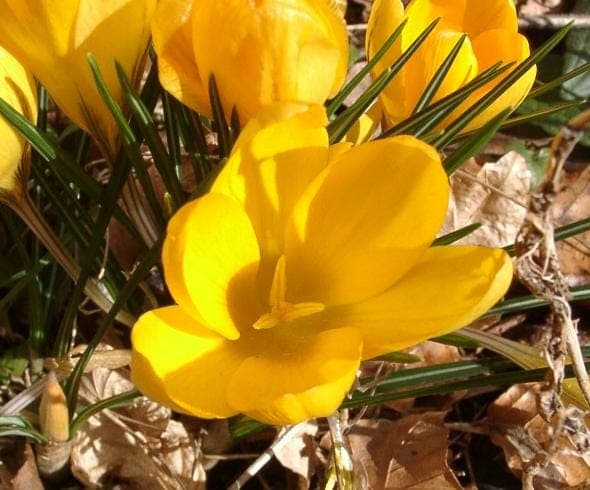
The original uploader was Ramin Nakisa at English Wikipedia. / CC BY-SA 3.0, via Wikimedia Commons
Golden crocus: complete guide
Crocus chrysanthus
Want to see Golden crocus: complete guide in your garden?
1 minute, no credit card
Overview
The Golden crocus, known botanically as Crocus chrysanthus, is one of the first signs that winter is loosening its grip. Native to the Balkans - Albania, Bulgaria, Greece, Romania and Turkey - this tough little bulb thrives in grasslands and open woodlands. In UK and US gardens, it's right at home in lawns, rockeries, under shrubs or in containers. It only grows 5 to 8 cm tall, but its bold, cup-shaped flowers punch well above their weight. What's more, it multiplies naturally over time, often forming dense drifts within a few years.
One of the best things about this crocus? It's practically care-free. Once planted in autumn, it comes back year after year with minimal effort. On gardenworld.app you can design a planting scheme that fits your garden's layout and sunlight patterns, ensuring your crocus colonies thrive in the right spots.
Appearance & bloom cycle
Crocus chrysanthus blooms between late February and mid-April, depending on your climate. In milder zones, you might see flowers as early as week 6 of the year. The blooms are star-shaped, with six petal-like tepals. Most are golden yellow - hence the name 'chrysanthus' meaning 'golden flower' - but cultivars come in white, pale purple and bicolor forms, often with a dark basal blotch inside.
The flowers open only in direct sunlight and close at night or on overcast days. Each bloom lasts about 5 to 7 days. The narrow, grass-like leaves appear alongside or just after the flower, 2 to 3 mm wide, bright green with a central silver stripe. They stay visible for 6 to 8 weeks before dying back.
Ideal location
This crocus loves full sun to light shade. Plant in areas that get at least 4 to 6 hours of direct sunlight daily. It's perfect for lawns, as it blooms before most grass growth begins. You can also tuck it into rock gardens, along pathways or under deciduous trees that leaf out late, such as dogwood or redbud.
For a natural look, scatter the corms and plant them where they land. This random pattern mimics how they grow in the wild. On gardenworld.app, you can simulate this planting style in a digital garden plan, helping you visualise how the crocus carpet will develop over time.
Soil requirements
Well-drained soil is essential. Heavy clay should be amended with horticultural sand or compost to improve drainage. Ideal soil is light, loamy and slightly acidic to neutral (pH 6.0–7.0). Avoid waterlogged spots - corms rot easily in soggy soil.
Plant corms 5 to 8 cm deep and 5 cm apart. In containers, use a mix of potting soil and perlite, and ensure drainage holes are clear. Depth is critical: too shallow and the corms may dry out; too deep and they may fail to emerge.
Free design
Want to see Golden crocus: complete guide in your garden? Make a free design now.
Watering
Rely on natural rainfall in most cases. During dry spells in late winter or early spring, give a light watering, especially if the plants are in pots. Avoid overwatering - these corms hate wet feet. Once the foliage dies back in late spring, stop watering completely. They go dormant through summer and don't need moisture until autumn rains return.
Pruning
No pruning required. Never cut or tie the leaves after flowering. Let them die back naturally over 6 weeks. This allows the plant to photosynthesise and store energy in the corm for next year's bloom. If planted in lawn, delay mowing until the foliage is fully yellow and collapsed - ideally not before early June.
Maintenance calendar
- September–October: Plant corms
- Late February–April: Bloom period; watch for slugs in wet weather
- May: Foliage yellows and dies back
- June–August: Dormant phase; leave undisturbed
Every 3 to 4 years, lift and divide overcrowded clumps in summer. Replant immediately or share with fellow gardeners.
Winter hardiness
Extremely hardy, surviving down to USDA zone 3 (–35 °C). The corms tolerate freezing temperatures and often push through light snow. No winter protection needed in most temperate gardens. They're also resistant to deer and rabbits, making them ideal for wildlife-prone areas.
Companion plants
Pair with other early spring bloomers like snowdrops (Galanthus), winter aconite (Eranthis hyemalis), or dwarf iris. In rock gardens, combine with sedums, creeping thyme or sempervivum. Under shrubs, plant alongside hellebores or early daffodils.
Bees and early bumblebees rely on crocus nectar - they're one of the first food sources after winter. This makes Crocus chrysanthus a valuable addition to pollinator-friendly gardens.
Closing
The Golden crocus is a humble hero of the early garden. It asks for little but gives back in spades with cheerful blooms when little else is flowering. Plant in groups of 25 or more for impact. You'll find corms at garden centres in autumn, often sold in mixed packs of yellow, white and purple varieties. Plant in October for February blooms. And remember, you can map out your crocus layout on gardenworld.app to see how your spring display will evolve over the seasons.
Want to see Golden crocus: complete guide in your garden? Make a free design now.
Upload a photo, pick a style, and get a photorealistic design with plant list in under a minute.
No credit card required


Similar plants
Iris tingitana: complete guide
Iris tingitana
Iris tingitana, the Morocco iris, is the bulb species behind the Dutch iris: early blue-violet blooms that need a sunny, well-drained position.
Iris hookeri: complete guide
Iris hookeri
Hooker's Iris is a compact North American native plant with blue flowers. Low-growing and moisture-loving water plant.
Siskiyou iris: complete guide
Iris bracteata
Complete guide to Iris bracteata, the Siskiyou iris: location, soil, bloom cycle, watering, pruning and companion plants for this rare Pacific Coast iris.