
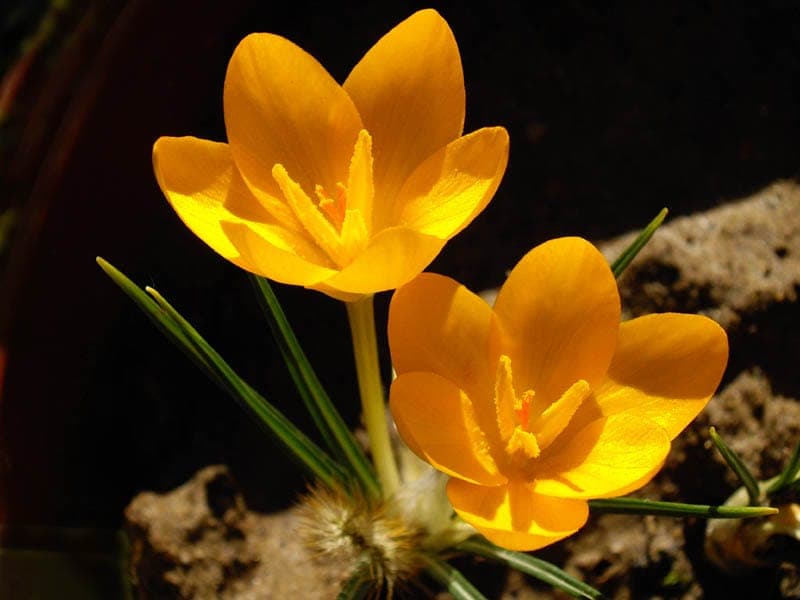
Ghislain118 http://www.fleurs-des-montagnes.net / CC BY-SA 3.0, via Wikimedia Commons
Crocus ancyrensis: complete guide
Crocus ancyrensis
Want to see Crocus ancyrensis: complete guide in your garden?
1 minute, no credit card
Overview
Ankara Crocus (Crocus ancyrensis) is an early-blooming species native to central Turkey, celebrated for its bright yellow flowers appearing as early as February and March. This diminutive crocus (merely 10-15 cm tall) is ideal for naturalization and rapidly forms impressive displays. Frost-hardy and maintenance-free.
Appearance and Bloom
Crocus ancyrensis reaches just 10-15 cm in height, forming dense clumps of narrow linear foliage. Flowers are bright golden yellow, sometimes with pale orange-red marking on outer petals. Peak bloom occurs February through March, making this one of spring's earliest treasures. Each corm produces 3-6 flowers simultaneously.
Ideal Location
This species thrives in full sun to light shade (minimum 4 hours direct daily sun). In complete shade, flowering diminishes significantly. In grassland settings the species performs well as cool soil benefits development. Protect from strong wind that damages delicate blooms.
Soil
Crocus ancyrensis performs optimally in well-draining, lightly acidic to neutral soils. Clay and heavy soils present challenges; amend with sand and peat for improved drainage. The species tolerates poor soils without difficulty. Avoid moisture during winter dormancy.
Free design
Want to see Crocus ancyrensis: complete guide in your garden? Make a free design now.
Watering
Once planted, this crocus requires minimal water. If conditions are dry, water lightly during growing season. In containers: maintain moderate moisture during growth, then very dry after flowering. Drainage matters far more than frequent watering.
Pruning
No pruning needed. Allow foliage to remain after blooming until yellow to return energy to the corm. This continues through May. Dead flowers may be removed for neatness, though optional.
Maintenance Calendar
August-September: Plant corms. October-January: Winter dormancy and root development. February-March: Peak bloom season. April-May: Post-bloom growth; do not remove foliage. June-July: Summer dormancy; no maintenance.
Winter Hardiness
Fully hardy to -20 degrees Celsius. Performs excellently throughout temperate European climates. This species actually requires minimal chilling for flower initiation. No winter protection needed.
Companion Plants
Pairs beautifully with other early ground covers such as Snowdrop, Scilla, Winter Aconite, and Helleborus. Perfect for lawn naturalization. Works in rock gardens and alpine borders. Excellent between perennials where early color is desired.
Closing Remarks
Ankara Crocus offers simple, reliable early-spring blooms and is ideal for naturalization. Easy and rewarding. Corms available at garden centers. Discover more spring bulbs at gardenworld.app/en!
Want to see Crocus ancyrensis: complete guide in your garden? Make a free design now.
Upload a photo, pick a style, and get a photorealistic design with plant list in under a minute.
No credit card required


Similar plants
Iris tingitana: complete guide
Iris tingitana
Iris tingitana, the Morocco iris, is the bulb species behind the Dutch iris: early blue-violet blooms that need a sunny, well-drained position.
Iris hookeri: complete guide
Iris hookeri
Hooker's Iris is a compact North American native plant with blue flowers. Low-growing and moisture-loving water plant.
Siskiyou iris: complete guide
Iris bracteata
Complete guide to Iris bracteata, the Siskiyou iris: location, soil, bloom cycle, watering, pruning and companion plants for this rare Pacific Coast iris.