
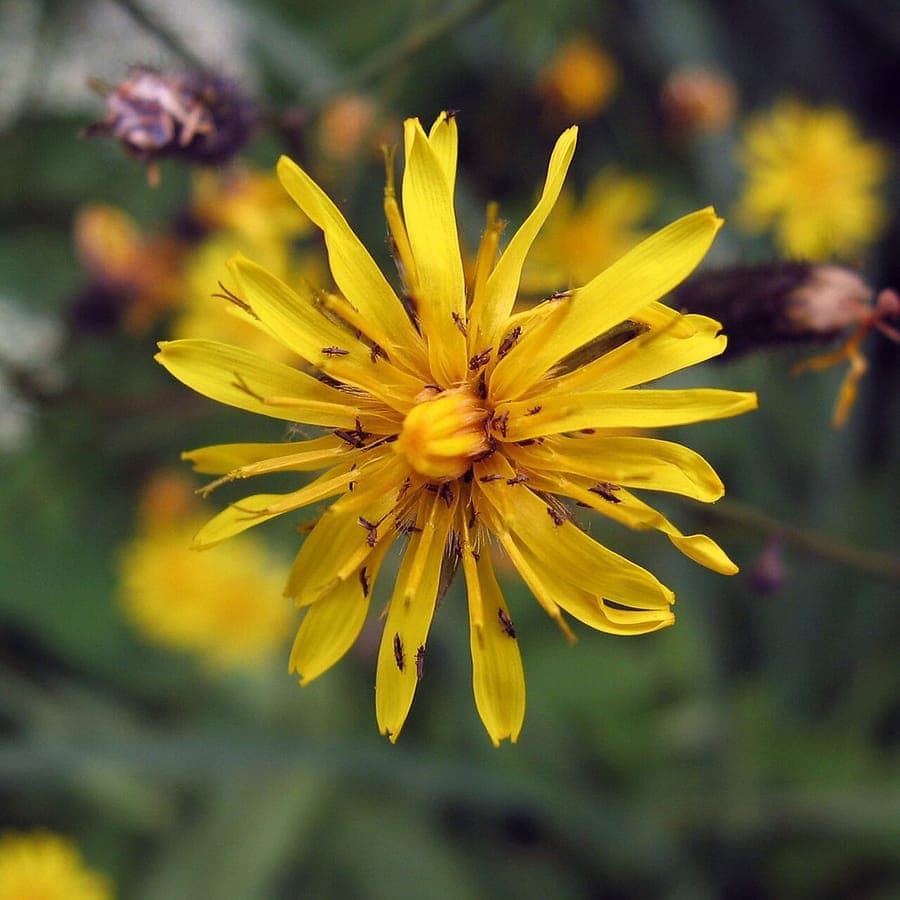
Julcatai / CC BY-SA 3.0, via Wikimedia Commons
Narrow-leaf hawk's-beard: complete guide
Crepis tectorum
Want to see Narrow-leaf hawk's-beard: complete guide in your garden?
1 minute, no credit card
Overview
Narrow-leaf hawk's-beard (Crepis tectorum) is a slender, annual or biennial herb from the Asteraceae family. Often mistaken for a weed, it's actually a graceful wildflower with bright yellow blooms that float above narrow, lance-shaped foliage from June to August. Native to regions like the Baltic States, Belarus, and Central European Russia, this plant thrives in neglected, dry areas - old walls, rooftops, gravel paths, and urban cracks. Its Dutch name, 'smal streepzaad', references its thin, striped seeds.
Despite its modest appearance, it's a valuable plant for pollinators. Bees and hoverflies visit the flowers early in the season when few others are blooming. It's also self-seeding and low-maintenance, making it ideal for naturalistic gardens. On gardenworld.app, you can design a garden layout that integrates narrow-leaf hawk's-beard seamlessly with drought-tolerant companions.
Appearance & bloom cycle
This plant grows 20 to 60 cm tall, with upright, branching stems and a rosette of deeply lobed basal leaves. Upper leaves are smaller and clasp the stem. The flowers are pale yellow, about 1.5 cm wide, and resemble tiny dandelions. They open in the morning and close by midday, lasting only a single day - but new buds form continuously, ensuring a long bloom period from early summer to late August.
After flowering, the seed heads develop into soft, wind-dispersed pappus tufts, similar to dandelions. These can travel several meters, especially in open or breezy locations. While it self-seeds readily, it rarely becomes invasive, preferring disturbed or open ground with little competition.
Ideal location
Full sun is essential - at least 6 hours of direct sunlight daily. In partial shade, the plant becomes leggy and produces fewer flowers. Narrow-leaf hawk's-beard excels in dry, exposed spots: rock gardens, gravel beds, stone walls, or between paving slabs. It's perfect for xeriscaping or adding soft texture to minimalist designs.
If you're planning a drought-resistant border, use gardenworld.app to map out where this plant fits best - perhaps as a filler between larger perennials or along a sunny path edge.
Soil requirements
It thrives in poor, well-drained soils. Sandy, gritty, or shallow soils are ideal. Avoid rich, compost-heavy mixes - they promote leafy growth at the expense of blooms. A pH between 5.5 and 7.5 is acceptable. The plant naturally grows in mineral-based substrates, so adding small gravel or crushed stone to your soil mix mimics its native habitat.
Clay or water-retentive soils are unsuitable unless heavily amended with sand or perlite. Root rot is a real risk in soggy conditions, especially in winter.
Free design
Want to see Narrow-leaf hawk's-beard: complete guide in your garden? Make a free design now.
Watering
Once established (after about 3 weeks), narrow-leaf hawk's-beard needs almost no supplemental watering. It's highly drought-tolerant and survives prolonged dry spells. Water only during extended heatwaves or if seedlings show signs of stress. When watering, keep it light and infrequent - just enough to moisten the top 2–3 cm of soil.
In containers, ensure pots have drainage holes and use a gritty mix. Water when the surface feels dry, but never let the pot sit in water.
Pruning
No pruning is required for plant health. However, if you want to limit self-seeding, cut back flower stems after blooming but before seeds mature. Alternatively, leave a few seed heads for winter interest and bird forage - finches and sparrows love the tiny seeds.
Deadheading isn't necessary, but it keeps the garden looking tidy. The plant often dies after setting seed, though biennial forms may overwinter as a basal rosette.
Maintenance calendar
- Jan–Feb: Dormant. Remove old stems if desired.
- Mar: Clear debris. Lightly loosen soil around emerging rosettes.
- Apr: Watch for seedlings. Thin if overcrowded.
- May: Protect young plants from slugs. No watering needed unless drought persists.
- Jun–Aug: Peak bloom. Avoid fertilizing. Deadhead for control.
- Sep: Allow a few plants to set seed for next year.
- Oct–Dec: Dies back. Leave standing for wildlife or cut down.
Winter hardiness
Hardy in USDA zones 4–8 (-30°C to -12°C). It survives winter as a rosette or through seed bank persistence. No mulch or protection is needed. In colder zones, snow cover provides natural insulation.
Companion plants
Pair with other sun-loving, drought-tolerant species: Sedum 'Autumn Joy', Echinacea purpurea, or Verbena bonariensis. The airy blooms contrast well with spiky textures like Kniphofia or ornamental grasses such as Stipa tenuissima.
Avoid aggressive spreaders like mint or bindweed. Instead, use it as a filler in gravel gardens alongside Thymus or Allium schubertii.
Closing
Narrow-leaf hawk's-beard won't win prizes at flower shows, but it brings quiet beauty to overlooked spots. It asks for little and gives back with pollinators, texture, and effortless charm. You can find seeds at garden centres like those stocking native wildflower mixes, or order online. It's not flashy - but for gardeners who value resilience and simplicity, it's a quiet triumph. And on gardenworld.app, you can build a design that celebrates plants like this: unassuming, tough, and perfectly in tune with their environment.
Want to see Narrow-leaf hawk's-beard: complete guide in your garden? Make a free design now.
Upload a photo, pick a style, and get a photorealistic design with plant list in under a minute.
No credit card required


Similar plants
Calendula stellata: complete guide
Calendula stellata
Complete guide to Calendula stellata, the star-flowered marigold from Sicily: location, soil, watering and companion planting tips.
Korean chrysanthemum: complete guide
Chrysanthemum x rubellum
Chrysanthemum x rubellum is a hardy autumn perennial with single pink to copper flowers from August to November. Care and combinations.
Helianthus divaricatus: complete guide
Helianthus divaricatus
Helianthus divaricatus is a North American woodland sunflower with yellow summer blooms, ideal for naturalistic borders and shady edges.