
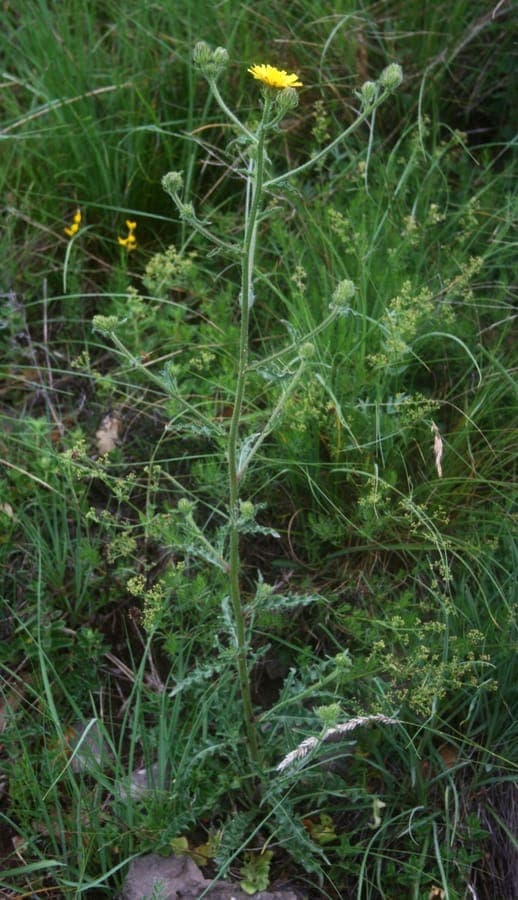
Franz Xaver / CC BY-SA 3.0, via Wikimedia Commons
Bristly hawk's-beard: complete guide
Crepis setosa
Want to see Bristly hawk's-beard: complete guide in your garden?
1 minute, no credit card
Overview
Crepis setosa, commonly known as Bristly hawk's-beard, is a hardy perennial forb in the Asteraceae family. Native to central and southern Europe, it thrives in dry, open habitats like grasslands, rocky slopes, and disturbed soils. While not indigenous to the UK or North America, it adapts well to sunny, well-drained garden spots, especially in naturalistic or xeriscaped designs. With its slender stems, deeply cut leaves, and cheerful yellow blooms, it adds texture and seasonal interest without demanding constant attention.
On gardenworld.app, you can design a planting scheme that maximizes the visual impact of Bristly hawk's-beard, using clustering patterns and bloom timing to create flow. The plant performs best when grouped in drifts of five or more, where it forms a soft, golden haze from early summer onward. It won't dominate your border, but it brings a subtle, wild charm to informal gardens.
Appearance & bloom cycle
Bristly hawk's-beard reaches 30 to 60 cm in height, growing upright with stiff, hairy stems-its defining 'bristly' feature. The basal rosette consists of dark green, deeply lobed leaves, while stem leaves are smaller and more linear. Flowering begins in June and continues through August, peaking in July. Each flower head is 2–3 cm wide, with 10–12 bright yellow ray florets, resembling a dandelion but more refined.
The blooms open fully only in direct sunlight; on overcast days, they remain closed. After pollination, they develop into fluffy seed heads, dispersed easily by wind. This self-seeding habit allows natural colonization, but can become weedy in tightly managed beds-deadheading helps control spread if needed.
Ideal location
This plant craves sun. Rate it a solid 9 out of 10 for light needs-meaning 6 to 8 hours of direct sunlight daily. South- or southwest-facing beds are ideal. It flourishes in dry, open areas: gravel gardens, rockeries, or neglected corners where few other perennials survive. Avoid shaded spots under trees or near tall shrubs.
Consider planting it along dry stone walls or in crevices where drainage is excellent. Use gardenworld.app to map out sun exposure in your garden and pinpoint the best microclimate for Crepis setosa, especially if you're integrating it into a larger drought-tolerant design.
Soil requirements
Crepis setosa prefers lean, well-drained soils with a pH between 7.0 and 7.5. Rich, fertile soils encourage excessive foliage at the expense of blooms. Sandy or loamy soils with added grit or small stones work best. Heavy clay or water-retentive soils are unsuitable-these lead to root rot, particularly in winter.
No fertilizing required. If amending soil, mix coarse sand or perlite into the planting hole. Avoid compost, manure, or synthetic fertilizers-they do more harm than good.
Free design
Want to see Bristly hawk's-beard: complete guide in your garden? Make a free design now.
Watering
Once established, Bristly hawk's-beard is highly drought-tolerant. During the first 6–8 weeks after planting, water twice weekly to help root development. After that, supplemental irrigation is rarely needed, even during prolonged dry spells. Overwatering weakens the plant and promotes fungal diseases.
Water deeply but infrequently, allowing the top layer of soil to dry between sessions. Drip irrigation or soaker hoses are ideal-avoid wetting foliage.
Pruning
Minimal pruning is needed. After flowering, cut stems back to just above the basal rosette to maintain neatness and limit self-seeding. Leave a few seed heads if you want natural propagation or to feed finches. Use clean, sharp shears and disinfect between cuts to prevent disease spread.
Remove any diseased or mushy foliage in autumn, but leave dry stems and leaves over winter to shelter beneficial insects.
Maintenance calendar
- January: No action needed. Check for heaving in frost-prone areas.
- February: Monitor for early growth. Keep mulch light.
- March: Clear away old debris. Watch for slugs.
- April: Plant new specimens after last frost. Water lightly if dry.
- May: Watch for bud formation. Inspect for aphids.
- June-August: Peak bloom. Deadhead as needed. Monitor self-sown seedlings.
- September: Cut back spent stems. Transplant volunteer seedlings.
- October: Leave some seed heads for birds.
- November: Remove diseased material. Avoid heavy mulching.
- December: No care required.
Winter hardiness
Crepis setosa is hardy in USDA zones 5 to 8. In zone 8 (most of the UK and Pacific Northwest), it overwinters without protection. The basal rosette may stay green through mild winters. No mulch is needed unless your soil is heavy and wet-then, a light layer of gravel or pine needles helps prevent rot.
Companion plants
Pair with drought-tolerant, sun-loving species: Thymus vulgaris, Sedum spectabile, Stachys byzantina, and Echinacea purpurea. Avoid aggressive spreaders or tall grasses that cast shade. In rock gardens, combine with Sempervivum or Sedum acre for textural contrast and pollinator appeal.
Closing
Bristly hawk's-beard isn't for gardeners who crave control. It's not a showy border star, but a quiet contributor to ecological planting. It fits perfectly in low-input gardens focused on resilience and habitat value. If you want a sun-loving, pollinator-friendly perennial that asks for little and gives back much, this is a worthy candidate.
Find Crepis setosa at garden centres in spring, particularly those specializing in native or drought-resistant plants. Space plants 30 cm apart for good airflow. And remember: on gardenworld.app, you can simulate seasonal growth and companion pairings to build a garden that evolves naturally with this unassuming beauty.
Want to see Bristly hawk's-beard: complete guide in your garden? Make a free design now.
Upload a photo, pick a style, and get a photorealistic design with plant list in under a minute.
No credit card required


Similar plants
Calendula stellata: complete guide
Calendula stellata
Complete guide to Calendula stellata, the star-flowered marigold from Sicily: location, soil, watering and companion planting tips.
Korean chrysanthemum: complete guide
Chrysanthemum x rubellum
Chrysanthemum x rubellum is a hardy autumn perennial with single pink to copper flowers from August to November. Care and combinations.
Helianthus divaricatus: complete guide
Helianthus divaricatus
Helianthus divaricatus is a North American woodland sunflower with yellow summer blooms, ideal for naturalistic borders and shady edges.