
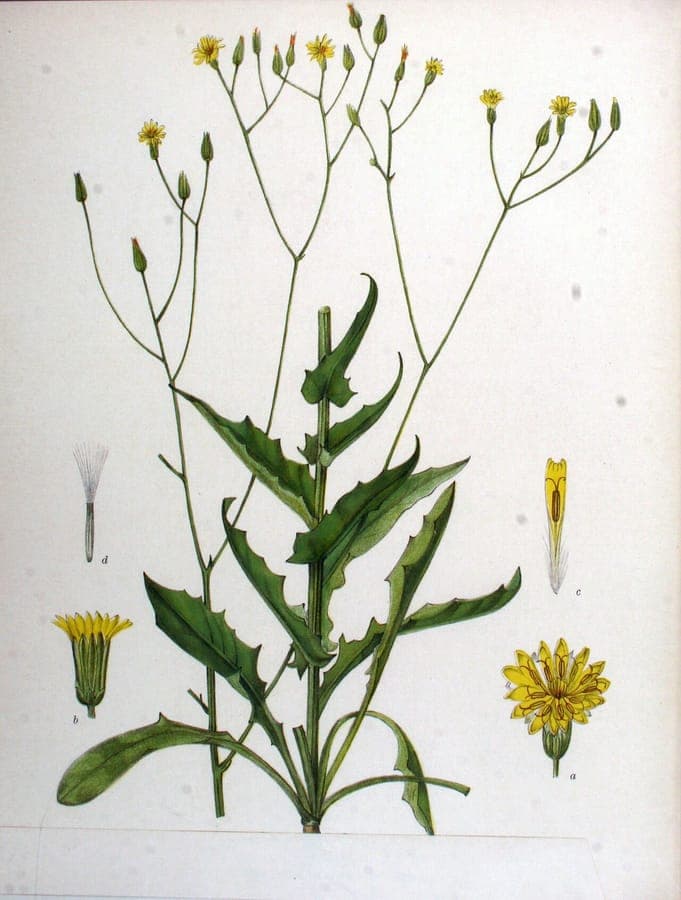
Oceancetaceen - Alice Chodura / Public domain, via Wikimedia Commons
Small-flower hawk's-beard: complete guide
Crepis pulchra
Want to see Small-flower hawk's-beard: complete guide in your garden?
1 minute, no credit card
Overview
Small-flower hawk's-beard (Crepis pulchra) is a slender, unassuming annual or biennial that slips quietly into borders and woodland edges. It doesn't shout for attention, but its delicate form and cheerful yellow blooms bring a soft charm to relaxed garden settings. As a member of the Asteraceae family, it shares traits with daisies and dandelions - composite flowers, wind-dispersed seeds - but its stature and habit are far more refined. While not native to the British Isles, it's increasingly valued in ecological gardens for its ability to self-seed gently and support early pollinators.
On gardenworld.app, you can design a planting scheme that lets Crepis pulchra drift naturally between perennials, mimicking its wild behaviour.
Appearance & bloom cycle
Growing 20–40 cm tall, Crepis pulchra sends up upright, branched stems with narrow, toothed leaves arranged in a basal rosette during its first year. The foliage is mid- to dark green, sometimes slightly hairy. Flowering occurs from May to July, with small, bright yellow daisy-like heads (1.5–2 cm across) appearing at the tips. These open only in full sun, closing at dusk or on overcast days - a quirky trait that adds rhythm to the garden.
Each flower head produces numerous fine, parachute-like seeds that float away on the breeze. If you want to prevent spreading, deadhead before seeds form. Otherwise, allow some stems to mature and self-sow - it rarely becomes invasive.
Ideal location
Choose partial shade to light shade with some sun exposure, especially in the morning. This plant thrives in the kind of conditions found along forest margins, under open tree canopies, or on sheltered banks. Avoid full sun in dry gardens - it can stress the plant. It's perfect for softening edges of paths or filling gaps under shrubs where little else grows.
For gardeners with shady corners, Crepis pulchra is a smart choice. Use gardenworld.app to map out these tricky areas and pair this species with other shade-tolerant plants for a cohesive look.
Soil requirements
It tolerates a range of soils but prefers well-drained, moderately fertile loam. Avoid heavy clay that stays wet in winter or overly rich compost-heavy beds - both lead to weak, floppy growth. A slightly acidic to neutral pH (5.8–7.0) works best. Add grit or composted leaf mould to improve structure in compacted ground.
No feeding required. In fact, excess nutrients reduce flowering and shorten lifespan. If your soil is very poor, a thin top dressing of compost in spring is enough.
Free design
Want to see Small-flower hawk's-beard: complete guide in your garden? Make a free design now.
Watering
Once established, Crepis pulchra handles dry spells well. Young plants need consistent moisture until rooted, especially when sown in spring. Water at the base to avoid wetting foliage, which can encourage fungal issues. In average UK rainfall conditions, supplemental watering is rarely needed.
In containers or under dense tree roots, check soil weekly in summer. Water deeply but infrequently - about once a week during prolonged drought. Rainwater is preferred over tap water, which can be too alkaline.
Pruning
Minimal pruning is needed. Remove spent flower stems to tidy up or limit self-seeding. If you encourage naturalising, leave some stems to set seed. Cut back all remaining growth in late September to make room for autumn mulching.
Overwintering rosettes may persist in mild areas - leave them undisturbed. They'll surge in early spring, giving a head start on next season's bloom.
Maintenance calendar
- Jan: Check for green rosettes; clear debris
- Feb: No action
- Mar: Loosen soil lightly; sow seeds under cover
- Apr: Direct sow outdoors; protect seedlings from slugs
- May: Stems elongate; flowering begins
- Jun: Peak bloom; monitor seed development
- Jul: Deadhead selectively; allow some seeding
- Aug: Reduce watering; observe seedlings
- Sep: Cut back old stems; thin overcrowded seedlings
- Oct: Let self-seeding occur; leave young plants
- Nov: Apply leaf litter for winter cover
- Dec: Watch for new rosettes in mild spells
Winter hardiness
Crepis pulchra is hardy in USDA zones 6–8. Biennial forms overwinter as rosettes, surviving light frosts. In colder zones, mulch with dry leaves to protect crowns. Avoid plastic covers - they trap moisture and promote rot.
In exposed gardens, self-seeding becomes the primary survival method. Ensure some bare soil remains for seeds to germinate in spring.
Companion plants
Pair with spring ephemerals like Erythronium, Anemone blanda, or early Alliums. It also blends well with fine-textured grasses such as Carex or Festuca. Avoid tall, aggressive plants that shade it out. Try it alongside forget-me-nots or Brunnera for a cottage-garden feel.
It works beautifully in gravel gardens or between stepping stones where its airy form contrasts with hardscape.
Closing
Small-flower hawk's-beard won't dominate your garden, and that's its strength. It's for gardeners who appreciate nuance - a flicker of yellow in dappled light, a plant that knows its place. Low effort, high charm. Seeds or plants are available at most garden centres, especially those focusing on native or wildlife-friendly species. Let it weave through your borders naturally, and you'll find it becomes a quiet favourite. Start planning your layout on gardenworld.app to see how it fits into your long-term design.
Want to see Small-flower hawk's-beard: complete guide in your garden? Make a free design now.
Upload a photo, pick a style, and get a photorealistic design with plant list in under a minute.
No credit card required


Similar plants
Calendula stellata: complete guide
Calendula stellata
Complete guide to Calendula stellata, the star-flowered marigold from Sicily: location, soil, watering and companion planting tips.
Korean chrysanthemum: complete guide
Chrysanthemum x rubellum
Chrysanthemum x rubellum is a hardy autumn perennial with single pink to copper flowers from August to November. Care and combinations.
Helianthus divaricatus: complete guide
Helianthus divaricatus
Helianthus divaricatus is a North American woodland sunflower with yellow summer blooms, ideal for naturalistic borders and shady edges.