
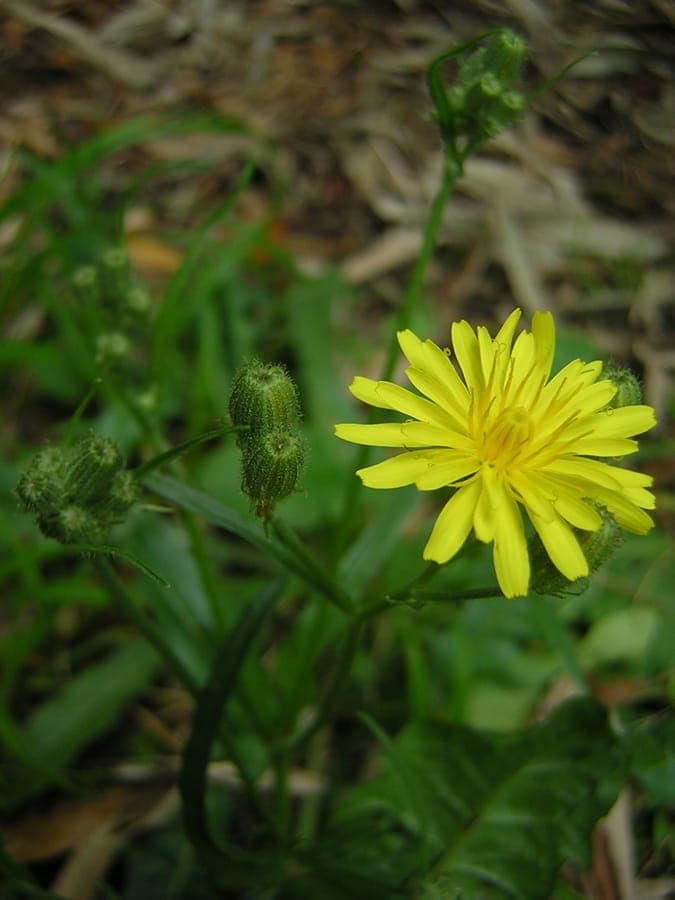
Aroche / CC BY-SA 3.0, via Wikimedia Commons
Foetid Hawk's-beard (Crepis foetida): complete guide
Crepis foetida
Want to see Foetid Hawk's-beard (Crepis foetida): complete guide in your garden?
1 minute, no credit card
Overview
Foetid Hawk's-beard, scientifically Crepis foetida, is a robust self-seeding annual plant belonging to the Asteraceae family. Despite its unprepossessing name (the plant produces a characteristic musty odor), this species possesses excellent qualities for arid, challenging sites. Native to the Mediterranean region and extending into Central Europe, Foetid Hawk's-beard thrives on degraded soils and requires minimal management.
At gardenworld.app, discover how to transform dry, difficult terrain into thriving, pollinator-friendly gardens. Foetid Hawk's-beard represents an intelligent choice for gardeners seeking low-maintenance species that simultaneously attract beneficial insects and produce birdseed.
Appearance & Bloom Cycle
Foetid Hawk's-beard is an annual or winter-annual plant reaching 30-60 cm in height. The plant grows upright with ascending branches creating an airy silhouette. Basal leaves are prominently lobed and lance-shaped, providing the plant's characteristic appearance. Upper stem leaves become progressively narrower.
Flowers appear in yellow, arranged in terminal umbel-like clusters from May through July. Individual flowers are small and modest, but collectively form attractive yellow displays. Following blooming, characteristic seed heads develop with distinctive pappus bristles that aid wind dispersal.
Ideal Location
Foetid Hawk's-beard thrives in full sun. Ensure minimum 6-8 hours of direct daily sunlight, which promotes compact growth and prolific flowering. The plant exhibits exceptional drought tolerance once established, making it ideal for arid, sunny garden positions.
Free design
Want to see Foetid Hawk's-beard (Crepis foetida): complete guide in your garden? Make a free design now.
Soil Requirements
This plant succeeds in well-drained, even impoverished soils. Foetid Hawk's-beard accepts all soil types from acidic to alkaline, though it prefers neutral to slightly calcareous conditions. Heavy fertilization is unnecessary and may promote excessive, floppy growth.
Watering
Once established, Foetid Hawk's-beard requires minimal irrigation. During establishment (initial 4-6 weeks), provide regular water until plants develop strong root systems. Subsequently, supplemental watering is necessary only during extended drought periods exceeding 3 weeks without rainfall.
Pruning & Maintenance
Foetid Hawk's-beard requires minimal pruning. Remove spent flowers to limit further seed production or allow plants to self-seed if you desire bird food creation. At season's end, following first frost, remove dead plant material from the garden.
Maintenance Calendar
- March-April: Sowing and site preparation
- May-July: Bloom period
- July-August: Seed development
- October-November: End-of-season cleanup
Winter Hardiness
Foetid Hawk's-beard is annual in the Netherlands and Belgium. In warmer climates (southern France and Germany), it may function as a winter-annual, germinating in autumn and flowering the following spring.
Companion Plants
Pair Foetid Hawk's-beard with other drought-tolerant species such as teasels, sea holly (Eryngium), and ornamental grasses. Yellow flowers provide striking contrast against silvery or blue-toned groundcovers.
Closing
Foetid Hawk's-beard may not appeal to every gardener aesthetically, but for those seeking a wild, pollinator-friendly garden with minimal intervention, it represents an excellent choice. It attracts beneficial insects and naturally produces birdseed. Explore gardenworld.app for ideas on transforming difficult, dry garden spaces into thriving ecosystems.
Want to see Foetid Hawk's-beard (Crepis foetida): complete guide in your garden? Make a free design now.
Upload a photo, pick a style, and get a photorealistic design with plant list in under a minute.
No credit card required


Similar plants
Calendula stellata: complete guide
Calendula stellata
Complete guide to Calendula stellata, the star-flowered marigold from Sicily: location, soil, watering and companion planting tips.
Korean chrysanthemum: complete guide
Chrysanthemum x rubellum
Chrysanthemum x rubellum is a hardy autumn perennial with single pink to copper flowers from August to November. Care and combinations.
Helianthus divaricatus: complete guide
Helianthus divaricatus
Helianthus divaricatus is a North American woodland sunflower with yellow summer blooms, ideal for naturalistic borders and shady edges.