
HermannSchachner / CC0, via Wikimedia Commons
Rough hawksbeard: complete guide
Crepis biennis
Want to see Rough hawksbeard: complete guide in your garden?
1 minute, no credit card
Overview
Rough hawksbeard (Crepis biennis) isn't the kind of plant you'll find at every garden centre, but if you're aiming for a relaxed, ecologically sound garden, it deserves a spot. A biennial from the Asteraceae family, it's native to much of Central and Eastern Europe, popping up naturally in field margins, dry grasslands, and light woodland clearings. It's not showy, but it's quietly effective – offering nectar in early summer and seeds for birds later on. In the UK and similar climates, it fits well in cottage-style borders or wild meadow patches where low intervention is the goal.
On gardenworld.app, you can design a planting scheme that works with species like Rough hawksbeard, letting it self-seed in the right spots without taking over. It's a plant that rewards patience – you won't see flowers until year two, but the wait is worth it.
Appearance & bloom cycle
In its first year, Rough hawksbeard forms a ground-hugging rosette of deeply lobed, rough-textured leaves. These are dark green above, paler and slightly hairy beneath, growing up to 15–20 cm long. The rosette persists through winter, adding subtle structure to the dormant garden. In the second year, from late spring to midsummer (typically May to August), it sends up branching stems reaching 60–100 cm tall. The stems are sturdy, pale green, and covered with small, alternate leaves.
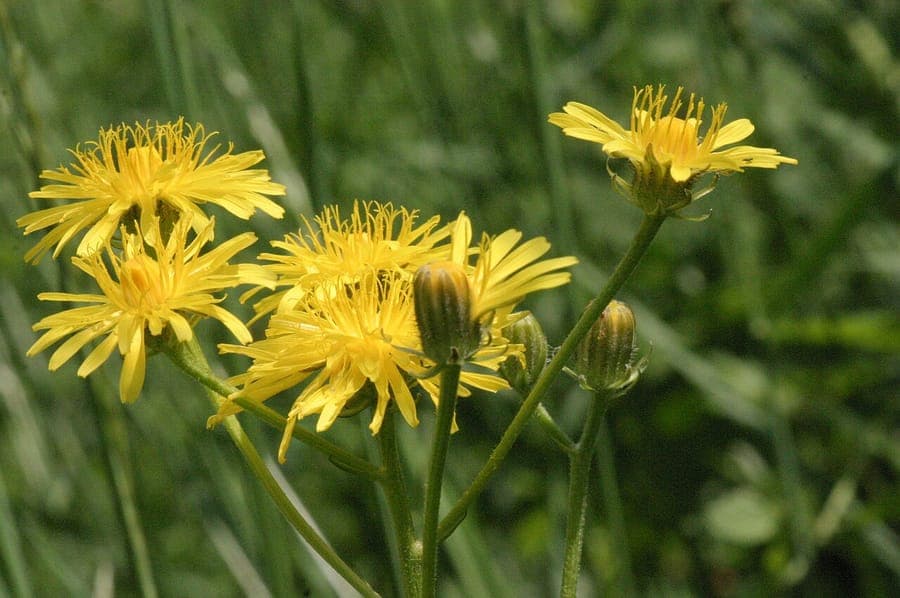
The flowers are bright yellow, daisy-like, about 2–3 cm across, and borne in loose clusters. Each bloom opens in the morning and closes at dusk, lasting a few days. After flowering, the seed heads form a fine, dandelion-style pappus, easily dispersed by wind. It's a strong self-seeder, so once established, it tends to come back year after year, often spreading gently into nearby cracks or thin turf.
Ideal location
Full sun to light shade is best – aim for at least 6 hours of direct light daily. It thrives in open, unshaded spots such as meadow edges, gravel gardens, or the back of a mixed border. Avoid heavily shaded areas or places dominated by vigorous perennials like Eupatorium or Solidago, which will outcompete it.
It does particularly well on slopes or banks where drainage is good. If you're using it in a formal setting, keep it towards the back where its height won't block lower plants. On gardenworld.app, you can map out zones where self-seeding plants like this can roam freely without clashing with more structured areas.
Soil requirements
Well-drained soil is essential. It tolerates sandy, loamy, or chalky soils with a pH from 5.5 to 7.8. It doesn't like wet feet, so avoid heavy clay unless you've improved it with grit or composted bark. Rich, heavily amended soils can lead to floppy growth and fewer flowers – it prefers lean conditions.
For planting, scatter seed in early spring or autumn on raked soil. No need to bury deeply; just press in lightly. It germinates best with some light, so don't cover it thickly.
Free design
Want to see Rough hawksbeard: complete guide in your garden? Make a free design now.
Watering
Once established, Rough hawksbeard is drought-tolerant. In the first year, during dry spells, water young rosettes once a week with about 3–4 litres per plant. After that, rainfall is usually sufficient. Overwatering promotes root rot, especially in winter. If you're gardening in a particularly dry region, occasional deep watering in prolonged droughts helps, but don't make it a habit.
Use rainwater when possible – it's what this plant would get in the wild.
Pruning
Pruning isn't required, but you can deadhead spent flowers if you want to limit self-seeding. Otherwise, leave the seed heads standing – they add winter interest and feed goldfinches and other small birds. Cut back the flowering stems in late autumn or early winter if they look untidy, but keep the basal rosette intact.
Maintenance calendar
- Jan: Check rosettes for slug damage. Clear debris to prevent rot.
- Feb: Keep area free of compacted leaf litter.
- Mar: Prepare bare soil patches for new seedlings.
- Apr: Watch for aphids on new growth. Thin overcrowded seedlings.
- May: Flowering stems emerge. No extra care needed.
- Jun: Peak bloom begins. Monitor for fungal issues in wet weather.
- Jul: Continue flowering. Take photos for your garden log on gardenworld.app.
- Aug: Flowers fade. Seeds start forming.
- Sep: Harvest seeds if desired, or let them scatter naturally.
- Oct: New seedlings may appear. Mark their location.
- Nov: Cut back old stems if messy. Leave rosettes.
- Dec: Winter rosettes remain green. Minimal intervention.
Winter hardiness
Rough hawksbeard is hardy to USDA zone 6 (-15°C). In zones 7–9, it thrives with no protection. The basal rosette survives frost and light snow, though extreme cold or wet can damage outer leaves. In milder climates, it stays semi-evergreen. No mulch needed – in fact, too much covering can promote rot.
Companion plants
Pair it with other meadow species: Knautia arvensis, Leucanthemum, or Stachys byzantina. It works well with grasses like Deschampsia or Festuca. Avoid dense ground covers or fast-spreading roots. Early bulbs like Allium or Tulipa create a nice sequence – Rough hawksbeard fills the gap after they die back.
Closing
Rough hawksbeard won't win any beauty contests, but it's a reliable, low-maintenance plant that supports wildlife and adds seasonal rhythm to the garden. It's rarely sold as a plant, but you might find seed at specialty suppliers or even in wildflower mixes. Standard garden centres in the UK don't always stock it, but keep an eye out at local nurseries or online seed banks. If you're planning a naturalistic layout, use gardenworld.app to visualise how it fits with other biennials and self-seeders. It's a subtle player, but one that brings real ecological value – and that's something every thoughtful gardener should grow.
Want to see Rough hawksbeard: complete guide in your garden? Make a free design now.
Upload a photo, pick a style, and get a photorealistic design with plant list in under a minute.
No credit card required


Similar plants
Calendula stellata: complete guide
Calendula stellata
Complete guide to Calendula stellata, the star-flowered marigold from Sicily: location, soil, watering and companion planting tips.
Korean chrysanthemum: complete guide
Chrysanthemum x rubellum
Chrysanthemum x rubellum is a hardy autumn perennial with single pink to copper flowers from August to November. Care and combinations.
Helianthus divaricatus: complete guide
Helianthus divaricatus
Helianthus divaricatus is a North American woodland sunflower with yellow summer blooms, ideal for naturalistic borders and shady edges.