
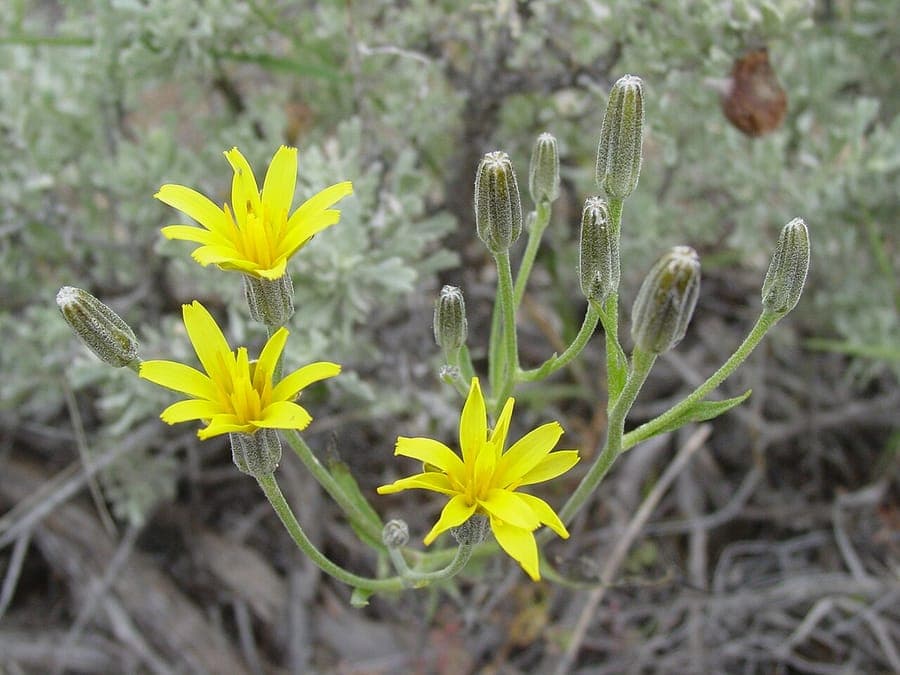
Wallace Keck / Public domain, via Wikimedia Commons
Tapertip hawksbeard: complete guide
Crepis acuminata
Want to see Tapertip hawksbeard: complete guide in your garden?
1 minute, no credit card
Overview
Crepis acuminata, known in English as tapertip hawksbeard, is a perennial herbaceous plant in the large and species-rich family Asteraceae. Native to western North America, it occurs from British Columbia and Idaho south to California, Nevada, and New Mexico. In the wild it grows on dry, rocky slopes, open sagebrush steppes, montane grasslands, and along mountain roads at elevations ranging from 400 to more than 2,500 metres above sea level. The common name 'tapertip hawksbeard' refers to the sharply tapered tips of the involucral bracts (phyllaries) that give the flower buds their distinctive pointed appearance.
Crepis is a large genus with more than 200 species distributed across temperate and subtropical zones of the Northern Hemisphere. The genus name derives from the Greek 'krepis' (sandal or shoe), a reference that is not entirely clear botanically but may have alluded to the shape of the seeds. The species epithet acuminata means 'tapering to a point', again describing the characteristic sharp tips of the phyllaries.
Unlike the familiar weedy species such as Crepis capillaris or Crepis biennis, which occur as arable and meadow plants across Europe, Crepis acuminata is a more specialised plant of dry mountain environments. It produces a basal rosette of deeply incised, arrow- to lance-shaped leaves and forms slender, branching stems that carry dandelion-like yellow flower heads, each 1 to 2 cm across, during the blooming period. The plant is remarkably tolerant of drought and heat stress, which makes it interesting for gardeners working on dry, naturalising borders.
In European gardens, tapertip hawksbeard remains largely unfamiliar, but it has potential as a light, unpretentious representative of the prairie style or montane grassland concept. It combines well with other drought-tolerant perennials, airy flowering grasses, and dry ground covers in open, sunny beds. Specialist nurseries in the United Kingdom and Germany occasionally stock it, and seed is available from several wildflower seed suppliers.
Appearance & bloom cycle
Crepis acuminata forms an erect to ascending plant 30 to 80 cm tall, occasionally reaching 100 cm in optimal conditions. The basal leaves are 10 to 30 cm long, deeply and irregularly incised, arrow- to lance-shaped, with a distinctly pale to grey-green colouring and a faint waxy coating that gives the foliage a slightly silvery appearance in bright sunlight. Stem leaves become smaller toward the top and partly clasp the stem. The stems themselves are hollow, lightly powdery in texture, and branching in the upper half, giving the plant an airy, open appearance.
Blooming occurs from May to August, depending on latitude and elevation. In lower, warmer positions the plant flowers earlier; in mountain or more northerly settings, later. The flower heads are 1 to 2 cm across and contain only ray florets (no disc florets), uniformly lemon-yellow to bright golden yellow. They are carried in loose, irregular corymb-like clusters at the tips of the branching stems. Individual heads open in the early morning and close during the afternoon or in overcast conditions, a behaviour typical of many Crepis species.
After flowering, the characteristic pappus seeds develop: lightweight, white, and feathery, resembling dandelion seeds but finer and more elegant. They are wind-dispersed and can germinate spontaneously near the parent plant under suitable conditions. This self-seeding tendency is mild and generally not invasive under ordinary garden conditions.
The roots are taproots that penetrate deeply into the soil, explaining both the drought tolerance and the difficulty of transplanting once established. Plant young specimens or sow directly in situ for the best results.
Ideal location
Crepis acuminata thrives best in a fully sunny position. In its native range across the dry mountain west of North America it grows on open, wind-swept slopes and steppes where sunlight is unimpeded. In the European garden, this means a position receiving at least six to eight hours of direct sunlight daily.
The plant tolerates warm, dry conditions exceptionally well and is a good candidate for raised borders, gravel gardens, rock gardens, or dry prairie-style borders. A gently sloping position eases drainage and mimics the mountain habitat. In flat gardens, a raised bed of 15 to 25 cm provides appropriate conditions. Semi-shaded positions are suboptimal: the plant may survive but will bloom more sparsely and may become somewhat lax in habit.
Good air circulation is important to avoid fungal diseases. Space plants at least 30 to 40 cm apart and away from dense neighbours so air can move freely. This is particularly relevant in regions with wetter summers, such as much of northwestern Europe, where Crepis species can be susceptible to powdery mildew when air movement is poor.
In a gravel or xeric garden, Crepis acuminata pairs beautifully with other light, open-flowering perennials. The airy flower structure contrasts well with more compact, mounded or mat-forming neighbours.
Soil requirements
The soil preferences of Crepis acuminata mirror its mountain habitat in the dry American west. The plant prefers poor to moderately fertile, well to sharply draining soil. A pH between 6.0 and 8.0 is acceptable; the species is not particularly fussy about acidity as long as drainage is good. Heavy, moisture-retaining clay soils are unsuitable.
On clay soils, add 25 to 30 percent coarse grit or perlite into the top 30 cm of soil before planting. A surface layer of 5 to 8 cm of gravel or stone chips helps improve surface drainage and keeps the plant's crown dry, reducing the risk of fungal infection. On sandy or other free-draining soils, little amendment is needed.
Fertilisation is only sparingly needed. Overly rich soil encourages lush but floppy growth and can shorten the flowering period. If the soil is very poor and the plant shows signs of nitrogen deficiency (pale, small leaves, slow growth), apply a limited amount of slow-release general fertiliser in early spring. Avoid nitrogen-heavy fertilisers in all cases.
Free design
Want to see Tapertip hawksbeard: complete guide in your garden? Make a free design now.
Watering
Once well established, Crepis acuminata is one of the more drought-tolerant perennials and rarely needs supplemental water during summer. The deep taproot allows the plant to access groundwater reserves beyond the reach of shallower-rooted neighbours.
During the first growing year, from planting (April to May) through the end of the growing season (September), regular but moderate watering is needed to encourage root development. Water once a week in the absence of rainfall, directing water to the base of the plant rather than overhead. Avoid prolonged wetness around the crown.
From the second year onward, supplemental watering is rarely needed in most western European climates unless extended dry periods of more than four weeks occur. In continental climates with hot summers (temperatures above 30 degrees Celsius), monthly deep watering can prevent severe drought stress. Winter waterlogging or spring wetness is the greatest threat; excellent drainage is essential at all times.
Pruning
Crepis acuminata requires little pruning. In early spring, once the frosty periods have passed (March to early April), dead stems from the previous season can be cut down to ground level. This is purely for aesthetics and tidiness: the basal rosette typically survives winter intact and will already be producing new leaves.
After flowering, spent flower heads can be removed if excessive self-seeding is unwanted. However, if a few spontaneous seedlings elsewhere in the garden are welcome, let the plumed seeds disperse freely: the spread is mild and generally not problematic. The seed heads themselves are ornamentally attractive and give the garden a light, romantic quality.
The plant can also be cut back to the basal rosette after the first flush of flowers to encourage a second, more modest bloom. This technique works for several Asteraceae species and can also produce positive results with Crepis acuminata in milder climates.
Maintenance calendar
January-February: No active intervention needed. The basal rosette overwinters in mild winters without protection. In severe winters with temperatures below -15 degrees Celsius, a layer of dry straw can be applied as protection.
March: Remove dead stems from the previous season. Check the basal rosette for slug damage. First young leaves begin to appear.
April-May: Active growth period. Remove weeds carefully around plants. Plant young specimens or sow directly in situ. Fertilise only if the soil is demonstrably poor.
May-July: Flowering period. Enjoy the yellow ray flowers. Remove spent heads if self-seeding is to be limited.
August-September: End of flowering; seed dispersal. Allow the plumed seeds to stand for ornamental value and as a bird food source. Optionally cut back for a second flush of bloom.
October-November: Plant retreats to its basal rosette. Remove stems. Mark the location if the plant disappears completely above ground.
December: Rest period. Check drainage around the plant.
Winter hardiness
Crepis acuminata is a cold-hardy perennial that in its natural range across the Rocky Mountains and Great Basin endures harsh winters with temperatures of -20 degrees Celsius or colder. In USDA garden zones 4 to 8, the species is reliably hardy, covering most of Europe including the great majority of the Benelux, Germany, France, and the United Kingdom.
The taproot penetrates deep enough into the soil to survive light frost without damage. The basal rosette survives most winters without protection. The greatest threat is winter wetness combined with cold: saturated, poorly draining soil that remains waterlogged for months can cause crown rot and kill the plant. On well-draining soils this risk is negligible.
In colder regions above USDA zone 4, a light winter covering of dry straw or spruce branches over the basal rosette is advisable. Remove this covering in March once frost risk has passed, exposing the growing leaf tips to light and air.
Discover how tapertip hawksbeard fits into a dry prairie or naturalised border in your own garden by using gardenworld.app, where you can upload a photo of your garden and explore dry planting styles with matching perennials. For more inspiration on drought-tolerant plants for sunny positions, visit gardenworld.app.
Companion plants
Crepis acuminata combines naturally with other perennials of open, dry montane and steppe grasslands. Excellent partners for a European dry border include:
- Salvia nemorosa: blue or purple flower spikes bloom in the same period and provide a classic colour contrast of blue-purple against yellow. Both plants thrive on identical soil requirements.
- Erigeron speciosus (aspen fleabane): low aster-like flowers in blue-purple bloom slightly earlier in summer but overlap with the start of the Crepis flowering period.
- Achillea millefolium (yarrow): flat flower clusters in white, pink, or yellow complement the height of Crepis well; both species tolerate drought and poor soil equally.
- Penstemon strictus or P. digitalis: long tubular flowers in blue-purple or white on slender stems give a similarly airy texture to that of Crepis.
- Festuca mairei (Moroccan fescue): a large clump-forming grass that provides a neutral structural counterpoint to the more loosely flowering Crepis.
Avoid plants with high moisture requirements or aggressive self-seeding tendencies that would crowd out the slender but persistent Crepis seedlings.
Closing
Crepis acuminata is an honest, unfussy plant that earns its place in the modern naturalistic garden. Its slender stems, airy yellow flowers, and elegant seed plumes provide texture and movement in dry borders over a long blooming period. As a mountain plant from the dry west of North America, it is accustomed to demanding conditions and asks little in cultivation: sun, well-draining soil, and patience. A plant that brings a touch of the steppe to the garden.
Want to see Tapertip hawksbeard: complete guide in your garden? Make a free design now.
Upload a photo, pick a style, and get a photorealistic design with plant list in under a minute.
10,000+ gardens designed already
No credit card required


Similar plants
Calendula stellata: complete guide
Calendula stellata
Complete guide to Calendula stellata, the star-flowered marigold from Sicily: location, soil, watering and companion planting tips.
Korean chrysanthemum: complete guide
Chrysanthemum x rubellum
Chrysanthemum x rubellum is a hardy autumn perennial with single pink to copper flowers from August to November. Care and combinations.
Helianthus divaricatus: complete guide
Helianthus divaricatus
Helianthus divaricatus is a North American woodland sunflower with yellow summer blooms, ideal for naturalistic borders and shady edges.