
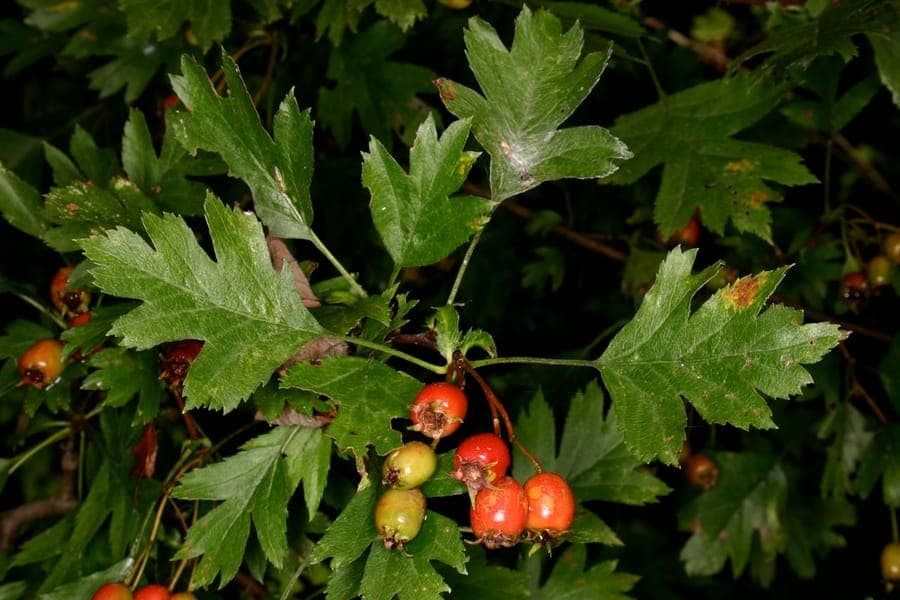
Knud Ib Christensen / CC BY-SA 3.0, via Wikimedia Commons
Calycine hawthorn: complete guide
Crataegus rhipidophylla
Want to see Calycine hawthorn: complete guide in your garden?
1 minute, no credit card
Overview
Crataegus rhipidophylla, commonly known as calycine hawthorn, is a hardy, long-lived deciduous shrub or small tree that thrives in temperate climates. Native to regions across Central and Eastern Europe - including Austria, Belarus, the Baltic States, and parts of France and Finland - it's well-suited to UK and northern European gardens. Despite its resilience and ecological benefits, it's underused in modern landscaping. That's a missed opportunity. This hawthorn brings year-round interest, supports pollinators, and fits perfectly into naturalistic or wildlife gardens.
On gardenworld.app you can design a garden layout that highlights the calycine hawthorn as a focal point or integrate it into a mixed native hedge for privacy and biodiversity.
Appearance & bloom cycle
Typically reaching 4 to 6 meters in height and spread, the calycine hawthorn has an upright, spreading form with thorny branches - the spines are usually 1–2 cm long, effective for deterring unwanted access. The leaves are deeply lobed, 3–5 cm wide, with a slightly ruffled margin, turning vibrant shades of yellow, orange, and red in autumn.
Flowering occurs from late May to early June. The blossoms appear in corymbs of 5–12 white flowers, each about 1.5 cm across, with a faint but sweet fragrance. They're a magnet for bees, hoverflies, and other beneficial insects. By late summer, small, round fruits - about 8 mm in diameter - begin to form. These start green, ripen to bright red, and mature to a deep maroon or near-black by autumn. The berries often persist into winter, offering food for birds like thrushes and redwings.
Ideal location
This hawthorn performs best in full sun to partial shade. While it tolerates light shade, flowering and fruiting are significantly reduced in deeper shade. For best results, plant in an open area with at least 6 hours of direct sunlight. It works well as a standalone specimen, in mixed hedgerows, or as part of a woodland edge planting.
Allow a minimum spacing of 3 meters from buildings or other large plants to prevent overcrowding and ensure good air circulation, which helps prevent fungal issues.
Soil requirements
The calycine hawthorn is adaptable to a wide range of soil types - sandy, loamy, or clay - as long as the soil is well-drained. It prefers a pH between 5.5 and 7.5. On heavy clay, amend the planting hole with well-rotted compost or grit to improve drainage. On very acidic soils (below pH 5.5), a light application of garden lime can help, though it's rarely necessary.
Watch for signs of iron deficiency (chlorosis) on alkaline soils - yellowing leaves with green veins - which can be corrected with chelated iron.
Free design
Want to see Calycine hawthorn: complete guide in your garden? Make a free design now.
Watering
Young plants need consistent moisture during their first two growing seasons. Water deeply once a week with 10–15 liters per plant, especially during dry spells. After establishment, Crataegus rhipidophylla is highly drought-tolerant and rarely needs supplemental watering, even in prolonged dry summers.
Avoid frequent shallow watering; deep, infrequent irrigation encourages deeper root development and greater resilience.
Pruning
Pruning isn't required for health, but it can help shape the plant or maintain a dense hedge. The best time to prune is in late winter to early spring (February to March), before bud break. Avoid autumn pruning, as it can stimulate new growth vulnerable to frost damage.
For hedges, light annual trimming keeps the shape tidy. For specimen trees, remove only dead, damaged, or crossing branches. Always use clean, sharp tools to reduce the risk of disease transmission.
Maintenance calendar
- Jan: Inspect for broken branches and signs of disease
- Feb: Begin light pruning and structural shaping
- Mar: Complete pruning, monitor for pests
- Apr: Observe new leaf emergence, no active care needed
- May: Peak bloom; ensure adequate moisture if spring is dry
- Jun: Flowering ends; fruit set begins
- Jul: Monitor for aphids or mildew
- Aug: Berries start to colour; check for bird activity
- Sep: Leaves begin to change; reduce watering
- Oct: Leaf fall; mulch base with compost
- Nov: Final check for fungal issues
- Dec: Dormant period; no maintenance required
Winter hardiness
This species is fully hardy in USDA zones 4 to 7, surviving temperatures down to -30°C. It's ideal for gardens in the UK, northern Europe, and similar climates. The bark is smooth when young, becoming slightly fissured with age, and remains undamaged in harsh winters. Persistent berries add visual interest during the dormant months.
Companion plants
Pair with other native species that share similar conditions. Good companions include blackthorn (Prunus spinosa), guelder rose (Viburnum opulus), dogwood (Cornus sanguinea), and field maple (Acer campestre). Underplant with shade-tolerant perennials like wood anemone, bluebell, or primrose.
Avoid invasive groundcovers like ivy that might smother young growth.
On gardenworld.app, you can explore planting schemes that combine the calycine hawthorn with native hedgerow species to create a wildlife corridor in your garden.
Closing
The calycine hawthorn is a low-maintenance, high-reward plant that brings structure, seasonal colour, and ecological value. It's ideal for hedges, screens, or as a standalone feature. With its resilience and beauty, it deserves a place in more gardens. Look for it at garden centres across the UK or specialist native plant suppliers. For inspiration and planting advice, check gardenworld.app, where you can visualise how this hawthorn fits into your garden design.
Want to see Calycine hawthorn: complete guide in your garden? Make a free design now.
Upload a photo, pick a style, and get a photorealistic design with plant list in under a minute.
No credit card required


Similar plants
Siberian crab apple: complete guide
Malus x robusta
Complete guide to the Siberian crab apple (Malus x robusta): location, soil, pruning, winter hardiness and the best companion plants for your garden.
Chinese flowering crabapple (Malus x spectabilis): complete guide
Malus x spectabilis
Meet the Chinese flowering crabapple (Malus x spectabilis): a classic spring bloomer with carmine buds and pink blossom.
Potentilla crassinervia: complete guide
Potentilla crassinervia
Potentilla crassinervia, the Corsican cinquefoil, grows wild on Corsica and Sardinia's peaks. Discover how to grow this hardy alpine rock garden gem.