
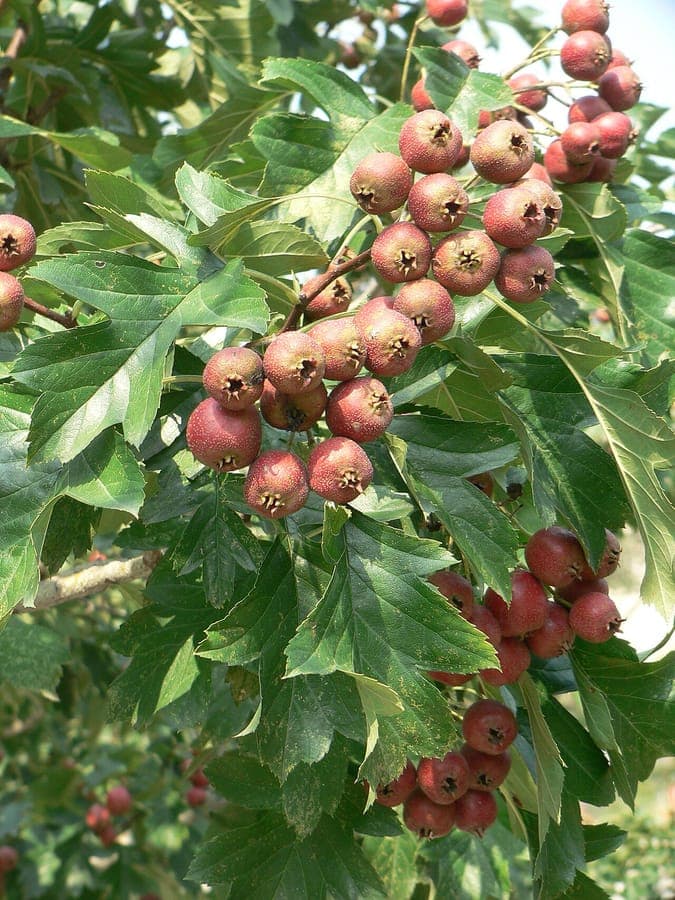
Yongxinge / CC BY-SA 3.0, via Wikimedia Commons
Crataegus pinnatifida: complete guide to Chinese hawthorn
Crataegus pinnatifida
Want to see Crataegus pinnatifida: complete guide to Chinese hawthorn in your garden?
1 minute, no credit card
Overview
Crataegus pinnatifida, better known as Chinese hawthorn or Chinese haw, is an attractive deciduous shrub-tree native to northeastern China, Russia, and Korea. This is among the more beautiful hawthorn species, featuring deeply lobed leaves, lovely white May flowers, and red fruits that provide bird food. For hedging and shrub planting designs, this is an outstanding choice.
Appearance and Bloom
Chinese hawthorn grows as a compact shrub-tree, typically 4 to 6 meters tall. Its most striking feature is the deeply lobed foliage: rich green and highly attractive. Leaves display interesting form - cut as if by a fern-like pattern.
In May, the shrub bears abundant trusses of small, white flowers with delightful fragrance. This blooming period is spectacular. Later in the season, small red fruits appear and persist long on the branches. These fruits attract birds and provide them with food during autumn and winter.
Ideal Location
Position Chinese hawthorn in full sun to light partial shade. Minimum four hours sunlight daily is required. This shrub excels in hedging, group planting, and as a specimen in larger gardens.
The plant is highly adaptable regarding location. It can be planted against light-colored walls for striking contrast. In landscapes, it works beautifully as wild growth. Its hardiness makes it an excellent wildlife plant in bird-friendly gardens.
Soil
Chinese hawthorn grows in virtually every soil type: clay, sand, loam - all work well. This shrub is undemanding. A well-draining soil is ideal, but even moist locations suit it. It tolerates poor soils admirably.
After planting, you may incorporate compost. This is optional. The plant establishes quickly in nearly every soil. Neutral to alkaline pH is fine.
Watering
During the first year, regular watering helps the plant establish. Subsequently, supplemental watering is minimally needed. This shrub tolerates both drought and moisture reasonably well.
Young plants appreciate weekly watering during dry periods. An established shrub is quite self-sufficient. Only during exceptionally dry summers might supplemental water help.
Free design
Want to see Crataegus pinnatifida: complete guide to Chinese hawthorn in your garden? Make a free design now.
Pruning
Chinese hawthorn requires minimal pruning. Allow it to develop its natural form or gently prune to a more open structure. Pruning occurs optimally after flowering in May-June.
Remove dead or weak branches. This shrub heals pruning wounds readily. For dense hedging, regular clipping works. For more natural forms, allow unrestricted growth.
Maintenance Calendar
Spring (April-May): Enjoy blooming and remove any dead branches. June: After flowering, pruning may occur. Summer: Water during dry weather. Fall: Enjoy red fruits and bird visits. Winter: No maintenance required.
This is truly an easy plant. Maintenance is minimal. After two years, it grows essentially by itself.
Winter Hardiness
Crataegus pinnatifida is extremely winter hardy. As a native plant from cold mountain regions, it endures significant frost. Throughout northern Europe, it thrives. USDA zones 4 to 8 are ideal.
No special protection is necessary. The plant is robust. Young specimens might be protected from strong winter winds.
Companion Plants
Combine Chinese hawthorn with other bird-food plants. Elderberry (Sambucus), rowan, and other berry-bearing shrubs create beautiful ecosystems. Grasses and underplanting with evergreen plants work well.
In hedging, Chinese hawthorn mixes beautifully with Hazel, Blackthorn, and native shrubs. Red fruits and white flowers create seasonal contrast. This is an ideal plant for wildlife gardens.
Conclusion
Crataegus pinnatifida is a wildlife-support plant essential to bird-friendly gardens. Quality material is available through major garden centers. This is a plant for those valuing bird food and flower beauty.
In gardenworld.app designs, this hawthorn is favored for hedging and natural woodland designs. The combination of flowers, fruits, and bird activity makes it a favorite. Let gardenworld.app design your garden with wildlife-friendly planting where this Chinese hawthorn forms the heart!
Want to see Crataegus pinnatifida: complete guide to Chinese hawthorn in your garden? Make a free design now.
Upload a photo, pick a style, and get a photorealistic design with plant list in under a minute.
No credit card required


Similar plants
Siberian crab apple: complete guide
Malus x robusta
Complete guide to the Siberian crab apple (Malus x robusta): location, soil, pruning, winter hardiness and the best companion plants for your garden.
Chinese flowering crabapple (Malus x spectabilis): complete guide
Malus x spectabilis
Meet the Chinese flowering crabapple (Malus x spectabilis): a classic spring bloomer with carmine buds and pink blossom.
Potentilla crassinervia: complete guide
Potentilla crassinervia
Potentilla crassinervia, the Corsican cinquefoil, grows wild on Corsica and Sardinia's peaks. Discover how to grow this hardy alpine rock garden gem.