
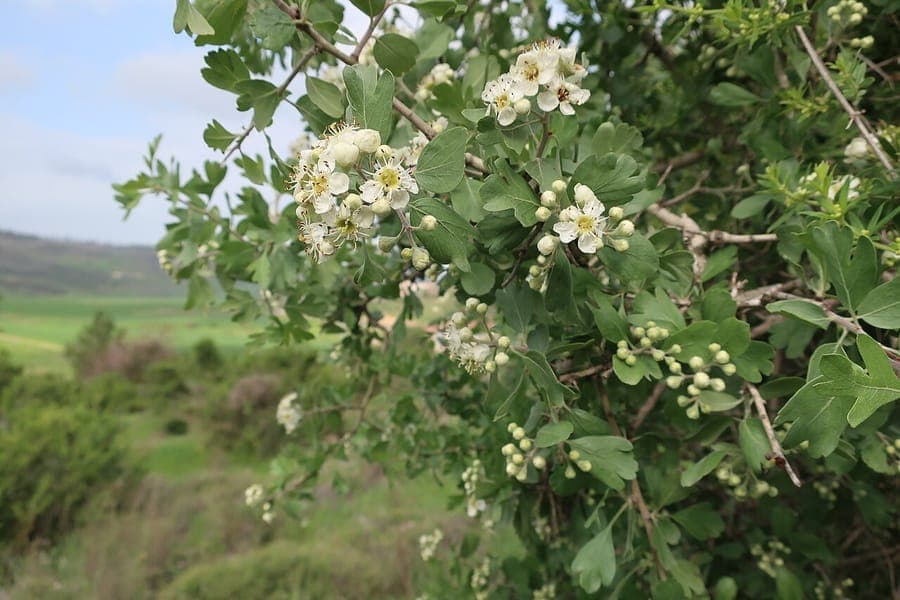
Davidbena / CC BY-SA 4.0, via Wikimedia Commons
Azarole: complete guide
Crataegus azarolus
Want to see Azarole: complete guide in your garden?
1 minute, no credit card
Overview
Crataegus azarolus, commonly known as Azarole, is a hardy, medium-sized deciduous shrub or small tree that brings year-round interest to temperate gardens. Native to the Mediterranean basin, it thrives in sunny spots and well-drained soils, making it a strong candidate for hedges, windbreaks, or standalone features in UK and northern European landscapes. It's a member of the Rosaceae family, closely related to the common hawthorn, but with more ornamental fruit and a slightly softer growth habit.
Gardeners appreciate the Azarole for its resilience and multi-season appeal. In spring, it's covered in clusters of fragrant white flowers; by autumn, it bears bright orange, apple-like fruits that persist into winter. These are edible-best after a frost-and can be turned into jams or syrups. The plant also supports wildlife: bees flock to the blooms, and birds such as thrushes and blackbirds feed on the fruit. On gardenworld.app, you can design a wildlife-friendly garden layout that features the Azarole as a structural anchor.
Appearance & bloom cycle
The Azarole typically reaches 4–6 meters in height with a spread of 3–4 meters over 10–15 years. It has a dense, upright-oval crown with spiny branches-thorns up to 2.5 cm long-so handle with care when pruning. The leaves are broadly ovate, 4–8 cm long, deeply lobed (3–5 lobes), and dark green with a slightly paler underside. In autumn, they turn golden-yellow to rusty red, adding seasonal drama.
Flowering occurs from late April to early May. The 2–3 cm wide white flowers appear in corymbs of 5–10 blooms and emit a mild, sweet scent that attracts pollinators. From September onward, egg-shaped fruits develop, ripening to a vibrant orange by October. These measure 2–3 cm and remain on the tree well into winter, especially if birds don't strip them early. Unlike the common hawthorn, the fruit is less astringent and more palatable fresh after cold exposure.
Ideal location
The Azarole performs best in full sun, though it tolerates light shade. At least 6 hours of direct sunlight daily ensures maximum flowering and fruit set. In shaded conditions, growth becomes leggy and fruit production drops significantly.
It adapts well to coastal gardens and inland sites, as long as it's sheltered from harsh easterly winds in winter. A south- or southwest-facing wall provides ideal microclimate conditions, especially in cooler regions. If you're unsure about aspect and exposure, gardenworld.app offers interactive sun mapping to help place your Azarole for optimal performance.
Soil requirements
This plant is adaptable but prefers deep, well-drained loam or sandy loam with a pH between 6.0 and 7.5. It tolerates clay soils if they're not waterlogged. Avoid sites with stagnant water-root rot is a real risk. In heavy clay, amend the planting hole with grit and compost to improve drainage. In sandy soils, mix in organic matter to boost moisture retention.
While it doesn't demand high fertility, a modest spring feed with a balanced organic fertilizer (like blood, fish, and bone) can enhance growth and fruiting. Avoid over-fertilizing, as this leads to excessive leafy growth at the expense of flowers.
Free design
Want to see Azarole: complete guide in your garden? Make a free design now.
Watering
Young plants need consistent watering during the first growing season-about 10–15 liters per week during dry spells. Deep, infrequent watering encourages deep root development. Once established (after 12–18 months), the Azarole is drought-tolerant and rarely needs supplemental water, except during prolonged dry periods (3+ weeks without rain).
In containers or shallow soils, monitor more closely. Water when the top 5 cm of soil feels dry. Use a soaker hose or watering can at the base to avoid wetting foliage, which can encourage fungal diseases.
Pruning
Pruning isn't essential, but you can shape the plant in late winter (February) or early spring before bud break. Remove dead, crossing, or inward-growing branches to improve airflow and reduce disease risk. For hedge formation, trim lightly in late winter to encourage bushy growth.
Always wear thick gloves and long sleeves-those thorns are sharp. Avoid pruning in autumn; fresh cuts can attract fungal infections during wet winter months.
Maintenance calendar
- Jan: inspect for storm damage, remove broken branches
- Feb: prune if needed, apply mulch
- Mar: apply organic fertiliser, check soil moisture
- Apr: prepare for flowering, remove weeds
- May: monitor for aphids or mildew after bloom
- Jun: minimal care, watch for drought
- Jul: inspect for leaf spot or rust
- Aug: track fruit development
- Sep: harvest early fruits if desired
- Oct: leave most fruit for birds
- Nov: clear fallen leaves to reduce disease carryover
- Dec: ensure young plants are protected from frost
Winter hardiness
The Azarole is hardy to USDA zone 7 (-15°C). In the UK (zones 8a–9a), it survives winter with no issues. Young plants benefit from a 5–10 cm mulch layer of compost or bark to insulate roots. Avoid plastic covers-use horticultural fleece or bracken instead.
Companion plants
Pair the Azarole with late-flowering perennials like Aster amellus or ornamental grasses such as Calamagrostis. Underplant with shade-tolerant herbs like thyme or self-heal (Prunella vulgaris). For a productive garden, combine with other fruiting shrubs like sea buckthorn or goumi. Avoid invasive groundcovers that compete for moisture.
Closing
The Azarole is a resilient, attractive plant that earns its place in any garden with its spring blossoms, autumn fruit, and winter structure. Low-maintenance and wildlife-supporting, it's a smart long-term investment. Buy a healthy, container-grown specimen (minimum 60 cm tall) from reputable garden centres. Check for strong branching and no signs of pests. And don't forget: on gardenworld.app, you can simulate how the Azarole fits into your garden over time, including seasonal changes and growth patterns.
Want to see Azarole: complete guide in your garden? Make a free design now.
Upload a photo, pick a style, and get a photorealistic design with plant list in under a minute.
No credit card required


Similar plants
Siberian crab apple: complete guide
Malus x robusta
Complete guide to the Siberian crab apple (Malus x robusta): location, soil, pruning, winter hardiness and the best companion plants for your garden.
Chinese flowering crabapple (Malus x spectabilis): complete guide
Malus x spectabilis
Meet the Chinese flowering crabapple (Malus x spectabilis): a classic spring bloomer with carmine buds and pink blossom.
Potentilla crassinervia: complete guide
Potentilla crassinervia
Potentilla crassinervia, the Corsican cinquefoil, grows wild on Corsica and Sardinia's peaks. Discover how to grow this hardy alpine rock garden gem.