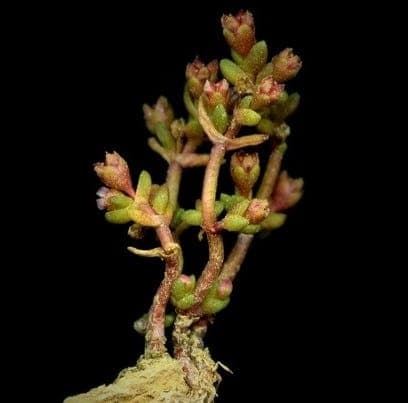
Unknown authorUnknown author / CC BY-SA 2.5, via Wikimedia Commons
Crassula vaillantii: complete guide
Crassula vaillantii
Want to see Crassula vaillantii: complete guide in your garden?
Full design in HD: €7.99
Look after your Crassula vaillantii with the GardenWorld app
Identify plants with your camera and get a care calendar with reminders for this plant.


Overview
Crassula vaillantii, commonly called southern water-stonecrop, is a delightful miniature succulent native to Mediterranean regions and parts of southern Africa. This tiny fleshy plant forms dense rosettes of fine green leaves and produces charming pink flowers throughout summer. It thrives in xeric gardens and dry landscapes.
Appearance and bloom
This succulent grows extremely compact, rarely exceeding 20-30 cm tall. Narrow, recurved leaves form tight rosettes that often turn reddish in full sun. From May to August, abundant tiny pink or purple flowers appear in clusters. These blooms attract bees and create a romantic garden effect.
Ideal location
Crassula vaillantii performs best in full sun positions receiving at least 6-8 hours of direct sunlight daily. This ensures dense growth and vibrant color development. In temperate climates, light afternoon shade is tolerated, though flowering may be less prolific.
Soil
Drainage is paramount. Use specialized cactus or succulent compost, or amend garden soil with coarse sand (1:1 ratio). pH should range 5.0-5.5. Add extra perlite to heavy soils to prevent waterlogging and root rot.
Watering
Allow soil to dry completely between waterings. During growth season (May-September), water weekly. In fall and winter, reduce dramatically to every 3-4 weeks. Using filtered water prevents mineral buildup on foliage.
Free preview
Want to see Crassula vaillantii: complete guide in your garden? Make a free preview of your design.
Pruning
This plant requires minimal pruning. Simply remove dead leaves and spent flowers. Tiny rosettes (offsets) develop naturally and can be separated for propagation or left to create denser colonies.
Maintenance calendar
Spring: Gradually increase watering. Pinch shoot tips to encourage branching. Summer: Regular watering, maximum sunlight. Monitor for stress signs. Fall: Reduce water gradually. Winter: Minimal moisture. Foliage may yellow slightly.
Winter hardiness
Crassula vaillantii lacks frost tolerance. While it survives winters in southern Europe, northern growers must protect it or move containers indoors. Roots begin failing below -5°C. Container culture allows easy relocation to frost-free spots.
Companion plants
Pair with other drought-lovers like Sedum, Sempervivum, or Echeveria for a polished xerigarden. In mixed borders, it complements lavender and succulent groundcovers beautifully.
Closing
Crassula vaillantii brings refined elegance to any dry garden spot. Whether gardening on the French Riviera or a sunny London balcony, this compact charmer rewards you with years of reliable beauty. Find premium specimens at gardenworld.app/en for expert guidance and finest cultivars.
Frequently asked questions about Crassula vaillantii
Is Crassula vaillantii winter hardy?
Crassula vaillantii lacks frost tolerance. While it survives winters in southern Europe, northern growers must protect it or move containers indoors.
When and how do you prune Crassula vaillantii?
This plant requires minimal pruning. Simply remove dead leaves and spent flowers.
How much water does Crassula vaillantii need?
Allow soil to dry completely between waterings. During growth season (May-September), water weekly.
Where does Crassula vaillantii grow best?
Crassula vaillantii performs best in full sun positions receiving at least 6-8 hours of direct sunlight daily. This ensures dense growth and vibrant color development.
What soil does Crassula vaillantii need?
Drainage is paramount. Use specialized cactus or succulent compost, or amend garden soil with coarse sand (1:1 ratio). pH should range 5.0-5.5.

See it in your garden
See Crassula vaillantii in your garden
One photo of your garden and a few questions. You see the result in about a minute.
Try it with a photoIdentify this plant in your own garden. Identify a plant
Similar plants
Aeonium tabuliforme: growing the saucer plant
Aeonium tabuliforme
Aeonium tabuliforme, the saucer plant, forms a flat, hairy rosette like a green plate. How to grow this Tenerife succulent, tilt it, water it and overwinter it.
String of buttons (Crassula perforata): care guide
Crassula perforata
How to grow string of buttons, Crassula perforata: light, watering, compost, cuttings and overwintering for this succulent with leaf pairs stacked like beads on a stem.
Glaucous echeveria (Echeveria secunda): complete guide
Echeveria secunda
Echeveria secunda forms mats of blue-grey rosettes with red leaf tips and is one of the toughest echeverias. Light, watering, potting mix, propagation and pet safety.
