
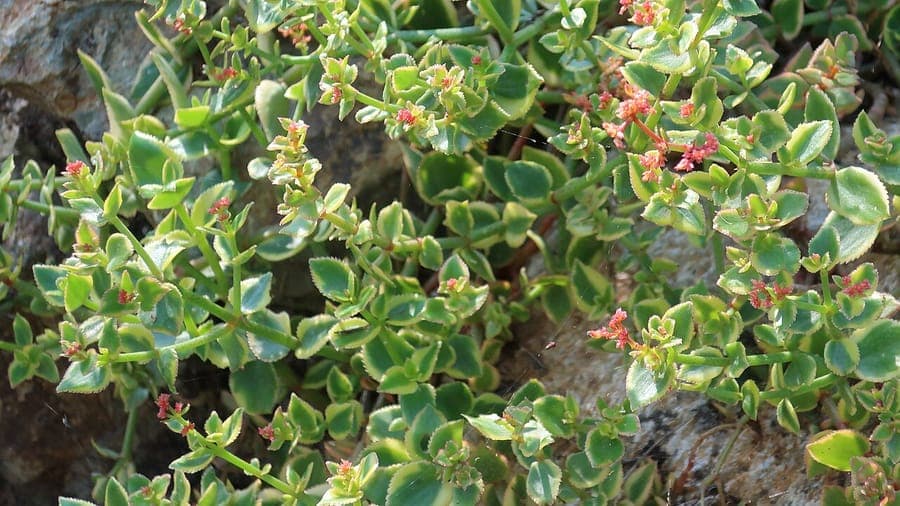
cultivar413 / CC BY 2.0, via Wikimedia Commons
Crassula sarmentosa: complete guide
Crassula sarmentosa
Want to see Crassula sarmentosa: complete guide in your garden?
1 minute, no credit card
Overview
The Jade-tree (Crassula sarmentosa) is an elegant, trailing succulent native to southeastern South Africa. What distinguishes this species from related Crassulas is its naturally trailing growth habit - slender stems that gracefully cascade, producing charming rooting along their length. Reaching 20-40 centimeters in height while spreading to 1.5 meters or more, it offers unexpected elegance in form.
Used as trailing container plant or ground-covering succulent in semi-shaded garden corners, the Jade-tree offers flexibility and charm. Compared to its robust cousin, the common Jade plant (Crassula ovata), this variety displays greater refinement yet slightly less extreme frost tolerance. Perfect for Mediterranean garden styles and water-wise designs.
Appearance and Bloom
Crassula sarmentosa grows as a naturally trailing plant with stems that gracefully cascade over pot edges or ground surfaces. Each leaf is small, rounded, densely packed in rosettes at twig terminals. Foliage ranges from green to deep reddish, especially during drought and cold periods.
In late autumn (October-November), tiny pink to white flowers appear in delicate clusters. Though small, they are numerous and impart subtle charm. After blooming, tiny seeds form and readily self-sow, potentially creating unwanted seedlings in container cultivation - a minor consideration.
Ideal Location
The Jade-tree thrives in full sun to partial shade, requiring minimum 3-4 hours daily sunlight. In extremely warm climates, afternoon shade prevents leaf scorch. This plant shows greater shade-tolerance than related species, making it suitable for semi-shadowed sites.
Ideal locations: wall-mounted trailing displays, beneath eaves or pergolas, rocky slopes, elevated containers on shaded patios. Also appropriate for indoor cultivation with sufficient light. Its trailing form makes it perfect for hanging baskets or elevated troughs.
Soil
The Jade-tree accepts variable soils, though well-draining conditions are preferred. For containers: a mixture of garden soil, sand, and perlite (1:1:1) works excellently. In garden plantings, it thrives in draining soils.
Add organic matter to poor soils, but maintain drainage essentials. Root rot through waterlogging represents the greatest risk. Mulching is optional but helpful in extremely arid conditions. Soil pH is non-critical; acidic through alkaline conditions are acceptable.
Free design
Want to see Crassula sarmentosa: complete guide in your garden? Make a free design now.
Watering
The Jade-tree requires regular water but less than most houseplants. During growing period (May-October), water when soil surface feels dry - moderate watering, not miserly. In winter (November-April), minimize watering substantially.
For container plants: water once every two weeks in summer, once every three to four weeks in winter. In garden plantings on average soils, natural rainfall usually suffices. Never allow waterlogging. Dry winters encourage blooming.
Pruning
Minimal pruning is required. The plant naturally assumes a trailing form. Remove dead or diseased stems when observed. To encourage more compact form, gently trim stem tips in spring. Propagation is effortless: detached stem pieces root readily - allow several weeks drying, then plant in sand.
Maintenance Calendar
May-June: End winter dormancy, gradually increase watering. July-September: Regular watering, light feeding monthly. October-November: Reduce watering, observe blooming. December-March: Minimal watering, prepare frost protection for containers. April: Prepare growth period, gradually restart watering.
Winter Hardiness
The Jade-tree shows less frost tolerance than many related Crassulas. Temperatures below -3 to -5 degrees may damage foliage and stems, though stronger portions may survive. For container culture: overwinter indoors in cool, dry, well-lit locations.
In garden plantings on very dry, well-drained sites with frost protection (dry mulch, loose stones), overwintering is possible. It cannot tolerate wet conditions combined with cold. In colder regions, bring containers indoors for winter protection.
Companion Plants
The Jade-tree pairs beautifully with other drought-tolerant species: Sedum varieties, Sempervivum, lower-growing Echeveria types. For Mediterranean gardens: combine with lavender, thyme, Helianthemum. In containers: trailing combinations with Senecio rowleyanus or low-growing petunias.
As a trailing specimen in elevated troughs or beneath wall-mounted displays, it creates compelling compositions. It favors dry, minimally-demanding plant communities.
Closing Thoughts
The Jade-tree is ideal for garden enthusiasts seeking elegant form within a maintenance-free package. Suitable for container culture, front garden integration, or indoor plant displays. Available through succulent specialists, online plant retailers, and quality nurseries.
Employ this elegant South African trailer as an accent in your garden design. Enjoy its graceful trailing form and delicate pink blooms - a refined plant perfectly suited to gardenworld.app users with sophisticated taste.
Want to see Crassula sarmentosa: complete guide in your garden? Make a free design now.
Upload a photo, pick a style, and get a photorealistic design with plant list in under a minute.
No credit card required


Similar plants
Sedum nevadense: complete guide
Sedum nevadense
Discover Sedum nevadense, the stunning alpine stonecrop from the Pyrenees. Expert care tips, growing requirements, and design ideas for rock gardens.
Aizoon stonecrop: complete guide
Phedimus aizoon
Everything about Phedimus aizoon - the frost-tolerant aizoon stonecrop from Siberia with bright yellow flowers. Planting, care and garden use.
Roseroot: complete guide
Rhodiola rosea
Everything about roseroot (Rhodiola rosea): a tough hardy succulent ideal for rock gardens, green roofs, and dry sunny positions.