
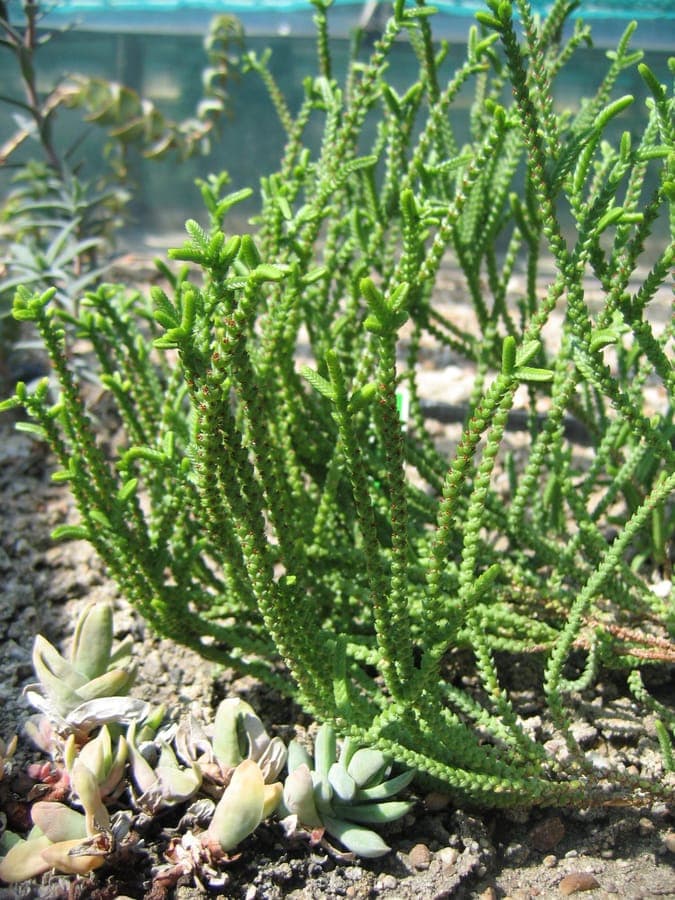
Agnieszka Kwiecień (Nova) / CC BY 2.5, via Wikimedia Commons
Toy-cypress: complete guide
Crassula muscosa
Want to see Toy-cypress: complete guide in your garden?
1 minute, no credit card
Overview
Crassula muscosa, commonly known as Toy-cypress, is a distinctive succulent that mimics the look of a miniature conifer with its dense, upright stems and tiny, needle-like leaves. Native to the arid regions of the Cape Provinces, Free State, and Namibia, this plant thrives in hot, dry conditions and is exceptionally drought-tolerant. On gardenworld.app you can design a garden layout that highlights drought-loving plants like Crassula muscosa, helping you place them exactly where they'll flourish.
It typically reaches 8–12 inches (20–30 cm) in height, occasionally stretching to 16 inches (40 cm), with a narrow spread of 2–3 inches (5–8 cm). This makes it ideal for tight spaces, vertical accents, or as part of a succulent arrangement. It's also well-suited to container gardening, both indoors and on patios.
Appearance & bloom cycle
The foliage of Crassula muscosa is its main attraction. The tiny, scale-like leaves densely clothe the thin, branching stems, creating a feathery, cypress-like silhouette. The leaves are bright green but can develop golden or faintly reddish tips when exposed to strong sunlight-especially in late summer and autumn.
Mature plants may produce clusters of small, star-shaped white flowers in late autumn to early winter. These blooms are lightly fragrant and can last up to three weeks. While not showy, they add subtle charm and may attract pollinators like hoverflies or small bees.
Ideal location
Provide full sun for best growth. A south- or west-facing windowsill indoors, or a sunny, sheltered spot outdoors, works well. In gardens, it performs best in rockeries, gravel beds, or raised planters where drainage is excellent. During hot summers, light afternoon shade can prevent scorching, but prolonged shade leads to leggy growth.
For indoor cultivation, aim for at least 6 hours of direct sunlight daily. Rotate the pot occasionally to encourage even growth. On gardenworld.app you can simulate sun exposure across your garden space and find the perfect microclimate for this succulent.
Soil requirements
Use a fast-draining mix. A combination of cactus soil with added perlite, pumice, or coarse sand (in a 2:1 ratio) prevents water retention. Avoid standard potting mixes, which hold too much moisture and can cause root rot.
When planting in the ground, amend heavy soils with grit or crushed rock. The ideal pH range is between 6.0 and 7.0. Always ensure pots have drainage holes and include a layer of gravel or broken terracotta at the base.
Free design
Want to see Toy-cypress: complete guide in your garden? Make a free design now.
Watering
Water sparingly. During active growth (April to September), water every 10–14 days, allowing the top 1–2 inches (2–5 cm) of soil to dry completely between waterings. Use room-temperature, low-lime water to avoid mineral buildup.
In winter (October to March), reduce watering to once every 4–6 weeks. The plant enters dormancy and requires minimal moisture. Overwatering during this period is the most common cause of failure.
Pruning
Pruning isn't essential, but you can trim leggy stems to maintain a compact shape. Use clean, sterilized scissors and cut just above a leaf node. The cuttings make excellent propagation material-let them callus for 24 hours before planting in dry, gritty soil.
If lower leaves drop, it may indicate insufficient light. Relocate the plant to a brighter spot to prevent stretching.
Maintenance calendar
- Jan: Dormant. Water very sparingly. Keep above 5°C (41°F).
- Feb: Monitor for pests like mealybugs. No feeding.
- Mar: Still dormant. Check soil dryness before any watering.
- Apr: Begin light feeding (half-strength cactus fertilizer). Gradually increase watering.
- May: Active growth. Water every 10–14 days. Watch for flower buds.
- Jun: Peak season. Ensure good airflow outdoors.
- Jul: Same as June. Protect from intense midday sun if needed.
- Aug: Possible blooming. Stop fertilizing by late August.
- Sep: Gradually reduce watering.
- Oct: Cease fertilizing. Bring indoors if frost is expected.
- Nov: Dormancy begins. Minimal water.
- Dec: Keep in bright light. Avoid cold drafts.
Winter hardiness
Crassula muscosa is not frost-hardy. It's rated for USDA zones 10–11, meaning it must be grown as a houseplant or in containers that can be moved indoors in colder climates. Overwinter at 5–15°C (41–59°F) with bright light. Avoid dark, damp sheds-this leads to etiolation and rot.
Companion plants
Pair with other drought-tolerant species such as Sedum rupestre, Echeveria 'Lola', or Delosperma 'Jewel of the Desert'. These share similar care needs and create cohesive, low-water displays. Avoid moisture-loving plants like ferns or impatiens.
In containers, consider adding Orostachys, Sempervivum, or dwarf Lavandula for texture and contrast.
Closing
Crassula muscosa is a low-maintenance, architectural succulent that adds year-round interest with minimal effort. Whether used as a standalone specimen or grouped in a succulent bowl, its fine texture stands out. Keep it in full sun, water infrequently, and protect it from winter cold. You'll find healthy stock at garden centres across the UK, including local independents and larger retailers. With proper care, this toy-cypress will stay compact and vibrant for years.
Want to see Toy-cypress: complete guide in your garden? Make a free design now.
Upload a photo, pick a style, and get a photorealistic design with plant list in under a minute.
No credit card required


Similar plants
Sedum nevadense: complete guide
Sedum nevadense
Discover Sedum nevadense, the stunning alpine stonecrop from the Pyrenees. Expert care tips, growing requirements, and design ideas for rock gardens.
Aizoon stonecrop: complete guide
Phedimus aizoon
Everything about Phedimus aizoon - the frost-tolerant aizoon stonecrop from Siberia with bright yellow flowers. Planting, care and garden use.
Roseroot: complete guide
Rhodiola rosea
Everything about roseroot (Rhodiola rosea): a tough hardy succulent ideal for rock gardens, green roofs, and dry sunny positions.