
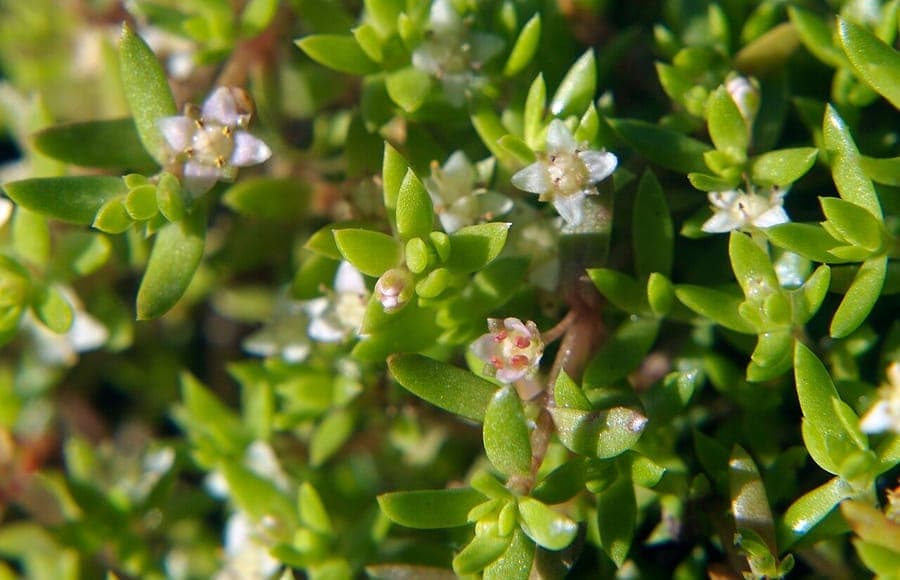
ashley BALSAM baz / CC BY 2.0, via Wikimedia Commons
New Zealand pigmyweed: complete guide
Crassula helmsii
Want to see New Zealand pigmyweed: complete guide in your garden?
1 minute, no credit card
Overview
New Zealand pigmyweed, scientifically known as Crassula helmsii, is a small but tenacious aquatic plant native to parts of Australia and New Zealand. Despite its unassuming appearance, it's earned a notorious reputation across European gardens and natural wetlands. In the UK and Ireland, it's classified as an invasive non-native species, capable of forming dense mats that choke out other plants and reduce oxygen levels in ponds. Yet, it still appears in some garden centres, often sold without proper warning.
This plant thrives in still or slow-moving water but can also survive in damp soil at pond margins. It spreads rapidly via stem fragments - even a tiny piece can take root and launch a new colony. If you're considering planting Crassula helmsii, think carefully. Its aggressive growth means it's better suited to controlled environments like sealed containers or lined ponds. On gardenworld.app, you can design a pond layout that avoids invasive species and promotes balanced aquatic ecosystems.
Appearance & bloom cycle
New Zealand pigmyweed has slender, branching stems with small, needle-like leaves arranged in whorls. The leaves are typically 2–4 mm long and give the plant a fine, wiry texture. Submerged stems are dark green to reddish-brown, while emergent growth is brighter green and more upright. In ideal conditions, stems can reach up to 1 metre in length, though 30–50 cm is more common in garden settings.
Flowering is rare in temperate climates. When it does occur, small white flowers with four petals may appear at stem tips in late summer. However, these blooms are insignificant and often go unnoticed. Reproduction is almost entirely vegetative - the plant doesn't rely on seeds, which makes containment even more critical.
Ideal location
For gardeners determined to grow this plant, strict containment is essential. Plant it only in artificial ponds with solid liners (plastic, rubber, or concrete) to prevent escape into surrounding soil or waterways. Avoid natural ponds, ditches, or bog gardens. Full sun to partial shade works best. In full sun, growth is denser and more compact; in shade, stems stretch and become spindly.
If planting at the water's edge, ensure the soil remains constantly moist. Use a root barrier if growing in boggy ground to limit lateral spread. Remember: once established in the wild, Crassula helmsii is extremely difficult to eradicate. On gardenworld.app, you can explore pond-safe planting schemes that support biodiversity without risking ecosystem damage.
Soil requirements
This species isn't fussy about soil type. Underwater, it grows well in clay, silt, or sandy substrates. For marginal planting, a mix of loam and compost works fine. The key is consistent moisture - dry soil will kill the plant quickly. pH tolerance is broad, ranging from 5.5 to 8.0, making it adaptable to most garden pond conditions.
Avoid nutrient-poor soils if you want vigorous growth, but note that high fertility may accelerate its invasive potential. In balanced pond systems, moderation is key.
Free design
Want to see New Zealand pigmyweed: complete guide in your garden? Make a free design now.
Watering
As an aquatic plant, Crassula helmsii requires constant moisture. Submerged plants draw water directly from the pond, but marginal or container-grown specimens need regular watering. In summer, daily watering may be necessary, especially in hot, dry spells.
In pond settings, avoid strong water currents that can break off stem fragments. Use gentle filtration or aeration systems. Never empty pond water containing this plant into natural water bodies.
Pruning
Pruning is crucial for managing Crassula helmsii. Monthly checks during the growing season (April–September) help prevent overgrowth. Cut back excessive stems with sharp scissors, making cuts just above leaf nodes to encourage bushiness.
Dispose of all clippings carefully - do not compost or discard near water. Incinerate or bag them for general waste. Even small fragments can regenerate, so thoroughness is non-negotiable.
Maintenance calendar
- January: Minimal care. Monitor for dieback.
- February: Inspect for early regrowth.
- March: Clear dead material. Prepare for growth.
- April: Begin active season. Light trim if needed.
- May–August: Monthly pruning. Maintain water levels.
- September: Reduce watering gradually.
- October: Final trim. Remove loose fragments.
- November–December: Dormant phase. No intervention required.
Winter hardiness
Crassula helmsii is hardy in USDA zones 7–10. In the UK and most of western Europe, it survives winter easily, especially when submerged. Above-ground parts may die back in frost, but submerged stems and roots persist. In harsh winters, a layer of mulch or horticultural fleece can offer extra protection for marginal plantings.
Companion plants
Due to its aggressive nature, avoid pairing New Zealand pigmyweed with slow-growing or delicate pond plants. In contained systems, consider robust companions like water forget-me-not (Myosotis scorpioides), mare's tail (Hippuris vulgaris), or dwarf reed (Phragmites australis 'Minimus'). These can hold their own without being smothered.
For eco-friendly alternatives, browse native pond plant combinations on gardenworld.app that support insects, amphibians, and birds.
Closing
New Zealand pigmyweed is a plant of contradictions - easy to grow, yet ecologically dangerous. Its low maintenance and adaptability make it tempting for beginners, but the risks far outweigh the benefits. If you see it for sale at garden centres, ask yourself: is it worth the potential harm?
There are plenty of attractive, non-invasive alternatives that provide similar texture and function. Choose wisely. Stick to native species when possible, and always plan your pond planting with long-term impact in mind. With tools like gardenworld.app, you can create stunning water features that are safe, sustainable, and full of life.
Want to see New Zealand pigmyweed: complete guide in your garden? Make a free design now.
Upload a photo, pick a style, and get a photorealistic design with plant list in under a minute.
No credit card required


Similar plants
Sedum nevadense: complete guide
Sedum nevadense
Discover Sedum nevadense, the stunning alpine stonecrop from the Pyrenees. Expert care tips, growing requirements, and design ideas for rock gardens.
Aizoon stonecrop: complete guide
Phedimus aizoon
Everything about Phedimus aizoon - the frost-tolerant aizoon stonecrop from Siberia with bright yellow flowers. Planting, care and garden use.
Roseroot: complete guide
Rhodiola rosea
Everything about roseroot (Rhodiola rosea): a tough hardy succulent ideal for rock gardens, green roofs, and dry sunny positions.