
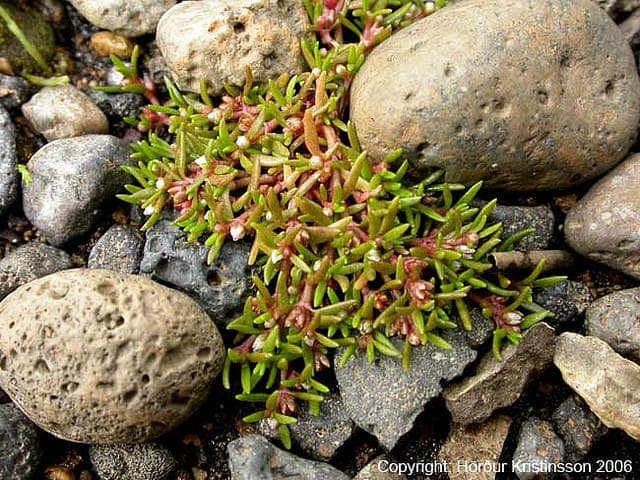
Hörður Kristinsson from Eyjafjarðarsveit, Island / CC BY 2.0, via Wikimedia Commons
Water pygmyweed: complete guide
Crassula aquatica
Want to see Water pygmyweed: complete guide in your garden?
1 minute, no credit card
Overview
Crassula aquatica, commonly known as water pygmyweed, is a small, often overlooked herbaceous plant that quietly thrives in shallow aquatic environments. As a member of the Crassulaceae family, it shares the succulent characteristics typical of its kin-thick, water-retaining leaves and a compact growth form. Native to regions stretching from Alaska to Central Europe and parts of Asia, this species is well adapted to fluctuating water levels and seasonal wetlands.
In the garden, it's ideal for the edges of ponds, rain gardens, or damp depressions where water collects after heavy rain. It's not a showstopper, but it plays a quiet yet valuable role in supporting micro-ecosystems. On gardenworld.app, you can map out moisture zones in your yard to see if you've got a spot that matches its natural preferences-shallow, still water with lots of sun.
Appearance & bloom cycle
Water pygmyweed forms low, creeping mats of bright green stems that float on or grow just below the water surface. Individual stems reach 5–15 cm in height, though submerged parts may extend up to 30 cm. The leaves are small, fleshy, and arranged in neat whorls of four around the stem. They're typically 3–8 mm long, oval to lance-shaped, and have a glossy finish that catches the light.
From July to September, tiny white flowers with four petals appear in terminal clusters. Each flower is only about 2 mm wide, but collectively they attract minute pollinators like hoverflies and tiny bees. The bloom isn't flashy, but it's a sign the plant is healthy and contributing to your garden's biodiversity.
Ideal location
This plant needs shallow water-between 5 and 15 cm deep-for optimal growth. It does best in full sun to light shade. In full sun, the foliage stays compact and may develop a reddish tinge in cooler months. In too much shade, the stems stretch out and become sparse.
It's perfect for the margins of ponds, seepage areas, or containers that hold standing water. If you're planting in a pond, use a small aquatic basket filled with heavy loam to anchor the roots. Avoid fast-moving water-this species likes calm conditions. gardenworld.app lets you design a pond layout that includes the right depth zones for Crassula aquatica and its companions.
Soil requirements
While it can grow free-floating, Crassula aquatica prefers a nutrient-poor, fine-textured substrate. A mix of clay, sand, and a small amount of organic matter works well. Avoid rich compost or high-nitrogen soils, which encourage algae and outcompete the plant.
The ideal pH is neutral to slightly acidic (6.0–7.0). In containers, use a heavy garden soil rather than lightweight potting mix, which will float away. A 2:1 ratio of clay loam to sand provides stability without compaction.
Free design
Want to see Water pygmyweed: complete guide in your garden? Make a free design now.
Watering
Keep the roots constantly moist or submerged. In natural settings, it grows in areas that are wet year-round or seasonally flooded. In the garden, ensure the water level remains stable, especially during the growing season (April–October). Brief dry periods may cause dieback, but the plant often rebounds when water returns.
If using in a rain garden, plant it in the lowest zone where water pools for several days after storms. Don't rely on irrigation alone-this plant needs actual standing water to thrive.
Pruning
Pruning is rarely needed. Water pygmyweed grows slowly and doesn't become invasive. However, a light trim in early spring helps remove dead or tangled stems and encourages fresh growth. Use clean, sharp snips and cut just above a leaf node to promote branching.
If the plant spreads too much, simply pull out excess stems or share them with a fellow gardener. Stem cuttings 5–8 cm long will root easily when placed in water.
Maintenance calendar
- Jan: Check for winter damage; remove any dead stems
- Feb: Minimal activity; no action needed
- Mar: Clear old growth; inspect root anchoring
- Apr: Ensure consistent moisture; secure loose stems
- May: Active growth begins; avoid disturbance
- Jun: Monitor for algae or pests
- Jul: Blooming period; maintain water depth
- Aug: Continue monitoring water quality
- Sep: Flowers fade; remove spent clusters if desired
- Oct: Growth slows; prepare for dormancy
- Nov: No maintenance required
- Dec: Dormant; may die back partially
Winter hardiness
Crassula aquatica is hardy in USDA zones 6–9 (-23°C to -1°C). In zone 7 and above, it usually survives winter under ice as long as the water doesn't freeze solid. The top growth may die back, but the roots and lower stems often persist and re-sprout in spring.
In colder zones, consider leaving a small opening in the ice for gas exchange. Avoid deep water placement-shallow zones are more likely to avoid complete freezing.
Companion plants
Pair Crassula aquatica with other marginal aquatic plants like water mint (Mentha aquatica), water hawthorn (Aponogeton distachyos), or lesser spearwort (Ranunculus flammula). These share similar moisture needs and create a layered, natural look.
Avoid aggressive spreaders like creeping jenny (Lysimachia nummularia) unless contained. For transition zones, use sedges (Carex spp.) or rushes (Juncus spp.) to bridge from water to dry land.
Closing
Water pygmyweed may not grab attention, but it's a resilient, low-maintenance plant that adds quiet value to wet areas. It's not commonly found in standard garden centres, but you might spot it at specialty nurseries or aquatic plant suppliers. On gardenworld.app, you can explore plant combinations and simulate seasonal changes to see how Crassula aquatica fits into your overall design. For gardeners aiming for ecological balance, this little succulent is a smart, understated choice.
Want to see Water pygmyweed: complete guide in your garden? Make a free design now.
Upload a photo, pick a style, and get a photorealistic design with plant list in under a minute.
No credit card required


Similar plants
Sedum nevadense: complete guide
Sedum nevadense
Discover Sedum nevadense, the stunning alpine stonecrop from the Pyrenees. Expert care tips, growing requirements, and design ideas for rock gardens.
Aizoon stonecrop: complete guide
Phedimus aizoon
Everything about Phedimus aizoon - the frost-tolerant aizoon stonecrop from Siberia with bright yellow flowers. Planting, care and garden use.
Roseroot: complete guide
Rhodiola rosea
Everything about roseroot (Rhodiola rosea): a tough hardy succulent ideal for rock gardens, green roofs, and dry sunny positions.